


En stock
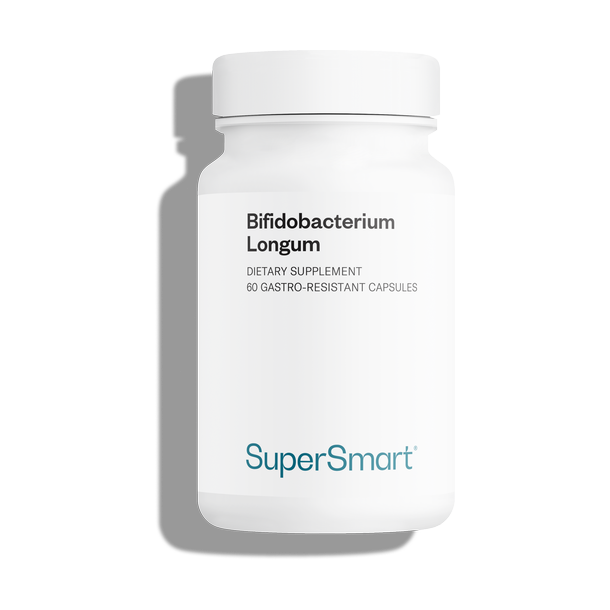
Bifidobacterium Longum
Probiotique Bifidobacterium longum pour le microbiote intestinal


Complétez votre sélection
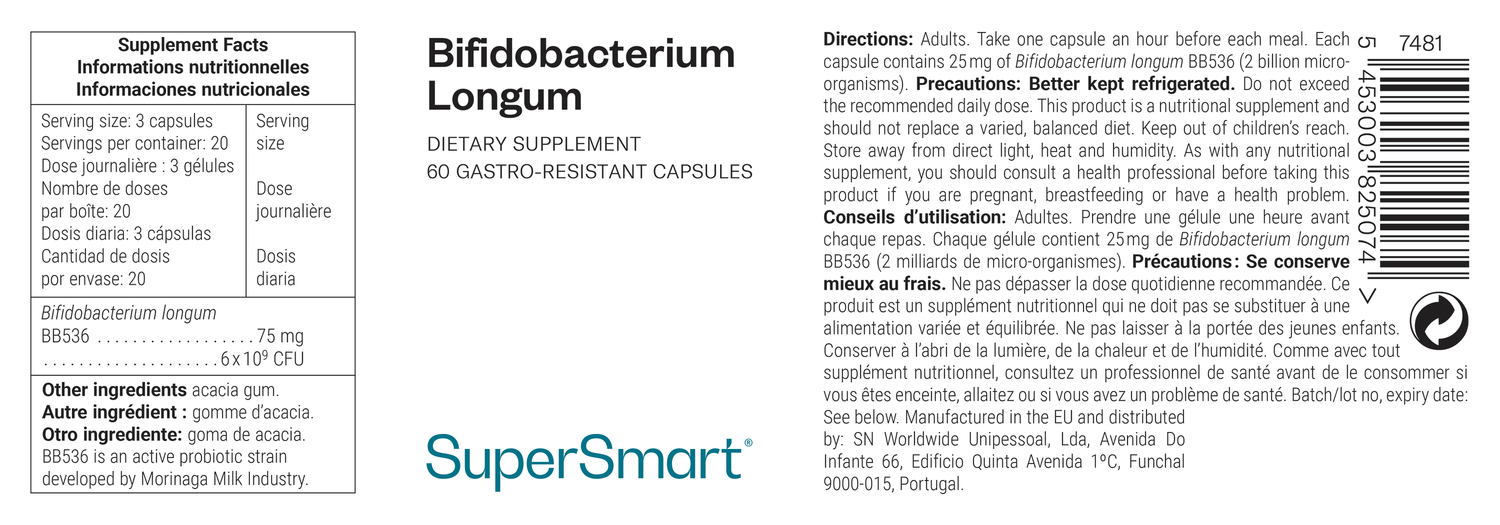
Bifidobacterium longum 25 mg est un complément probiotique destiné à régénérer la flore intestinale.
Il contient 2 milliards de micro-organismes bénéfiques par gélule, d’une souche abondamment soutenue par les études scientifiques (BB536), le tout sous forme de gélules DR Caps™ pour garantir la survie des probiotiques jusqu’à l’intestin.
Qu’est-ce que la souche probiotique Bifidobacterium longum ?
Le Bifidobacterium a été isolé pour la première fois en 1899 d'un nourrisson en bonne santé nourri au sein. Il a ensuite été reconnu comme un genre indépendant de bactéries dont la principale caractéristique est de produire de l'acide lactique et de l'acide acétique comme principaux produits dérivés de la fermentation du glucose. Isolé en 1977, le Bifidobacterium longum BB536 est la souche bifidobactérienne humaine dont les effets bénéfiques ont été les plus étudiés. C'est également l'une des plus connues. Plus de 40 articles ont été publiés dans des revues scientifiques, soulignant notamment qu'elle améliore l'environnement intestinal, aide à entretenir un système immunitaire sain et à combattre les infections.
Quels sont les bienfaits des probiotiques au niveau de la flore intestinale ?
La microflore intestinale est composée de plus de 100 espèces de bactéries bénéfiques, neutres ou nuisibles constamment en conflit. Leur nombre et leur équilibre peuvent être perturbés par une grande diversité de causes comme la prise d'antibiotiques ou d'autres médicaments, le stress, le vieillissement ou la consommation d'alcool. Dans ce cas, la santé de l'intestin, voire celle de l'hôte peut être affectée. Les probiotiques comme les bifidobactéries aident à rétablir l'équilibre de la microflore intestinale. Les travaux scientifiques ont notamment montré que le Bifidobacterium longum BB536 contribue à :
- améliorer la microflore intestinale des personnes âgées (le nombre des bifidobactéries est diminué avec le vieillissement) qui, à son tour, améliore l'environnement intestinal et contribue à la bonne santé du système gastro-intestinal et, à terme, sa résistance aux infections ;
- augmenter significativement la proportion de Bifidobacterium dans la flore intestinale ;
- réduire les produits de putréfaction, comme l'ammoniac ;
- soutenir le système immunitaire (il induit la production d'anticorps spécifiques et non spécifiques) et réduire les infections intestinales (les bifidobactéries produisent de l'acide acétique dont la puissante action bactéricide est responsable de la destruction de bactéries nuisibles comme Escherichia coli) ;
- prévenir la diarrhée provoquée par l'administration d'antibiothérapies ;
- réguler le transit intestinal des personnes constipées (il améliore l'environnement intestinal, notamment en diminuant le contenu en ammoniac des selles, l'activité de certaines enzymes fécales et augmente la fréquence des selles) ;
- stimuler le système immunitaire de personnes âgées immunodéprimées en activant leurs neutrophiles et leurs cellules NK (il diminue ainsi le risque d'infections, notamment par le virus de la grippe) ;
- réduire significativement les symptômes de l'allergie aux pollens. Il semblerait agir en s'opposant aux modifications que la flore fécale subit au cours de la saison pollinique ;
- renforcer la santé des os, probablement en influençant l'absorption du calcium.
Un apport de 2 milliards de micro-organismes par gélule
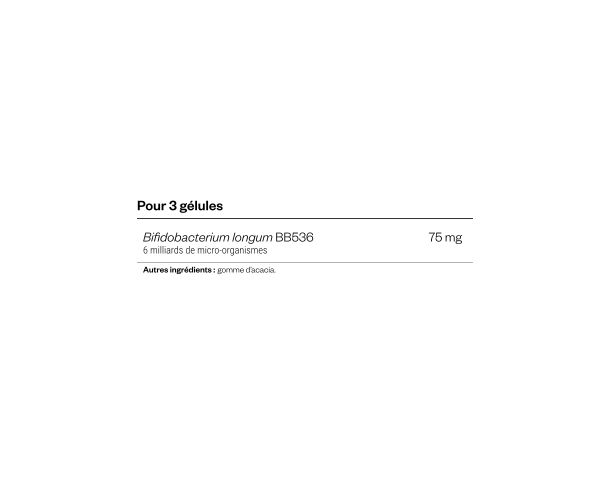
Pour permettre une absorption et une biodisponibilité optimales, notre complément alimentaire a été formulé en gélules DR Caps™. Chaque gélule permet ainsi un apport de près de 2 milliards de micro-organismes par gélule. La posologie proposée pour ce produit est de trois gélules, ce qui permet un apport exceptionnel de 6 milliards de micro-organismes. Cette posologie peut varier en fonction de vos besoins et selon les conseils de votre thérapeute.
Pour préserver la qualité de ces probiotiques, il est conseillé de les conserver au réfrigérateur. Leur efficacité peut également être renforcée par la prise de prébiotiques, comme les fructo-oligosaccharides. Une fois dans l’organisme, ces derniers contribuent au développement des probiotiques.
De quoi se compose Bifidobacterium Longum
Avis
La note de ce produit est de 4.9 sur 5 étoiles.
Nous avons récolté 15 avis.
87%
13%
0%
0%
0%
9 avril 2024
Un produit de qualité, que j'utilise quotidiennement depuis des années, et qui me ravit à 100% ! Je le recommande sans réserve !
2 mars 2024
Je l'utilise régulièrement et depuis longtemps avec la plus grande satisfaction !
22 décembre 2023
Très bon probiotique. Efficace contre la perméabilité intestinale et pour la régulation du transit.
17 décembre 2023
Je recommande vivement ce produit que j'utilise régulièrement depuis plusieurs années. Son efficacité est totale et j'en suis ravi !
26 mai 2023
Un produit efficace, de qualité, utilisé depuis des années et que je recommande vivement !
Besoin d'aide ?
Téléphone
0800 666 742
de 8h30 à 19h00 du lundi au vendredi
(*France Métropolitaine uniquement, +352 283 831 29 depuis les autres pays)
Formulaire de contact
Vous pourriez aussi aimer
ou remboursé