
Remarkable new discoveries about EGCG, the active ingredient in green tea
Antioxidant, fat burner... The health benefits of green tea's EGCG are countless. But what if it had other, hitherto unknown superpowers? Here's what the latest research on the subject reveals.


What is epigallocatechin gallate (EGCG)?
EGCG, which stands for epigallocatechin gallate, is a molecule in the catechin family, a subgroup of the large polyphenol family. This plant pigment is found almost exclusively in green tea, regularly touted as the Japanese secret to longevity, and is its most potent and abundant active compound (1).
It has already been established that epigallocatechin gallate has a remarkable antioxidant action: it helps protect our bodies by strengthening the body's natural defences against the harmful effects of free radicals, and slows down the ageing of cells due to oxidative damage (2). It also supports cardiovascular health: in combination with regular physical activity, it improves blood circulation and helps maintain normal blood pressure (3). It is also to this that green tea owes its reputation as a slimming drink: in conjunction with a healthy diet and exercise, it promotes weight control, helps to reduce body fat (by increasing lipid oxidation) and helps normalise blood sugar levels (by regulating the storage and release of liver glycogen) (4-5).
But in light of the most recent scientific studies, EGCG may have revealed only a fraction of its virtues.
EGCG: the latest scientific findings on green tea's super-active ingredient
New hope for β-thalassaemia patients
β-thalassaemia is a genetic blood disorder which affects the synthesis of haemoglobin (the protein in red blood cells responsible for transporting oxygen), resulting in anaemia of varying severity. In the most severe forms, it requires repeated blood transfusions, leading to a number of complications, including iron overload and chronic oxidative stress. For the first time, an animal study published in 2022 demonstrated the potential value of green tea extracts rich in epigallocatechin-3-gallate in improving the efficiency of erythropoiesis (red blood cell production), correcting iron dysregulation and reducing pro-oxidant products in β-thalassaemic mice (6).
Modulatory effects on intestinal microbiota
What if EGCG interacted directly with our microbiota? This is the hypothesis explored by a team of scientists in an in vitro study published in 2020 (7). They observed that this catechin was rapidly broken down in the small intestine into a series of metabolites, including 4-phenylbutyric acid and phenylacetic acid, which could positively modulate the composition of the intestinal flora.
The results of the microbiome profiling suggest that they could stimulate several beneficial bacterial strains, including 5 species of the Bacteroides genus (which have essential metabolic and immunological functions), species of the Christensenellaceae genus (linked to a lower body mass index and increased longevity), as well as Clostridium symbiosum, Ruminococcus bromii and Bifidobacterium adolescentis. They could also suppress pathogenic strains from the Forsterygion, Bilophila and Enterobacteriaceae species.
Potential protection against the harmful effects of microplastics on fertility
Another study from 2024 looked at the effects of epigallocatechin gallate on the damage induced by polystyrene microplastics on testicular cells (8). The accumulation of these particles, which are ubiquitous in our environment, in the male reproductive system is thought to interfere with the spermatogenesis process, which explains the decline in fertility currently observed in men.
It appears that EGCG can mitigate these deleterious effects by mediating several cell signalling pathways, including Nrf2/HO-1 (involved in the antioxidant response), mTOR/Atg-7 (which activates autophagy, the degradation of defective cell components) and Cx-43/NOX-1 (which propagates inflammatory and pro-apoptotic 'cell death' messengers).
An advanced neuroprotectant
Research is also progressing in the field of neuroprotection. A 2024 study reported that EGCG could attenuate neuronal damage in animal models of ischaemic stroke and cell death in neurons exposed to glutamate, in a dose-dependent manner (9). Epigallocatechin gallate is thought to interfere with the expression of hippocalcin, a protein that ensures the proper functioning of the nervous system and controls cellular calcium concentrations in the cerebral cortex.
Is drinking tea a necessary step to reap the benefits of EGCG?
In theory, to reap the benefits of this catechin, you need to drink green tea frequently and regularly. Bear in mind, however, that various parameters affect the actual final EGCG content in the teapot: the variety of tea, the method of preparation, the quality of the leaves, etc.
That's why opting for standardised EGCG supplementation is a much better option for ensuring a more consistent intake over time.
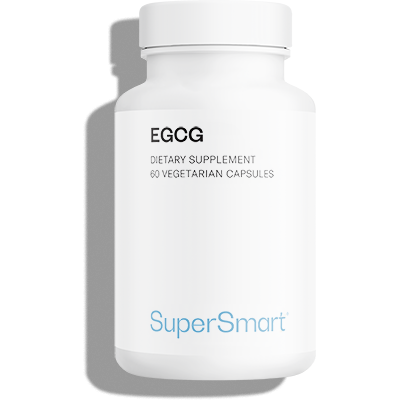
 Our EGCG supplement contains 227 mg per capsule, compared with 20 to 100 mg on average in a cup of tea.
SUPERSMART ADVICE
References
- Mokra D, Joskova M, Mokry J. Therapeutic Effects of Green Tea Polyphenol (‒)-Epigallocatechin-3-Gallate (EGCG) in Relation to Molecular Pathways Controlling Inflammation, Oxidative Stress, and Apoptosis. Int J Mol Sci. 2022 Dec 25;24(1):340. doi: 10.3390/ijms24010340. PMID: 36613784; PMCID: PMC9820274.
- Mokra D, Adamcakova J, Mokry J. Green Tea Polyphenol (-)-Epigallocatechin-3-Gallate (EGCG): A Time for a New Player in the Treatment of Respiratory Diseases? Antioxidants (Basel). 2022 Aug 13;11(8):1566. doi: 10.3390/antiox11081566. PMID: 36009285; PMCID: PMC9405266.
- Potenza MA, Marasciulo FL, Tarquinio M, Tiravanti E, Colantuono G, Federici A, Kim JA, Quon MJ, Montagnani M. EGCG, a green tea polyphenol, improves endothelial function and insulin sensitivity, reduces blood pressure, and protects against myocardial I/R injury in SHR. Am J Physiol Endocrinol Metab. 2007 May;292(5):E1378-87. doi: 10.1152/ajpendo.00698.2006. Epub 2007 Jan 16. PMID: 17227956.
- Chen IJ, Liu CY, Chiu JP, Hsu CH. Therapeutic effect of high-dose green tea extract on weight reduction: A randomized, double-blind, placebo-controlled clinical trial. Clin Nutr. 2016 Jun;35(3):592-9. doi: 10.1016/j.clnu.2015.05.003. Epub 2015 May 29. PMID: 26093535.
- Yurtseven K, Yücecan S. Exploring the Potential of Epigallocatechin Gallate in Combating Insulin Resistance and Diabetes. 2024 Dec 18;16(24):4360. doi: 10.3390/nu16244360. PMID: 39770980; PMCID: PMC11676372.
- Settakorn K, Kongkarnka S, Chompupoung A, Svasti S, Fucharoen S, Porter JB, Srichairatanakool S, Koonyosying P. Effects of green tea extract treatment on erythropoiesis and iron parameters in iron-overloaded β-thalassemic mice. Front Physiol. 2022 Dec 23;13:1053060. doi: 10.3389/fphys.2022.1053060. PMID: 36620219; PMCID: PMC9816339.
- Liu Z, de Bruijn WJC, Bruins ME, Vincken JP. Reciprocal Interactions between Epigallocatechin-3-gallate (EGCG) and Human Gut Microbiota In Vitro. J Agric Food Chem. 2020 Sep 9;68(36):9804-9815. doi: 10.1021/acs.jafc.0c03587. Epub 2020 Aug 26. PMID: 32808768; PMCID: PMC7496747.
- Obukohwo, Oyovwi & Ugwuishi, Emeka & Udi, Onoriode & Atere, Adedeji & ROTU, Arientare & ODOKUMA, Emmanuel & EMOJEVWE, Victor & Olowe, Gideon & Nwangwa, Eze & Benneth, Ben-Azu. (2024). Epigallocatechin-gallate ameliorates polystyrene microplastics-induced oxido-inflammation and mitochondria-mediated apoptosis in testicular cells via modulation of Nrf2/HO-1, /mTOR/Atg-7, and Cx-43/NOX-1 levels. European Journal of Medicinal Chemistry Reports. 13. 100243. 10.1016/j.ejmcr.2024.100243.
- Park DJ, Kang JB, Koh PO. Epigallocatechin gallate improves neuronal damage in animal model of ischemic stroke and glutamate-exposed neurons via modulation of hippocalcin expression. PLoS One. 2024 Mar 1;19(3):e0299042. doi: 10.1371/journal.pone.0299042. PMID: 38427657; PMCID: PMC10906901.
Keywords





7 Days
Prodotti eccezionali
Prodotti eccezionali! Consegna rapida e precisa
paola
18 Days
Heldere info
Heldere info
HanS.
18 Days
Snelle levering
Snelle levering
harrie
23 Days
Adequate info en hoge kwaliteit
Adequate info en hoge kwaliteit
HanS.
33 Days
Supplementen zijn goed.
Supplementen zijn goed. Zachte prijzen. Website met problemen ( altijd ) niet goed voor nieuwe klanten.
Gino RJ
42 Days
Alles op tijd geleverd.
Alles op tijd geleverd. De producten worden alsmaar duurder, terwijl mijn pensioen niet meer stijgt. Vandaar kan ik alsmaar minder vaak bestellen.
Wouters
1113 Days
Great service
Great service
Ryszard
1125 Days
Profesjonalna obsługa
Bardzo dobre i rzeczowe opisy. Profesjonalna obsługa.
PIEKOSZEWSKI Chris
1793 Days
Wszystko OK!
Wszystko poszło jak powinno 🙂
SITKIEWICZ Pawel
2580 Days
Szybko sprawnie bez problemów
Szybko sprawnie bez problemów
Marek
of experience
your money back
##montant## purchase