
How can you make your tan last longer?
A tan gives you that much-loved healthy glow, but it often fades quickly. So how can you keep your tan for longer? Certain good habits and nutrients could help prolong your glow naturally.

Why doesn’t a tan last forever?
A tan is the skin’s natural response to exposure to ultraviolet (UV) rays from the sun, which helps protect skin cells.
Under their influence, specialised cells called melanocytes produce melanin, the pigment responsible for skin colour (1).
The higher the amount of melanin in the epidermis, the darker the skin appears, which explains why a tanned complexion develops when exposed to the sun.
However, this phenomenon is temporary. This is because the skin is constantly renewing itself: skin cells gradually migrate to the surface before being naturally shed. And as they do so, they take the melanin with them, causing it to gradually fade.
This cell renewal usually takes place over a few weeks. As the pigmented cells disappear, the tan gradually fades.
However, the duration of a tan can vary depending on several factors.
A diet rich in beta-carotene, antioxidant vitamins and polyphenols, as well as good hydration, are being studied in particular for their role in maintaining skin balance and the normal functioning of the cells involved in pigmentation.
Which nutrients can help make a tan last longer?
Certain nutrients are being studied for their role in the appearance and radiance of the skin, particularly in relation to the function of skin cells exposed to the sun.
Carotenoids: a role in skin colour
Carotenoids, including beta-carotene, are natural pigments that can accumulate to some extent in the skin, giving it a more golden hue.
They do not replace melanin, which is responsible for tanning, but can visually enhance a healthy glow by contributing to a brighter, slightly tanned complexion (2).
They are mainly found in orange or red fruits and vegetables, such as carrots, sweet potatoes and apricots, but also in certain green vegetables such as spinach and lettuce.
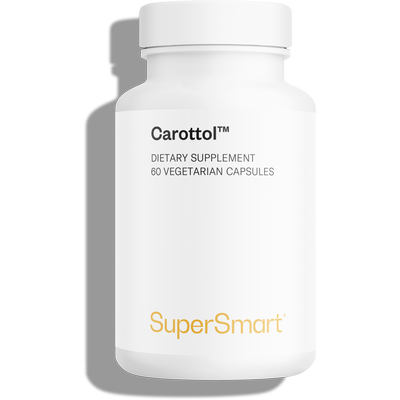
 Discover the Carottol™ dietary supplement, which contains vitamin A and a selection of other carotenoids (lutein, zeaxanthin, lycopene, etc.).
Antioxidants: for protection and a radiant tan
Exposure to UV rays promotes the formation of free radicals, molecules that can contribute to oxidative stress.
These molecules can alter the lipids and proteins present in the skin, which can affect the evenness and radiance of your tan.
Antioxidants are substances that help limit this phenomenon by partially neutralising the effects of free radicals (3).
In this context, they may help to promote a more even and radiant tan.
These include vitamins C and E, which help protect cells against oxidative stress.
Meanwhile, polyphenols (found particularly in green tea and red berries) and lycopene (derived from tomatoes) are also being studied for their interactions with sun-exposed skin.
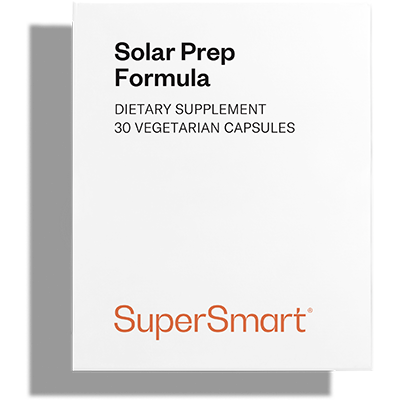
Discover Solar Prep Formula, a dietary supplement that combines several carotenoids and antioxidants for a comprehensive approach to sun-exposed skin.
The role of melanin and keratinocytes in tanning
Beyond diet, the mechanism of tanning also plays a key role.
Tanning relies mainly on the activity of melanocytes, which are responsible for producing melanin in response to UV exposure.
This pigment is then transferred to the surface skin cells, known as keratinocytes, where it becomes visible as a darker skin tone.
The evenness and visual appearance of a tan therefore depend on the proper functioning of these cells.
However, sun exposure also generates oxidative stress, which can disrupt the skin’s cellular balance and affect the complexion’s radiance.
This is why certain active ingredients are studied for their interactions with the skin’s structure and the balance of sun-exposed skin.
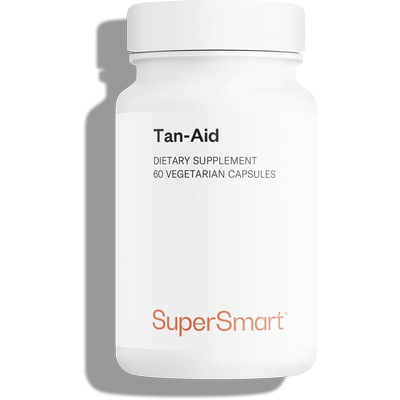
Discover the Tan-Aid 325 mg supplement, a formula containing, in particular, a melanin-standardised keratin hydrolysate, which works in conjunction with the natural mechanisms of pigmentation and the structure of the epidermis.
Hydration and overall balance: key factors for prolonging the radiance of your tan
Hydrate the skin from the inside and out
The duration of a tan also depends on the skin’s hydration levels and, more broadly, on the body’s overall balance.
Dehydrated skin is more likely to appear dull, feel uncomfortable and flake more quickly, which can accelerate the fading of the tan.
Conversely, well-hydrated skin generally looks more supple, radiant and even-toned.
In this context, it is recommended to combine internal hydration—by drinking enough water—with external hydration, using suitable skincare products.
After-sun care or emollient products can thus help maintain skin comfort.
Using sun cream when exposed to UV rays also remains essential to limit the sun’s effects on the skin.
A suitable diet to complement tanning
At the same time, a varied and balanced diet, rich in antioxidant vitamins, carotenoids and other nutrients, forms part of a holistic approach to skin balance.
Essential fatty acids, in particular, play a structural role in cell membranes. They contribute to the skin’s suppleness and integrity.
Some studies suggest that they may also interact with the mechanisms involved in the skin’s response to UV radiation (4).
Maintaining a balanced intake of essential fatty acids could therefore help to preserve the skin’s even appearance, even after sun exposure.
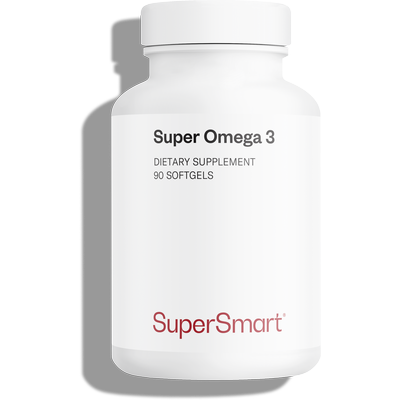
Discover the Super Omega 3 dietary supplement, which contains EPA and DHA fatty acids and vitamin E.
SUPERSMART’S ADVICE
References
- Brenner M, Hearing VJ. The protective role of melanin against UV damage in human skin. Photochem Photobiol. 2008 May-Jun;84(3):539-49. doi: 10.1111/j.1751-1097.2007.00226.x. PMID: 18435612; PMCID: PMC2671032.
- Clarke ED, Duncan MJ, Burrows T, Gómez-Martín M, Brain K, Stanford J, Ferguson JJA, Wood L, Collins CE. Associations Between Dietary Carotenoid Intake and Plasma Carotenoid Concentrations and Skin Yellowness, a Validation Study. J Hum Nutr Diet. 2025 Jun;38(3):e70075. doi: 10.1111/jhn.70075. PMID: 40522063; PMCID: PMC12169085.
- Dunaway S, Odin R, Zhou L, Ji L, Zhang Y, Kadekaro AL. Natural Antioxidants: Multiple Mechanisms to Protect Skin From Solar Radiation. Front Pharmacol. 2018 Apr 24;9:392. doi: 10.3389/fphar.2018.00392. PMID: 29740318; PMCID: PMC5928335.
- Harauma A, Enomoto Y, Endo S, Hariya H, Moriguchi T. Omega-3 fatty acids mitigate skin damage caused by ultraviolet-B radiation. Prostaglandins Leukot Essent Fatty Acids. 2024 Apr;203:102641. doi: 10.1016/j.plefa.2024.102641. Epub 2024 Sep 11. PMID: 39299174.
Keywords


1083 Days
Great service
Great service
Ryszard
1096 Days
Profesjonalna obsługa
Bardzo dobre i rzeczowe opisy. Profesjonalna obsługa.
PIEKOSZEWSKI Chris
1764 Days
Wszystko OK!
Wszystko poszło jak powinno 🙂
SITKIEWICZ Pawel
2551 Days
Szybko sprawnie bez problemów
Szybko sprawnie bez problemów
Marek
of experience
your money back
##montant## purchase