
Tanning: a herb and a fruit studied to protect you from harmful UV rays
What if certain plants could help you bask in the sun while preventing photo-ageing? Two of them, isolated by researchers, are said to have very promising effects...


Sun exposure: balancing benefits and risks
Exposure of the skin to the sun's UV rays is the main route for synthesising vitamin D — on average, diet alone provides only 15-30% of our needs.
This vitamin (which should more accurately be called a hormone) plays a key role in our bodies, contributing to normal immune function, the normal absorption and use of calcium and phosphorus and, by extension, the maintenance of normal teeth and bones (1).
Even so, you don't need to lie in the sun for hours on end: a short exposure to the sun (around 15 to 20 minutes) in the late morning or afternoon is more than enough.
On the other hand, prolonged (or unprotected) exposure to ultraviolet rays, in particular UVA and UVB rays, accelerates skin ageing. This phenomenon, known as photoageing, is the result of excessive production of free radicals, which induces oxidative stress in skin cells (2). This typically results in a visible loss of elasticity, the early appearance of wrinkles or brown spots, and even deep-seated changes to dermal tissue that can lead to skin cancer (melanoma) (3).
To avoid such damage, it's a good idea to follow the basic recommendations, which are now well known: avoid exposure during the hottest part of the day (typically between 12:00 and 16:00), wear clothes that cover you up and apply a suitable sun cream (4). But can you go even further to protect yourself from the harmful effects of UV rays and still have a lovely, tanned complexion by the end of the summer?
Herbs and fruit to combat photoageing
Could certain plants enhance our skin's natural resilience to UV?
This is the avenue that experts in photoprotection have been exploring for several years. After intensive research, two potential candidates have especially caught their attention: rosemary and grapefruit.
Used for centuries in phytotherapy, rosemary is a hardy aromatic plant from the Lamiaceae family native to the Mediterranean basin.
Widely recognised for its immunostimulant, hepatoprotective and digestive properties, this 'plant shield' contains rosmarinic acid, which is thought to have a powerful antioxidant action.
A study suggests that combining it with UVB filters in sun protection products reduces oxidative stress levels in the stratum corneum (the superficial part of the epidermis) (5).
As for grapefruit, it concentrates a whole range of bioactive nutrients, including vitamin C (which helps to maintain normal skin by enabling normal collagen synthesis); carotenoids (including beta-carotene, a precursor to vitamin A, which contributes to skin health); and, above all, polyphenols from the flavonoid family, including naringenin and hesperidin, which are thought to have both anti-inflammatory and anti-free radical properties (6).
Rosemary and grapefruit: better together for photoprotection?
Research carried out on both skin cells and human subjects seems to confirm the efficacy of the rosemary-grapefruit combination for photoprotection (7).
This confirms the legitimacy of synergistic compounds such as Nutroxsun®, a registered extract of rosemary and grapefruit standardised to 35% polyphenols.
A double study of Nutroxsun® sheds further light on the biological mechanisms at work (8).
After 2 weeks of supplementation, a reduction was observed in ultraviolet-induced redness and UVA-stimulated skin lipid peroxidation (which 'attacks' the fatty acids in cell membranes).
An increase in skin elasticity and a reduction in the depth of wrinkles were also reported.
Researchers attribute this supposed dual photoprotective and anti-ageing action to the inhibition of UV-induced reactive oxygen species and inflammatory markers such as cytokines, as well as to changes in the cell signalling pathways that control the breakdown of the extracellular matrix (the assembly of proteins that 'bind' cells together).
Tanning: the best compounds to prepare and protect your skin
There are other natural compounds capable of stimulating tanning and/or reducing the harmful effects of UV rays.
These include molecules from the carotenoid family, renowned for their healthy glow: lutein, astaxanthin, lycopene and, of course, beta-carotene, a plant precursor of vitamin A that contributes to good skin health.
Studies have also highlighted their role in neutralising the photooxidative reactions that affect the integrity of skin cells (9).
The most effective sun-preparation supplements are based on synergistic combinations.
They aim to enhance the complexion (whether to start a pre-tan, tan more effectively or even prolong the tan) while offering the highest level of skin protection (in addition to the usual preventive measures).
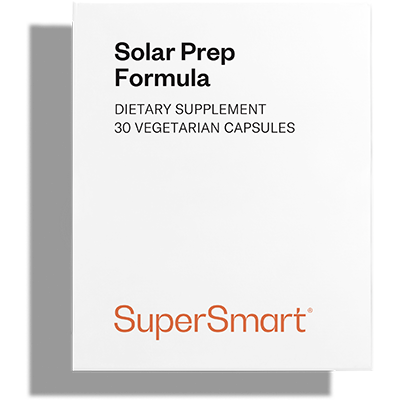
Some manufacturers have chosen to capitalise on Nutroxsun® by including it in their formulation and combining it with carotenoids (this is the case with Solar Prep Formula, which also contains zinc, SOD, biotin, etc.) (10-11).
SUPERSMART ADVICE
References
- Chauhan K, Shahrokhi M, Huecker MR. Vitamin D. [Updated 2023 Apr 9]. In: StatPearls [Internet]. Treasure Island (FL): StatPearls Publishing; 2025 Jan-. Available from: https://www.ncbi.nlm.nih.gov/books/NBK441912/
- Amano S. Characterization and mechanisms of photoageing-related changes in skin. Damages of basement membrane and dermal structures. Exp Dermatol. 2016 Aug;25 Suppl 3:14-9. doi: 10.1111/exd.13085. PMID: 27539897.
- Heistein JB, Acharya U, Mukkamalla SKR. Malignant Melanoma. [Updated 2024 Feb 17]. In: StatPearls [Internet]. Treasure Island (FL): StatPearls Publishing; 2025 Jan-. Available from: https://www.ncbi.nlm.nih.gov/books/NBK470409/
- Sultana N. Sun Awareness and Sun Protection Practices. Clin Cosmet Investig Dermatol. 2020 Sep 29;13:717-730. doi: 10.2147/CCID.S265477. PMID: 33061512; PMCID: PMC7532884.
- Macedo PIS, Pinto CASO, Hiraishi CF, Marques GA, Escudeiro CC, Pessoa FVLS, Gregório J, Rosado C, Velasco MVR, Baby AR. Enhancing Photoprotection and Mitigating Ex Vivo Stratum Corneum Oxidative Stress: A Multifunctional Strategy Combining Rosmarinic Acid with UVB Filters. Antioxidants (Basel). 2025 Feb 26;14(3):274. doi: 10.3390/antiox14030274. PMID: 40227214; PMCID: PMC11939370.
- Castro-Vazquez L, Alañón ME, Rodríguez-Robledo V, Pérez-Coello MS, Hermosín-Gutierrez I, Díaz-Maroto MC, Jordán J, Galindo MF, Arroyo-Jiménez Mdel M. Bioactive Flavonoids, Antioxidant Behaviour, and Cytoprotective Effects of Dried Grapefruit Peels (Citrus paradisi Macf.). Oxid Med Cell Longev. 2016;2016:8915729. doi: 10.1155/2016/8915729. Epub 2016 Jan 21. PMID: 26904169; PMCID: PMC4745316.
- Pérez-Sánchez A, Barrajón-Catalán E, Caturla N, Castillo J, Benavente-García O, Alcaraz M, Micol V. Protective effects of citrus and rosemary extracts on UV-induced damage in skin cell model and human volunteers. J Photochem Photobiol B. 2014 Jul 5;136:12-8. doi: 10.1016/j.jphotobiol.2014.04.007. Epub 2014 Apr 20. PMID: 24815058.
- Nobile V, Michelotti A, Cestone E, Caturla N, Castillo J, Benavente-García O, Pérez-Sánchez A, Micol V. Skin photoprotective and antiageing effects of a combination of rosemary (Rosmarinus officinalis) and grapefruit (Citrus paradisi) polyphenols. Food Nutr Res. 2016 Jul 1;60:31871. doi: 10.3402/fnr.v60.31871. PMID: 27374032; PMCID: PMC4931025.
- Stahl W, Sies H. Carotenoids and protection against solar UV radiation. Skin Pharmacol Appl Skin Physiol. 2002 Sep-Oct;15(5):291-6. doi: 10.1159/000064532. PMID: 12239422.
- Alaluf S, Heinrich U, Stahl W, Tronnier H, Wiseman S. Dietary carotenoids contribute to normal human skin color and UV photosensitivity. J Nutr. 2002 Mar;132(3):399-403. doi: 10.1093/jn/132.3.399. PMID: 11880562.
- Ogawa Y, Kinoshita M, Shimada S, Kawamura T. Zinc and Skin Disorders. 2018 Feb 11;10(2):199. doi: 10.3390/nu10020199. PMID: 29439479; PMCID: PMC5852775.



7 Days
Heldere info
Heldere info
HanS.
7 Days
Snelle levering
Snelle levering
harrie
12 Days
Adequate info en hoge kwaliteit
Adequate info en hoge kwaliteit
HanS.
22 Days
Supplementen zijn goed.
Supplementen zijn goed. Zachte prijzen. Website met problemen ( altijd ) niet goed voor nieuwe klanten.
Gino RJ
32 Days
Alles op tijd geleverd.
Alles op tijd geleverd. De producten worden alsmaar duurder, terwijl mijn pensioen niet meer stijgt. Vandaar kan ik alsmaar minder vaak bestellen.
Wouters
1102 Days
Great service
Great service
Ryszard
1114 Days
Profesjonalna obsługa
Bardzo dobre i rzeczowe opisy. Profesjonalna obsługa.
PIEKOSZEWSKI Chris
1782 Days
Wszystko OK!
Wszystko poszło jak powinno 🙂
SITKIEWICZ Pawel
2569 Days
Szybko sprawnie bez problemów
Szybko sprawnie bez problemów
Marek
of experience
your money back
##montant## purchase