

Complete your selection
Liposomal Apigenin is a dietary supplement containing apigenin, a flavonoid found in certain plants and widely studied for its potential effects on maintaining cellular vitality and relaxation.
We are one of the few brands to offer apigenin in liposomal form, a technology of encapsulation in microvesicles composed of phospholipids which protect the compound during digestion and thus improve its absorption.
Liposomal Apigenin is included in our Longevity category.
Definition and benefits of an apigenin dietary supplement
What is apigenin?
Apigenin is a natural bioflavonoid belonging to the flavone family, a class of polyphenolic compounds produced by plants (1).
It is notably present in certain medicinal plants and aromatic herbs such as camomile, parsley and celery.
In plants, apigenin plays the role of a secondary metabolite, helping to protect them from external stressors such as oxidative stress, UV radiation and various microorganisms.
A flavonoid studied for longevity, relaxation and brain health
Apigenin has been the subject of numerous scientific studies for its potential health benefits:
- its possible ability to increase levels of NAD+, a key player in cellular metabolism and longevity: apigenin is thought to be a natural inhibitor of CD38, the main enzyme that breaks down NAD+, a coenzyme essential for cellular energy and overall longevity. By inhibiting the hydrolase activity of CD38, apigenin prevents the reduction of NAD+ and increases its intracellular reserves. This in turn activates sirtuins (a family of enzymes such as SIRT1 and SIRT3), strengthening several cellular mechanisms involved in DNA repair, mitochondrial function and metabolic regulation. In vitro, it has been shown that apigenin added to cells effectively inhibited CD38 and caused an increase in NAD+ levels, resulting in reduced acetylation of p53 and RelA/p65, a marker of increased sirtuin activity (2). In vivo, administration of the flavonoid to obese mice resulted in an increase in tissue NAD+, a decrease in overall protein acetylation and an improvement in glucose and lipid metabolism. These results indicate that inhibition of CD38 by apigenin may result in physiological benefits, improving metabolic parameters in a model of metabolic syndrome. In diabetic rats, apigenin administration led to a significant reduction in kidney damage. The strengthening of mitochondrial antioxidant defence via the lowering of renal CD38, the restoration of NAD+ levels and therefore the stimulation of SIRT3, was associated with a reduction in oxidative stress in renal tissues. This suggests that apigenin may attenuate organ damage linked to metabolic disorders or ageing by activating longevity pathways (3);
- its possible role in relaxation and sleep: apigenin also appears to interact with the brain's GABA system, the main inhibitory mechanism in the central nervous system, responsible for curbing excessive neuronal activity. More specifically, apigenin could modulate GABA_A receptors and thus promote a state of relaxation that can facilitate falling asleep (4);
- its interest in protecting neurons: apigenin is thought to exert neuroprotective effects through several mechanisms. Firstly, it is thought to boost the signalling of neurotrophic factors, i.e. the parameters that promote the growth, survival and differentiation of neurons. For example, apigenin intake may increase brain-derived neurotrophic factor (BDNF) in the hippocampus, thereby promoting neuronal survival and plasticity. The flavonoid also attenuated neurotoxic stress through antioxidant and anti-inflammatory actions in the central nervous system. These mechanisms help to preserve neurons and cognitive functions, helping to maintain brain health and emotional balance (5);
- its potential anti-inflammatory properties: a number of studies suggest that apigenin is anti-inflammatory. It is thought to down-regulate the NF-κB pathway, a central factor in inflammation, and to inhibit the expression of pro-inflammatory enzymes such as cyclooxygenase-2 (COX-2). By inhibiting NF-κB, apigenin is thought to reduce the production of cytokines such as IL-1β, IL-6 and TNF-α by immune cells. This could result in a weakening of inflammatory signal cascades and a reduction in oxidative stress and tissue damage in inflammatory conditions (6);
- its possible ability to modulate uric acid levels: finally, this flavonoid could inhibit xanthine oxidase (XO), the enzyme responsible for converting purines into uric acid. Apigenin's flavone structure enables it to bind to the XO enzyme and interfere with the synthesis of uric acid. In vitro enzymatic tests confirm these effects, identifying apigenin as a powerful inhibitor of XO-mediated reactions (7). It has also shown hypouricaemic effects in vivo: in a mouse model of hyperuricaemia, administration of the flavonoid for 7 days significantly reduced serum uric acid levels compared with controls. This was accompanied by a reduction in hepatic xanthine oxidase activity (8).
3 key points and reasons to buy our liposomal apigenin
Liposomal Apigenin has 3 strong points:
- apigenin in liposomal form, which is still rare on the market: apigenin is a bioflavonoid that is naturally not very bioavailable. Our dietary supplement stands out from the rest of the market by using liposomal technology, which encapsulates the active ingredient in small vesicles made up of phospholipids derived from sunflower lecithin. These vesicles protect the active ingredient during digestion and considerably increase its absorption by the body;
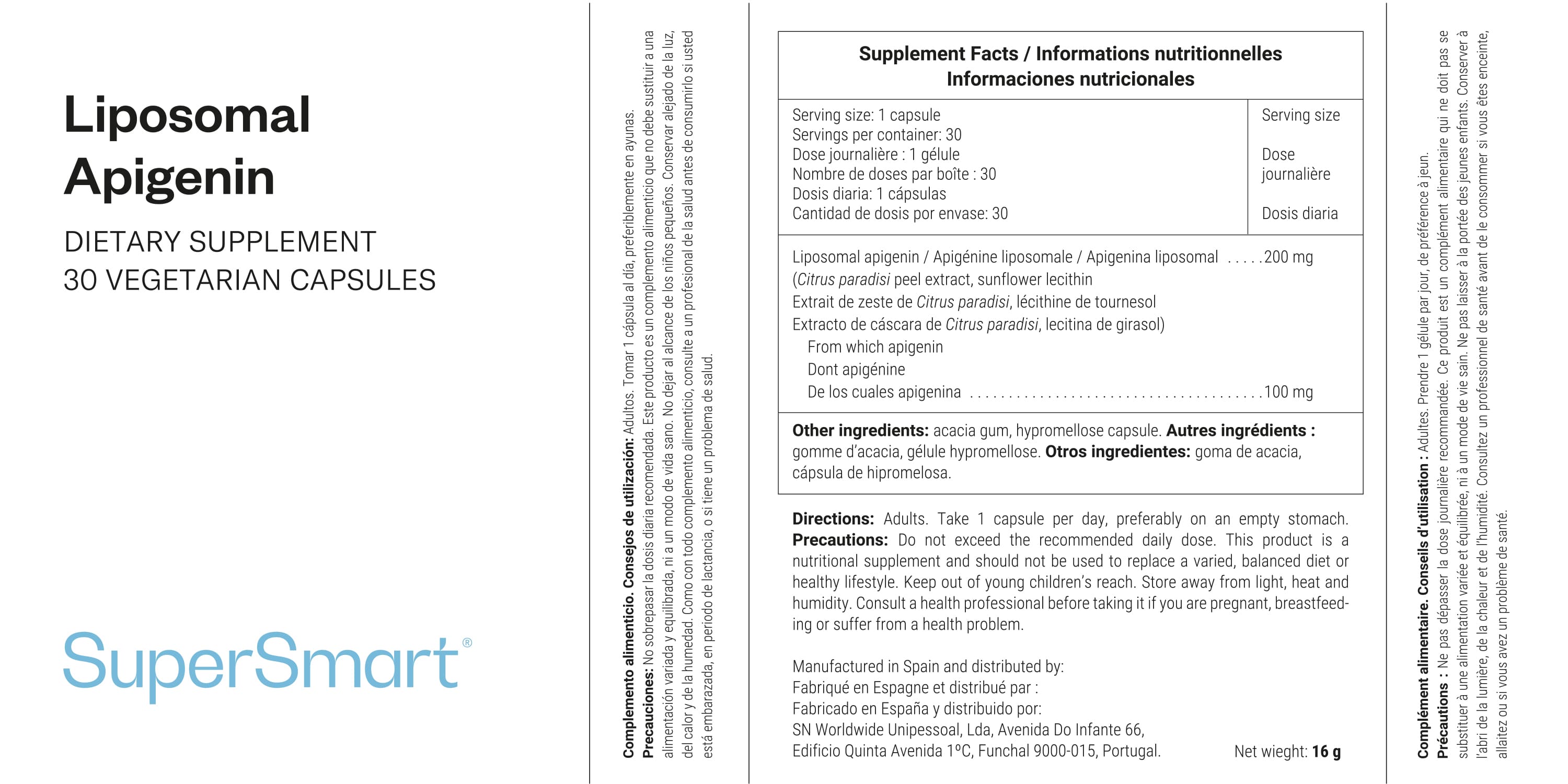
- a high, relevant dose: each daily dose provides 200 mg of liposomal apigenin, i.e. 100 mg of pure apigenin per day, an ideal quantity established on the basis of the data available in the scientific literature;
- a purified, vegan formula: made from grapefruit peel (Citrus paradisi), our supplement contains no ingredients of animal origin. It is packaged in vegetarian capsules made from hypromellose (a cellulose derivative) with acacia gum as the only excipient, to ensure that the composition is as pure as possible.
What is in Liposomal Apigenin
Any questions?
Our team of nutrition experts and scientists has the answers.
Once consumed, apigenin is partially absorbed within a few hours, at which point it begins to take effect.
Its more advanced potential health benefits typically manifest after approximately 1 month of consistent supplementation.
Our high dosage of 100 mg of apigenin per day enables the body to reach significant concentrations more rapidly.
The main food sources of apigenin are:
- some aromatic herbs: parsley, thyme, oregano
- some medicinal plants: camomile, yarrow
- some vegetables: celery, lettuce
However, dietary intakes remain modest, and the compound is not naturally bioavailable.
This is why some food supplement formulations, particularly in liposomal form and at high dosage (such as Liposomal Apigenin), are designed to improve absorption.
This flavone is being studied for its potential sedative and relaxing properties.
It is thought to act by modulating certain GABA receptors in the nervous system, which are involved in calming brain activity.
This effect could actually help you fall asleep and improve the quality of your sleep.
In addition to taking Liposomal Apigenin, you can take a complementary flavonoid called luteolin. This compound is also being researched for its potential effects on brain health, inflammatory response and cell protection (see Luteolin).
We also recommend considering trans-resveratrol, another plant polyphenol, this time from the stilbene family. It is found especially in grapes and Japanese knotweed (Polygonum cuspidatum). Several studies suggest its benefits for cell longevity, cardiovascular health and certain cell protection mechanisms (for example, buy Trans-Resveratrol, a trans-resveratrol supplement made from Polygonum cuspidatum root extract).
Need help?
You may also like
of experience
your money back
##montant## purchase