
Haemorrhoids: 5 natural remedies to try
Pain, burning, rectal bleeding: many people suffer from haemorrhoids (up to 75% of those over 45). The good news is that natural remedies can help. Discover which of them are most effective .....


Haemorrhoids: a particularly uncomfortable complaint
Like the rest of the body, the rectum has a network of blood vessels. These are called rectal veins , though in the past, they were referred to as haemorrhoidal veins. These crucial blood vessels play a role in continence - the ability to control when you empty your bowels (1).
When we refer to ‘haemorrhoids’ nowadays, we’re actually talking about a problem of the haemorrhoidal veins in which they become inflamed and over-dilated – a kind of anal varicose veins.
Once they are swollen and inflamed, haemorrhoids may itch, burn and even bleed, and above all, become painful. Even if flare-ups generally only last a few days, haemorrhoids can thus cause considerable discomfort.
Those most at risk of haemorrhoids are pregnant women (due to excessive pressure by the uterus which prevents venous return) (2), new mothers who have had vaginal deliveries, and those who suffer from constipation (3).
In fact constipation is the leading cause of haemorrhoids (4): difficulty in passing stools leads to excessive straining, which in turn results in too much pressure in the haemorrhoidal veins which then become swollen. Blockages which may be caused by constipation exacerbate the problem by impeding venous return. It’s a vicious circle.
That’s why the first step in treating haemorrhoids is to prevent constipation, primarily by adopting the right diet (see our article on dietary fibre).
Sitz baths: grandma’s anti-haemorrhoid remedy
It’s probably the best-known natural remedy for haemorrhoids (5), the one used by our grandmothers – and theirs before them: the sitz bath. There are different schools of thought on this option:
- there’s the ‘spartan’ approach which, with good reason, advocates using cold, or even iced, water, to add a vasoconstrictive (blood vessel-narrowing) effect to the sitz bath’s decongesting one;
- or the more gentle, comfortable approach, using lukewarm water, which helps to decongest haemorrhoids but does not have a vasoconstrictive effect.
Whichever you choose, the sitz bath should be used at least once a day for 10-15 minutes. Bicarbonate of soda can also be added to the water to help disinfect inflamed veins.
Patchouli: an effective decongestant
With decongestant and anti-inflammatory effects (6),essential oil of patchouli can be gently massaged for a minute or two into the area affected by haemorrhoids. A few drops (4-6) is enough, once or twice a day.
Take care though: essential oil of patchouli has a similar effect to oestrogens which means it should not be used by pregnant women, children and those suffering from hormone-dependent cancers.
Horse chestnut supplement: a recognised venotonic
Horse chestnut is known to be one of the most powerful natural venotonics (7). In other words, it promotes venous return: it enables the flow of blood back from lower to upper parts of the body, thus helping to ‘disgorge’ haemorrhoids. It is its high content of aescin, a mixture of saponins, which is responsible for this effect.
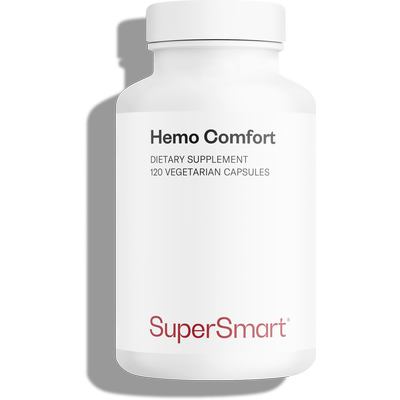
In this case, it works from the inside out so choose the oral option, with a supplement rich in horse chestnut extract. There are actually synergistic formulations (such as Hemo Comfort, which in addition to horse chestnut, also contains diosmin, a flavone extracted from the fruit of Citrus aurantium, hesperidin, an exceptional citrus flavonoid, and troxerutin, extracted from the flowers of Sophora japonica).
A witch hazel compress to soothe the anus
An attractive shrub popular for its winter blossom, witch hazel is also widely used in phytotherapy for treating a number of circulation-related problems. Its bark and leaves contain tannins and flavonoids which are thought to protect blood vessels (8).
You can either:
- gently bathe the haemorrhoids with a compress soaked in witch hazel extract two or three times a day;
- or mix the witch hazel extract with aloe vera gel and as with patchouli (but without the contraindications), gently massage into the affected area.
Cider vinegar: perfect for haemorrhoid flare-ups
Containing less acetic acid but more minerals, essential acids and enzymes than other vinegars, cider vinegar is thought to protect against inflammation. As such, it can be applied to haemorrhoids, two or three times a day. It can also be added to the water in a sitz bath (9).
Note: if you find that applying cider vinegar to your haemorrhoids produces an adverse reaction (the acidity may cause a burning sensation), stop and use an alternative natural method.
Bonus: green clay poultice
Green clay is recognised for cleansing, disinfecting and helping to heal skin tissue. With remineralising properties, it may also be a powerful anti-bacterial. With all these benefits, it makes another excellent traditional haemorrhoid home remedy, in the form of a a green clay poultice (10).
Simply mix powdered green clay with water to obtain a toothpaste-like consistency, and apply this to your haemorrhoids, covering them with a compress for a good 30 minutes. Repeat two to three times a day until you obtain relief.
SUPERSMART ADVICE
References
- HAAS, Peter A., FOX, Thomas A., et HAAS, Gabriel P. The pathogenesis of hemorrhoids. Diseases of the colon & rectum, 1984, vol. 27, no 7, p. 442-450.
- STAROSELSKY, Arthur, NAVA-OCAMPO, Alejandro A., VOHRA, Sabina, et al.Hemorrhoids in pregnancy. Canadian Family Physician, 2008, vol. 54, no 2, p. 189-190.
- RISS, Stefan, WEISER, Friedrich Anton, SCHWAMEIS, Katrin, et al.The prevalence of hemorrhoids in adults. International journal of colorectal disease, 2012, vol. 27, no 2, p. 215-220.
- JOHANSON, John F. et SONNENBERG, Amnon. The prevalence of hemorrhoids and chronic constipation: an epidemiologic study. Gastroenterology, 1990, vol. 98, no 2, p. 380-386.
- SHIRAH, Bader Hamza, SHIRAH, Hamza Asaad, FALLATA, Abdelelah Hussein, et al.Hemorrhoids during pregnancy: Sitz bath vs. ano-rectal cream: A comparative prospective study of two conservative treatment protocols. Women and Birth, 2018, vol. 31, no 4, p. e272-e277.
- PULLAGUMMI, Chakrapani, RAO, Nirmala Babu, SINGH, B. Chandra Sekhar, et al.Comparitive studies on antibacterial activity of Patchouli [Pogostemon cablin (Blanco) Benth] and Geranium (Pelargonium graveolens) aromatic medicinal. African Journal of Biotechnology, 2014, vol. 13, no 23.
- GUILLAUME, M. et PADIOLEAU, F. Veinotonic effect, vascular protection, antiinflammatory and free radical scavenging properties of horse chestnut extract. Arzneimittel-forschung, 1994, vol. 44, no 1, p. 25-35.
- KORTING, H. C., SCHÄFER-KORTING, M., HART, H., et al.Anti-inflammatory activity of hamamelis distillate applied topically to the skin. European journal of clinical pharmacology, 1993, vol. 44, no 4, p. 315-318.
- LEE, Kun W. et JACOB, Sharon E. Apple cider vinegar baths. Journal of the Dermatology Nurses' Association, 2018, vol. 10, no 1, p. 59.
- LEO, Cosimo Alex, CHANDRASINGHE, Pramodh, HODGKINSON, Jonathan D., et al.Technical Tips and Tricks of Outpatient Treatments for Hemorrhoids. Hemorrhoids, 2018, p. 151.
Keywords




4 Days
Heldere info
Heldere info
HanS.
4 Days
Snelle levering
Snelle levering
harrie
9 Days
Adequate info en hoge kwaliteit
Adequate info en hoge kwaliteit
HanS.
19 Days
Supplementen zijn goed.
Supplementen zijn goed. Zachte prijzen. Website met problemen ( altijd ) niet goed voor nieuwe klanten.
Gino RJ
29 Days
Alles op tijd geleverd.
Alles op tijd geleverd. De producten worden alsmaar duurder, terwijl mijn pensioen niet meer stijgt. Vandaar kan ik alsmaar minder vaak bestellen.
Wouters
1099 Days
Great service
Great service
Ryszard
1111 Days
Profesjonalna obsługa
Bardzo dobre i rzeczowe opisy. Profesjonalna obsługa.
PIEKOSZEWSKI Chris
1779 Days
Wszystko OK!
Wszystko poszło jak powinno 🙂
SITKIEWICZ Pawel
2566 Days
Szybko sprawnie bez problemów
Szybko sprawnie bez problemów
Marek
of experience
your money back
##montant## purchase