
A study suggests multiple benefits of quercetin on the skin
Constantly exposed to oxidative stress and external aggression, our skin plays a key protective role. Plant compounds such as quercetin could have beneficial effects on skin balance. A recent review takes stock of the situation.


The skin: a living protective barrier subject to numerous stresses
The largest organ in the human body, the skin performs several essential functions:
- a physical barrier against external aggressors
- regulation of body temperature
- participation in immune mechanisms
- a major sensory and psychosocial role
Every day, the skin is exposed to external factors (UV rays, pollution, climatic variations, etc.), as well as internal imbalances and metabolic stress.
These factors can increase oxidative stress, activate inflammatory mechanisms and slow down the skin's natural repair processes.
They can also contribute to pigmentation irregularities and the appearance of visible signs of skin ageing.
Beyond the aesthetic concerns (dull complexion, discomfort, imperfections), these imbalances can sometimes have an impact on quality of life.
Against this backdrop, research is focusing increasingly on molecules of plant origin, particularly flavonoids, to better understand their potential interactions with skin health.
Among them is quercetin, a natural compound that is attracting growing scientific interest.
What a recent scientific review reveals about quercetin and the skin
A recent study (1) compiles 65 studies selected from over 1,300 publications to assess the biological effects of quercetin on various skin parameters.
Quercetin and cutaneous oxidative stress
The review highlights quercetin's antioxidant potential.
In various experimental models, it may help neutralise certain unstable molecules produced during oxidative stress (often called 'free radicals'). These can weaken cells when present in excess.
Quercetin may also support the activity of the body's natural defence systems, such as certain antioxidant enzymes (SOD, catalase, glutathione), which help to protect cells.
These mechanisms suggest that it may help to preserve cell integrity in the face of the oxidative damage involved in skin ageing.
However, these observations are mainly based on experimental models, and must be interpreted with caution.
Quercetin and the modulation of skin inflammation
The review also mentions possible interactions between quercetin and certain signalling pathways involved in the inflammatory response.
Studies suggest that quercetin may act on biological mechanisms that regulate the production of substances involved in inflammation.
These substances, such as certain cytokines or enzymes, are normally involved in the body's defence mechanisms. But when they are produced in excess, they can maintain a state of discomfort or imbalance in the skin.
These effects, observed in cellular and animal models, suggest a potential role for quercetin in the inflammatory balance of the skin.
However, the review emphasises that this is an evolving area of research, not an established dermatological treatment.
Quercetin and skin repair
The review also looks at the skin's natural repair processes.
Some data suggest that quercetin may:
- influence the activity of fibroblasts, cells essential to skin structure
- participate in the production of collagen
- interact indirectly with factors involved in tissue regeneration
These results – which come mainly from preclinical studies – suggest a possible contribution to the physiological processes of skin repair.
Quercetin, pigmentation and tyrosinase activity
Finally, the review mentions a possible effect of quercetin on pigmentation mechanisms.
Some experimental studies show that quercetin could influence the activity of tyrosinase, an enzyme involved in the production of melanin, the pigment responsible for skin colour.
By modulating this activity, quercetin could theoretically play a role in the processes linked to skin pigmentation.
As with the other areas studied, these results come mainly from preclinical models and must be interpreted with caution.
A promising scientific avenue, but still evolving
The review highlights the diversity of biological mechanisms associated with quercetin: antioxidant activity, modulation of inflammation, possible influence on tissue repair and pigmentation.
However, it brings together data from experimental models and clinical observations, without always clearly distinguishing between the different modes of administration (topical or nutritional).
Research is continuing to better understand its potential role in skin balance.
Although it is not yet an established treatment, quercetin appears to be an interesting avenue of research in the nutritional and dermocosmetic fields.
Where can I find quercetin, and how can it be incorporated into an overall approach?
Quercetin is a flavonoid naturally present in many plant-based foods: it is found in apples, red berries, red and white onions, tea, broccoli and citrus fruits.
Consumed as part of a varied, balanced diet, it contributes to the overall intake of polyphenols, plant compounds that have been widely studied for their interactions with mechanisms linked to oxidative stress.
In addition to its potential benefits for the skin, quercetin is also being studied for its other presumed biological properties, particularly in the fields of inflammatory balance, specific immune responses in the context of allergies and overall cellular protection (2-4).
This work is part of a constantly evolving scientific context.
For people wishing to optimise their intake, quercetin can be offered in the form of food supplements, formulated to form part of an overall nutritional approach aimed at supporting cellular balance.
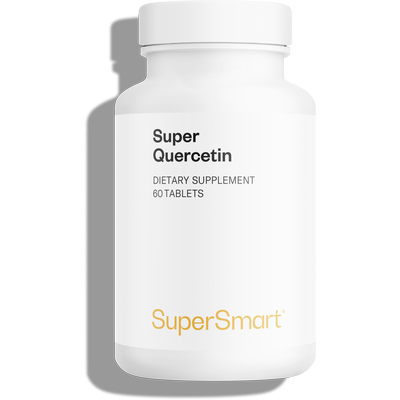
 Discover the Super Quercetin food supplement, a formula concentrated in quercetin naturally extracted from the Dimorphandra mollis tree, with improved bioavailability.
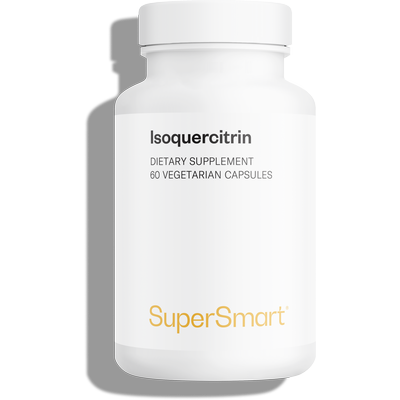
Discover IsoQuercitrin, a highly bioavailable form of quercetin, designed to optimise its absorption.
It is important to remember that food supplements are not a substitute for medical advice and do not constitute a targeted treatment.
They are part of an overall nutritional support approach, complementing a balanced diet, a healthy lifestyle and appropriate skin protection.
SUPERSMART ADVICE
References
- Okselni T, Septama AW, Juliadmi D, Dewi RT, Angelina M, Yuliani T, Saragih GS, Saputri A. Quercetin as a therapeutic agent for skin problems: a systematic review and meta-analysis on antioxidant effects, oxidative stress, inflammation, wound healing, hyperpigmentation, aging, and skin cancer. Naunyn Schmiedebergs Arch Pharmacol. 2025 May;398(5):5011-5055. doi: 10.1007/s00210-024-03722-3. Epub 2024 Dec 30. PMID: 39738831.
- Ozorowski M, Wiciński M, Kuźmiński O, Wojciechowski P, Siedlecki Z, Śniegocki M, Włodarczyk E. The Effects of Quercetin on Vascular Endothelium, Inflammation, Cardiovascular Disease and Lipid Metabolism-A Review. Nutrients. 2025 May 3;17(9):1579. doi: 10.3390/nu17091579. PMID: 40362888; PMCID: PMC12073147.
- Naso M, Trincianti C, Tosca MA, Ciprandi G. Quercetin and Its Lecithin-Based Formulation: Potential Applications for Allergic Diseases Based on a Narrative Review. Nutrients. 2025 Apr 27;17(9):1476. doi: 10.3390/nu17091476. PMID: 40362785; PMCID: PMC12073759.
- Li M, Cui Y, Wu X, Yang X, Huang C, Yu L, Yi P, Chen C. Integrating network pharmacology to investigate the mechanism of quercetin's action through AKT inhibition in co-expressed genes associated with polycystic ovary syndrome and endometrial cancer. Int J Biol Macromol. 2025 Mar;297:139468. doi: 10.1016/j.ijbiomac.2025.139468. Epub 2025 Jan 5. PMID: 39765297.




7 Days
Heldere info
Heldere info
HanS.
7 Days
Snelle levering
Snelle levering
harrie
12 Days
Adequate info en hoge kwaliteit
Adequate info en hoge kwaliteit
HanS.
22 Days
Supplementen zijn goed.
Supplementen zijn goed. Zachte prijzen. Website met problemen ( altijd ) niet goed voor nieuwe klanten.
Gino RJ
31 Days
Alles op tijd geleverd.
Alles op tijd geleverd. De producten worden alsmaar duurder, terwijl mijn pensioen niet meer stijgt. Vandaar kan ik alsmaar minder vaak bestellen.
Wouters
1102 Days
Great service
Great service
Ryszard
1114 Days
Profesjonalna obsługa
Bardzo dobre i rzeczowe opisy. Profesjonalna obsługa.
PIEKOSZEWSKI Chris
1782 Days
Wszystko OK!
Wszystko poszło jak powinno 🙂
SITKIEWICZ Pawel
2569 Days
Szybko sprawnie bez problemów
Szybko sprawnie bez problemów
Marek
of experience
your money back
##montant## purchase