
Vitamin B9 deficiency: symptoms, causes and natural solutions
Persistent tiredness, difficulty concentrating, headaches... Think you're suffering from vitamin B9 deficiency? Find out the warning signs, the causes and the natural solutions to remedy the situation.


What is the role of vitamin B9?
Vitamin B9, whether in the form of natural folates or synthetic folic acid, plays a key role in many essential biological functions:
- contributes to normal cell division; requirements for vitamin B9 increase sharply during pregnancy, with low maternal folate levels constituting a risk factor for the development of neural tube defects in the foetus (1-2);
- supports the growth of maternal tissues during pregnancy, including early placental and embryonic development;
- contributes to normal blood formation. In particular, it is involved in the production of red blood cells, and a deficiency can lead to megaloblastic anaemia, which causes tiredness, shortness of breath and paleness;
- helps reduce exhaustion and fatigue;
- contributes to normal synthesis of amino acids, which the body needs to make proteins, enzymes and proteins;
- supports normal homocysteine metabolism, elevated levels of which are associated with increased cardiovascular risk (3);
- contributes to normal psychological functions through involvement in the synthesis of neurotransmitters, including dopamine, serotonin and noradrenaline, which are involved in regulating mood, motivation and attention (4);
- supports the normal functioning of the immune system through its role in the production of white blood cells.
Recommended folate intakes vary according to age and situation (5).
For adults, the recommended daily intake is 330 µg for men and 300 µg for women. Requirements increase for pregnant women, with a recommended intake of 400 µg to 5 mg per day.
What are the symptoms of vitamin B9 deficiency?
Vitamin B9 deficiency most often manifests itself as persistent fatigue that does not resolve with rest.
It is generally accompanied by anaemia, which means a drop in the number of red blood cells or haemoglobin levels.
The most common signs include
- paleness
- shortness of breath
- headaches
- dizziness
Other symptoms can sometimes occur: red and painful tongue, loss of taste, diarrhoea, weight loss and depression (6).
What are the causes of vitamin B9 deficiency?
Vitamin B9 deficiency is common because the body does not store much of it.
Winter and early spring are critical periods, when the risk of folate deficiency increases in the general population.
The main cause is thought to be an inadequate dietary intake of fresh fruit and vegetables, which are rich in folate (7).
Certain situations also increase the risk of deficiency:
- pregnant women are most at risk, as their folate requirements increase from the very first weeks of pregnancy and remain elevated throughout pregnancy;
- older adults are also at greater risk of deficiency, because their diet is often less varied and their intestinal absorption less efficient;
- excessive alcohol consumption disrupts the absorption of folates and accelerates their elimination. In addition, alcohol-dependent people often suffer from malnutrition, which further reduces their folate intake from food;
- restrictive vegetarian or exclusion diets, particularly when folate-rich foods are excluded from the diet;
- chronic inflammatory bowel diseases, such as coeliac disease, which can impair nutrient absorption;
- certain medications, including some anti-epileptic drugs and antibiotics, which may reduce absorption or interfere with folate metabolism.
In case of doubt or persistent symptoms, it is always advisable to consult a health professional for a precise medical diagnosis.
What natural solutions are there to correct a vitamin B9 deficiency?
As it cannot be produced by the body, vitamin B9 must be provided through the diet or by targeted supplementation.
Eat foods rich in vitamin B9
Some foods that are very rich in folates are eaten too little or only in small quantities. Others contain less vitamin B9, but are easier to incorporate into our diets.
Here are the main food sources of vitamin B9, ranked in order of average folate content (8-9):
- brewer's yeast (1000 µg/100 g)
- offal from poultry, lamb and veal (300 to 800 µg/100 g)
- some green leafy vegetables: spinach, watercress, chicory (100 to 200 µg/100 g)
- cooked legumes: chickpeas, white and kidney beans, lentils (100 to 150 µg/100 g)
- nuts and seeds: chestnut, hazelnut, peanut, flax (100 to 150 µg/100 g)
- mature cheeses (100 to 150 µg/100 g)
- vegetables: cauliflower, broccoli, lettuce, asparagus, parsley (60 to 110 µg/100 g)
- eggs (50 to 60 µg/100 g);
- some fruits: citrus fruit, bananas, kiwi fruit, berries, dates, figs (20 to 50 µg/100 g)
Pay attention to food preparation
Vitamin B9 is a particularly fragile vitamin, which degrades under the effect of heat, light and water.
Depending on the type of food prepared and the method used, cooking can result in a loss of 50–70% of folates (10).
Boiling food for a long time is one of the most destructive methods: only 49% of folates are retained in spinach and 44% in broccoli after boiling (compared with virtually no loss when steamed).
Steaming, gentle braising or flash-cooking preserves the folate content of foods much better.
Vegetable storage and handling are also important: prolonged rinsing and soaking, as well as storage conditions, can significantly reduce vitamin B9 levels.
Avoid alcohol and remain vigilant if you are currently taking medication
To maintain good vitamin B9 status and preserve folate intake, it is best to limit regular alcohol consumption.
This also helps to protect the liver and digestive system, both of which are involved in folate metabolism.
As mentioned above, certain medications can also reduce the absorption of vitamin B9: if you are being treated for epilepsy, diabetes or chronic inflammatory bowel disease, talk to your doctor.
In addition to regular medical check-ups, your doctor may prescribe vitamin B9 supplements if you are deficient.
Opt for targeted vitamin B9 supplementation
Vitamin B9 supplementation is useful when you are looking to improve your folate status over the long term.
As the body can only store very small amounts of this vitamin, the level of folate available depends very much on daily intake.
A synthetic version of vitamin B9, folic acid is often not directly assimilated by our bodies; it must undergo several metabolic transformations before being converted into (6S)-5-methyltetrahydrofolic acid, the active form of vitamin B9.
Taking a supplement based on 5-MTHF ensures maximum bioavailability. It's also a completely safe form that doesn't raise levels of non-metabolised folic acid, the long-term effects of which are still uncertain (11).
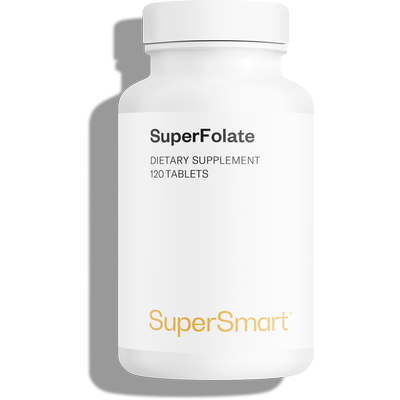
 Discover the SuperFolate dietary supplement, formulated using Quatrefolic® technology, for a highly bioavailable form of vitamin B9 that can be used directly by the body.
Indispensable for the body, group B vitamins are not generally well synthesised and are poorly stored. Yet they play an essential metabolic role, and the benefits of combining them have been widely studied.
Studies have highlighted the benefits of supplementation with a combination of several group B vitamins for reducing fatigue and enhancing physical performance, cognition, stress and energy (12-13).
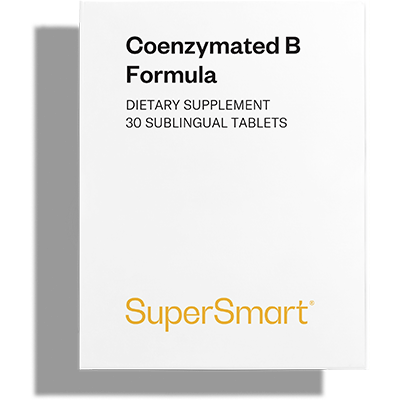
Discover Coenzymated B Vitamins, an exceptional dietary supplement combining the 8 B vitamins in their best (coenzymated) forms.
SUPERSMART ADVICE
References
- Enrichir la farine en acide folique une solution contre les malformations du tube neural, ANSES, 2024
- EFSA Panel on Dietetic Products, Nutrition and Allergies (NDA); Scientific Opinion on the substantiation of health claims related to folate and blood formation (ID79), homocysteine metabolism (ID 80), energy‐yielding metabolism (ID 90), function of the immune system (ID 91), function of blood vessels (ID 94, 175, 192), cell division (ID 193), and maternal tissue growth during pregnancy (ID 2882) pursuant to Article 13(1) of Regulation (EC) No 1924/2006 on request from the European Commission. EFSA Journal 2009 ; 7 (9) : 1213. [22 pp.].
- Clarke R, Daly L, Robinson K, Naughten E, Cahalane S, Fowler B, Graham I. Hyperhomocysteinemia: an independent risk factor for vascular disease. N Engl J Med. 1991 Apr 25;324(17):1149-55. doi: 10,105 6/NEJM199104253241701. PMID: 2011158.
- Ravaglia G, Forti P, Maioli F, Martelli M, Servadei L, Brunetti N, Porcellini E, Licastro F. Homocystéine et folate comme facteurs de risque de démence et de maladie d’ Suis J Clin Nutr. Septembre 2005 ; 82 (3) : 636-43. est ce que je: 10.1093/ajcn.82.3.636. PMID : 16 155 278.
- https://www.vidal.fr/parapharmacie/complements-alimentaires/vitamine-b9-m-acide-folique.html
- Botez MI. Folate deficiency and neurological disorders in adults. Med Hypotheses. 1976 Jul-Aug;2(4):135-40. doi: 10.1016/0306-9877(76)90068-2. PMID: 958035.
- Krajcovicová-Kudlácková M, Valachovicová M, Blazícek P. Seasonal folate serum concentrations at different nutrition. Cent Eur J Public Health. 2013 Mar;21(1):36-8. doi: 10,211 01/cejph.a3785. PMID: 23741898.
- Ami N, Bernstein M, Boucher F, Rieder M, Parker L ; Société canadienne de pédiatrie, comité de pharmacologie et des substances dangereuses. Le folate et les anomalies du tube neural: le rôle des suppléments et des aliments enrichis. Paediatr Child Health. 2016 Apr ; 21 (3) : 150–4. French. PMCID : PMC4933078.
- Les Folates — Ministère de la Santé
- McKillop DJ, Pentieva K, Daly D, McPartlin JM, Hughes J, Strain JJ, Scott JM, McNulty H. The effect of different cooking methods on folate retention in various foods that are amongst the major contributors to folate intake in the UK diet. Br J Nutr. 2002 Dec;88(6):681-8. doi: 10.1079/BJN2002733. PMID: 12493090.
- Tam C, O'Connor D, Koren G. Circulating unmetabolized folic Acid: relationship to folate status and effect of supplementation. Obstet Gynecol Int. 2012;2012:485179. doi: 10.1155/2012/485179. Epub 2012 Feb 19. PMID: 22529856; PMCID: PMC3317000.
- Lee MC, Hsu YJ, Shen SY, Ho CS, Huang A functional evaluation of anti-fatigue and exercise performance improvement following vitamin B complex supplementation in healthy humans, a randomized double-blind trial. Int J Med Sci. 2023 Aug 15;20(10):1272-1281. doi : 10,715 0/ijms.86738. PMID: 37786445; PMCID: PMC10542023.
- Ford TC, Downey LA, Simpson T, McPhee G, Oliver C, Stough C. Effet d’un supplément multivitaminé à forte dose de vitamine B sur la relation entre le métabolisme cérébral et les biomarqueurs sanguins du stress oxydatif : un essai contrôlé randomisé. Nutriments. 1er décembre 2018 ; 10 (12) : 1860. doi : 10,339 0/nu10121860. PMID : 30 513 795 ; PMCID : PMC6316433.





2 Days
Adequate info en hoge kwaliteit
Adequate info en hoge kwaliteit
HanS.
12 Days
Supplementen zijn goed.
Supplementen zijn goed. Zachte prijzen. Website met problemen ( altijd ) niet goed voor nieuwe klanten.
Gino RJ
21 Days
Alles op tijd geleverd.
Alles op tijd geleverd. De producten worden alsmaar duurder, terwijl mijn pensioen niet meer stijgt. Vandaar kan ik alsmaar minder vaak bestellen.
Wouters
1091 Days
Great service
Great service
Ryszard
1104 Days
Profesjonalna obsługa
Bardzo dobre i rzeczowe opisy. Profesjonalna obsługa.
PIEKOSZEWSKI Chris
1772 Days
Wszystko OK!
Wszystko poszło jak powinno 🙂
SITKIEWICZ Pawel
2559 Days
Szybko sprawnie bez problemów
Szybko sprawnie bez problemów
Marek
of experience
your money back
##montant## purchase