
Magnesium and heart health: the latest scientific findings
Recent scientific data supports the long-rumoured link between magnesium, blood pressure and cardiovascular health.


What is magnesium, and what role does it play in the body?
Magnesium is a mineral that is essential to life and plays a role in over 300 biochemical reactions in the body. It is involved in the normal functioning of the nervous system and muscles, particularly the heart, by modulating nerve transmission and muscle contraction (1). By mediating the opening of ion channels in cell membranes (particularly those for calcium, potassium and sodium), it helps maintain electrolyte balance, which guarantees the electrical stability of myocardial cells and the regularity of heartbeats (2-3).
Effects of magnesium on heart health: what do the latest scientific studies say?
Increased cardiovascular risk in cases of latent deficiency
An article published in the international journal Nutrients in October 2024 suggests that over 25% of adults have a chronic latent magnesium deficiency (i.e. a reduction in total body magnesium despite normal blood magnesium levels) (4). However, we know that even a slight depletion is enough to weaken cardiac function by promoting inflammatory and oxidative stress, disturbances in lipid metabolism, calcification of the coronary arteries and vascular rigidity, as well as deregulation of ion channels. A slight to moderate deficiency would therefore already constitute a cardiovascular risk factor (5).
Reduced cardiac mortality after myocardial infarction
A prospective analysis published in August 2022 compared the magnesium intake of 4,365 Dutch patients aged between 60 and 80 who had suffered a myocardial infarction in the previous 10 years with their risk of mortality from cardiovascular disease (6). The researchers reported that the subjects with the highest intakes (> 320 mg/d) had a 28% lower risk of cardiovascular death than the reference group (< 283 mg/d). It should be noted that this association was even more marked in participants taking diuretic treatment. This finding, therefore, suggests that maintaining adequate magnesium status after a cardiovascular event could support cardiac recovery and longevity.
A potential preventive role in major cardiovascular events
A cross-sectional study from September 2024 followed 2,980 subjects aged between 40 and 79 between 1998 and 2008. It found an inverse association between dietary magnesium intake and the 10-year risk of a first major atherosclerotic cardiovascular event, or, more simply put, the formation of deposits on arterial walls, such as myocardial infarction or stroke (7). This is the first long-term cohort study to highlight the promising role of magnesium in preventing serious cardiovascular events.
Reduced blood pressure
This meta-analysis, which compiled 38 randomised controlled trials, examined the effects on blood pressure of magnesium supplementation over 12 weeks, at doses ranging from 82.3 mg to 637 mg/d, in 2,709 participants (8). The subjects who actually received the supplement showed a reduction in systolic blood pressure of 2.81 mmHg and diastolic blood pressure of 2.05 mmHg compared with placebo subjects. This reduction was even greater in hypertensive subjects taking antihypertensive medication and in those with hypomagnesaemia. Obviously, magnesium supplementation is not a substitute for medical treatment: in the case of hypertension or underlying pathologies, medical advice is imperative.
How can we effectively cover our daily magnesium requirements?
The recommended daily allowance of magnesium is 420 mg for men, 320 mg for women, and 400 mg for adolescents, pregnant women and breastfeeding mothers. The best food sources include cocoa powder, oilseeds (such as sunflower seeds, sesame seeds, Brazil nuts and almonds), pulses (especially white beans), wholegrain cereals and some mineral waters (9).
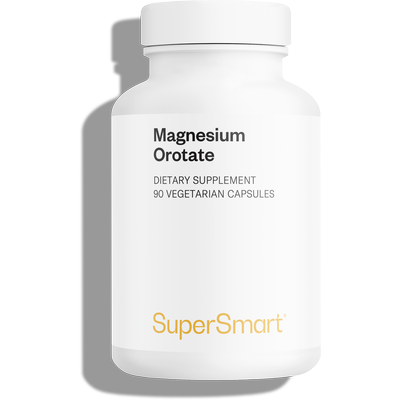
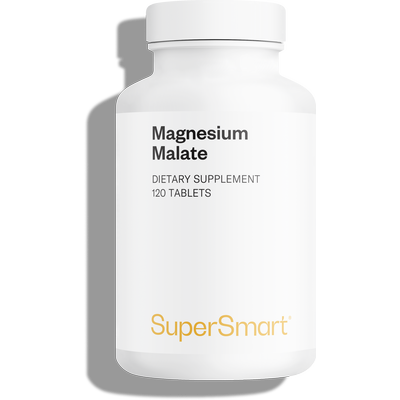
To increase your intake easily and effectively, you can also take magnesium supplements. Bear in mind, however, that not all forms are equal in terms of assimilation. The so-called chelated forms, which are linked to an organic molecule (amino acid, peptide, etc.), benefit from both better intestinal absorption and better digestive tolerance. Examples include magnesium malate and orotate (10).
 Discover Magnesium Orotate, which combines magnesium with orotic acid to facilitate its penetration into the heart of cells.
Magnesium Malate is coupled with malic acid, a powerful detoxifying agent.
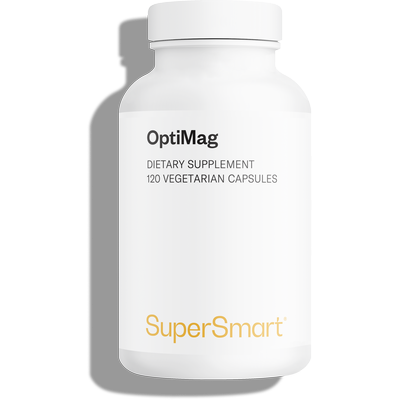
Another relevant option is to choose a synergistic formula, combining several forms with excellent bioavailability.
This is the case with OptiMag, with its 8 carefully selected forms of magnesium, which excludes the least bioavailable forms (oxide, hydroxide and carbonate).
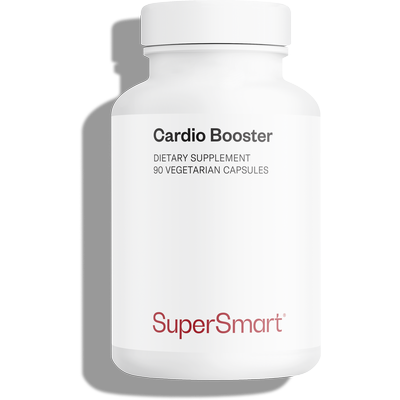
Finally, it is worth noting that some complexes enhance the benefits of magnesium with recognised cardioprotective substances, such as hawthorn (whose flavones support heart and vascular health) or potassium (which helps maintain normal blood pressure) (11-12).
Combining magnesium, potassium and hawthorn extract, the Cardio Booster synergy also contains taurine and CoQ10, which have been extensively studied in relation to heart function.
SUPERSMART ADVICE
References
- Siddiqui RW, Nishat SMH, Alzaabi AA, Alzaabi FM, Al Tarawneh DJ, Al Tarawneh YJ, Khan A, Khan MAM, Siddiqui TW, Siddiqui SW. The Connection Between Magnesium and Heart Health: Understanding Its Impact on Cardiovascular Wellness. Cureus. 2024 Oct 24;16(10):e72302. doi: 10.7759/cureus.72302. PMID: 39583450; PMCID: PMC11585403.
- Ahmed F, Mohammed A. Magnesium: The Forgotten Electrolyte-A Review on Hypomagnesemia. Med Sci (Basel). 2019 Apr 4;7(4):56. doi: 10.3390/medsci7040056. PMID: 30987399; PMCID: PMC6524065.
- Negru AG, Pastorcici A, Crisan S, Cismaru G, Popescu FG, Luca CT. The Role of Hypomagnesemia in Cardiac Arrhythmias: A Clinical Perspective. Biomedicines. 2022 Sep 21;10(10):2356. doi: 10.3390/biomedicines10102356. PMID: 36289616; PMCID: PMC9598104.
- Nielsen, F.H. The Role of Dietary Magnesium in Cardiovascular Disease. Nutrients 2024, 16, 4223. https://doi.org/10.3390/nu16234223
- DiNicolantonio JJ, O'Keefe JH, Wilson W. Subclinical magnesium deficiency: a principal driver of cardiovascular disease and a public health crisis. Open Heart. 2018 Jan 13;5(1):e000668. doi: 10.1136/openhrt-2017-000668. Erratum in: Open Heart. 2018 Apr 5;5(1):e000668corr1. doi: 10.1136/openhrt-2017-000668corr1. PMID: 29387426; PMCID: PMC5786912.
- Evers I, Cruijsen E, Kornaat I, Winkels RM, Busstra MC and Geleijnse JM (2022) Dietary magnesium and risk of cardiovascular and all-cause mortality after myocardial infarction: A prospective analysis in the Alpha Omega Cohort. Front. Cardiovasc. Med. 9:936772. doi: 10.3389/fcvm.2022.936772
- Zhen Yang, Ying Zhang, Jie Gao, Qiaoning Yang, Hua Qu, Junhe Shi, Association between dietary magnesium and 10-year risk of a first hard atherosclerotic cardiovascular disease event, The American Journal of the Medical Sciences, Volume 368, Issue 4, 2024, Pages 355-360, ISSN 0002-9629, https://doi.org/10.1016/j.amjms.2024.05.014
- Argeros Z, Xu X, Bhandari B, Harris K, Touyz RM, Schutte AE. Magnesium Supplementation and Blood Pressure: A Systematic Review and Meta-Analysis of Randomized Controlled Trials. Hypertension. 2025 Nov;82(11):1844-1856. doi: 10.1161/HYPERTENSIONAHA.125.25129. Epub 2025 Sep 26. PMID: 41000008; PMCID: PMC12529988.
- Vormann J. Magnesium: Nutrition and Homoeostasis. AIMS Public Health. 2016 May 23;3(2):329-340. doi: 10.3934/publichealth.2016.2.329. PMID: 29546166; PMCID: PMC5690358.
- Stepura OB, Martynow AI. Magnesium orotate in severe congestive heart failure (MACH). Int J Cardiol. 2009 May 1;134(1):145-7. doi: 10.1016/j.ijcard.2009.01.047. Erratum in: Int J Cardiol. 2009 May 1;134(1):144. Corrected and republished in: Int J Cardiol. 2009 Jan 9;131(2):293-5. doi: 10.1016/j.ijcard.2007.11.022. PMID: 19367681.
- Tassell MC, Kingston R, Gilroy D, Lehane M, Furey A. Hawthorn (Crataegus spp.) in the treatment of cardiovascular disease. Pharmacogn Rev. 2010 Jan;4(7):32-41. doi: 10.4103/0973-7847.65324. PMID: 22228939; PMCID: PMC3249900.
- Aburto NJ, Hanson S, Gutierrez H, Hooper L, Elliott P, Cappuccio FP. Effect of increased potassium intake on cardiovascular risk factors and disease: systematic review and meta-analyses. BMJ. 2013 Apr 3;346:f1378. doi: 10.1136/bmj.f1378. PMID: 23558164; PMCID: PMC4816263.
Keywords





16 Hours
Adequate info en hoge kwaliteit
Adequate info en hoge kwaliteit
HanS.
10 Days
Supplementen zijn goed.
Supplementen zijn goed. Zachte prijzen. Website met problemen ( altijd ) niet goed voor nieuwe klanten.
Gino RJ
19 Days
Alles op tijd geleverd.
Alles op tijd geleverd. De producten worden alsmaar duurder, terwijl mijn pensioen niet meer stijgt. Vandaar kan ik alsmaar minder vaak bestellen.
Wouters
1090 Days
Great service
Great service
Ryszard
1102 Days
Profesjonalna obsługa
Bardzo dobre i rzeczowe opisy. Profesjonalna obsługa.
PIEKOSZEWSKI Chris
1770 Days
Wszystko OK!
Wszystko poszło jak powinno 🙂
SITKIEWICZ Pawel
2557 Days
Szybko sprawnie bez problemów
Szybko sprawnie bez problemów
Marek
of experience
your money back
##montant## purchase
Bagaian G
12/02/2026
Thank you for information.
SuperSmart.com
12/02/2026
Hello Bagaian G,
Thank you very much for your message.
We’re glad you found the information helpful.
Have a great day,
The SuperSmart Team 💊🌿