
Testosterone: 5 foods to avoid to maintain hormonal balance
Food has a direct influence on hormones. Some seemingly innocuous choices can upset the balance and affect testosterone production without us realising it.


What is testosterone, and what role does it play in the body?
Testosterone is an essential steroid hormone. In men, it is involved in the development of muscle mass, libido, energy, bone density and overall vitality (1). Although its levels gradually decline with age, lifestyle can also play a major role in its production (diet, stress, sleep, physical activity, etc.).
Good to know: this article is aimed primarily at men, for whom testosterone plays a central role in hormonal balance. It is also present in women, but the mechanisms, issues and levers for action are different and may require a more specific approach.
5 types of food to avoid to maintain testosterone levels
By disrupting blood sugar levels, promoting inflammation, fat storage or the action of hormones, certain foods can create a less favourable environment for optimal testosterone production (2).
Here is a list of 5 categories of food whose negative effects can end up affecting hormonal balance if consumed too regularly.
1. Refined sugars and ultra-processed products
Refined sugars tend to cause repeated insulin spikes.
In the long term, this can encourage fat storage, particularly in the abdominal area.
Adipose tissue can convert some testosterone into oestrogen, which contributes to a reduction in its natural production (3).
At the same time, ultra-processed products can fuel background inflammation, which is not conducive to hormonal balance.
That's why we recommend limiting your daily consumption of this type of food.
2. Alcohol (in excess)
Excessive alcohol consumption tends to put a strain on the liver.
This organ, however, plays a key role in hormone metabolism.
Alcohol is also being studied for its negative impact on the hypothalamic-pituitary-gonadal hormonal axis, and could therefore reduce testicular testosterone production, while encouraging a relative increase in oestrogen (4).
3. Highly concentrated soya and its isolates
Soya contains isoflavones: phytoestrogens capable of interacting with hormone receptors (5).
For certain sensitive individuals, high consumption in the form of isolates or highly concentrated products can contribute to hormonal imbalance.
However, the impact of soya on the body depends above all on the quantity consumed and the form in which it is eaten.
If consumed occasionally in its traditional state, soya does not have the same effects as if it is used in concentrated or isolated form. It is the latter that can be the cause of certain risks of hormonal imbalance in men, particularly if consumed too regularly.
4. Trans fats and poor-quality refined oils
Trans fats and certain refined oils can promote chronic inflammation. They tend to alter the structure of cell membranes, which are essential for the synthesis of steroid hormones (6).
Over time, this inflammatory environment can slow down hormone production and impair cell signalling.
5. Foods rich in endocrine disruptors
Pesticide residues, additives, heavy metals and compounds from plastics can act as significant endocrine disruptors.
These substances can interfere with hormone receptors, increase oxidative stress and fuel systemic inflammation (7).
When this happens, the body struggles to maintain a stable hormonal balance, which has a direct impact on testosterone levels in the body.
Note: these factors can also influence female hormonal balance, although the mechanisms, issues and consequences differ depending on the physiological context.
What dietary choices encourage a more stable hormonal balance?
To achieve lasting hormonal balance, it's just as important to know which foods to eat on a daily basis.
Certain nutrients can play a driving role in testosterone production, more or less directly.
These include:
- quality proteins, which support hormone synthesis
- healthy fats, which play a role in the production of steroid hormones
- zinc, which helps to maintain normal levels of testosterone in the blood
- magnesium, which contributes to the normal functioning of the nervous system
- B-group vitamins, which contribute to a normal energy metabolism
In practice, it is therefore recommended to prioritise oily fish, eggs, green vegetables, nuts and seeds, low-sugar fruit and unrefined grains.
Food supplements and testosterone: what can be considered?
A drop in testosterone is not always pathological. It can also reflect general fatigue linked to stress, lack of sleep or age (8).
In some cases, a complementary approach may be considered. However, under no circumstances should this replace more in-depth medical advice.
Among the ingredients studied for their potential impact on testosterone production are:
- Tribulus terrestris, an herbaceous plant often included in the formulas of supplements dedicated to male vitality
- muira puma (Ptychopetalum olacoides), nicknamed 'banded wood', an Amazonian shrub used to support energy and tone in men
- zinc, which deserves special attention, especially when combined with other active ingredients in a synergistic formula
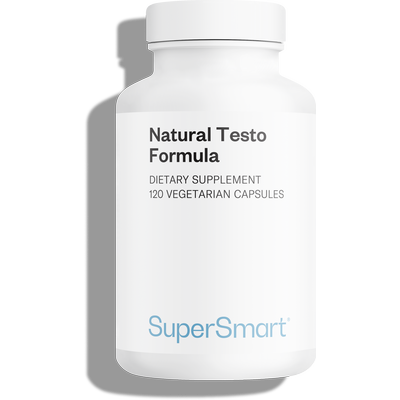
 Discover NaturalTesto Formula, a supplement based on the combination of these three natural ingredients, for a more structured nutritional approach.
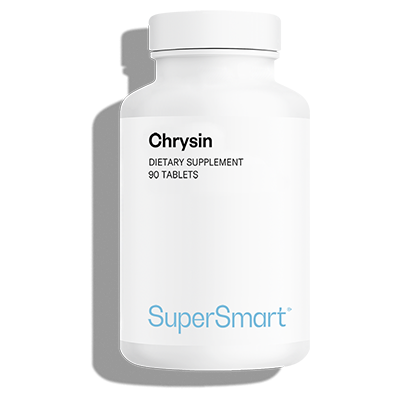
Finally, chrysin is a natural flavonoid currently under scientific study for its potential role in regulating hormonal balance in men, particularly in relation to aromatase activity.
Discover Chrysin, a dietary supplement made from chrysin, to be considered in the event of declining testosterone levels in mature men.
SUPERSMART ADVICE
References
- Nassar GN, Leslie SW. Physiology, Testosterone. 2023 Jan 2. In: StatPearls [Internet]. Treasure Island (FL): StatPearls Publishing; 2025 Jan–. PMID: 30252384.
- Giagulli VA, Castellana M, Murro I, Pelusi C, Guastamacchia E, Triggiani V, De Pergola G. The Role of Diet and Weight Loss in Improving Secondary Hypogonadism in Men with Obesity with or without Type 2 Diabetes Mellitus. Nutrients. 2019 Dec 5;11(12):2975. doi: 10.3390/nu11122975. PMID: 31817436; PMCID: PMC6950423.
- Hausman GJ, Barb CR. Adipose tissue and the reproductive axis: biological aspects. Endocr Dev. 2010;19:31-44. doi: 10.1159/000316895. Epub 2010 Jun 15. PMID: 20551666.
- Emanuele MA, Emanuele NV. Alcohol's effects on male reproduction. Alcohol Health Res World. 1998;22(3):195-201. PMID: 15706796; PMCID: PMC6761906.
- Cano A, García-Pérez MA, Tarín JJ. Isoflavones and cardiovascular disease. Maturitas. 2010 Nov;67(3):219-26. doi: 10.1016/j.maturitas.2010.07.015. Epub 2010 Aug 21. PMID: 20728290.
- MInguez-Alarcón L, Chavarro JE, Mendiola J, Roca M, Tanrikut C, Vioque J, Jørgensen N, Torres-Cantero AM. Fatty acid intake in relation to reproductive hormones and testicular volume among young healthy men. Asian J Androl. 2017 Mar-Apr;19(2):184-190. doi: 10.4103/1008-682X.190323. PMID: 27834316; PMCID: PMC5312216.
- Gore AC, Chappell VA, Fenton SE, Flaws JA, Nadal A, Prins GS, Toppari J, Zoeller RT. EDC-2: The Endocrine Society's Second Scientific Statement on Endocrine-Disrupting Chemicals. Endocr Rev. 2015 Dec;36(6):E1-E150. doi: 10.1210/er.2015-1010. Epub 2015 Nov 6. PMID: 26544531; PMCID: PMC4702494.
- Ohlsson C, Wallaschofski H, Lunetta KL, Stolk L, Perry JR, Koster A, Petersen AK, Eriksson J, Lehtimäki T, Huhtaniemi IT, Hammond GL, Maggio M, Coviello AD; EMAS Study Group; Ferrucci L, Heier M, Hofman A, Holliday KL, Jansson JO, Kähönen M, Karasik D, Karlsson MK, Kiel DP, Liu Y, Ljunggren O, Lorentzon M, Lyytikäinen LP, Meitinger T, Mellström D, Melzer D, Miljkovic I, Nauck M, Nilsson M, Penninx B, Pye SR, Vasan RS, Reincke M, Rivadeneira F, Tajar A, Teumer A, Uitterlinden AG, Ulloor J, Viikari J, Völker U, Völzke H, Wichmann HE, Wu TS, Zhuang WV, Ziv E, Wu FC, Raitakari O, Eriksson A, Bidlingmaier M, Harris TB, Murray A, de Jong FH, Murabito JM, Bhasin S, Vandenput L, Haring R. Genetic determinants of serum testosterone concentrations in men. PLoS Genet. 2011 Oct;7(10):e1002313. doi: 10.1371/journal.pgen.1002313. Epub 2011 Oct 6. PMID: 21998597; PMCID: PMC3188559.
Keywords




12 Hours
Puntulidad y eficacia
Puntulidad y eficacia
SOTELO PRESAS Jose
1 Days
Prodotti eccezionali
Prodotti eccezionali! Consegna rapida e precisa
paola
11 Days
Heldere info
Heldere info
HanS.
11 Days
Snelle levering
Snelle levering
harrie
17 Days
Adequate info en hoge kwaliteit
Adequate info en hoge kwaliteit
HanS.
27 Days
Supplementen zijn goed.
Supplementen zijn goed. Zachte prijzen. Website met problemen ( altijd ) niet goed voor nieuwe klanten.
Gino RJ
36 Days
Alles op tijd geleverd.
Alles op tijd geleverd. De producten worden alsmaar duurder, terwijl mijn pensioen niet meer stijgt. Vandaar kan ik alsmaar minder vaak bestellen.
Wouters
1106 Days
Great service
Great service
Ryszard
1119 Days
Profesjonalna obsługa
Bardzo dobre i rzeczowe opisy. Profesjonalna obsługa.
PIEKOSZEWSKI Chris
1787 Days
Wszystko OK!
Wszystko poszło jak powinno 🙂
SITKIEWICZ Pawel
2574 Days
Szybko sprawnie bez problemów
Szybko sprawnie bez problemów
Marek
of experience
your money back
##montant## purchase