
3 benefits of spirulina for weight loss
Spirulina is now one of the most popular superfoods for people seeking vitality and better weight management. Known for its exceptional nutritional richness, it has a number of weight-loss benefits.


What is spirulina, and why is there so much interest in it?
Spirulina (Spirulina Arthrospira platensis) is a freshwater cyanobacterium considered to be one of the oldest microorganisms on Earth.
A major source of nutrients, this microscopic algae is now considered a ‘superfood’.
Spirulina is particularly rich in plant proteins, phycocyanin (an antioxidant pigment), vitamins (A, B, E, K, etc.), iron, zinc, magnesium and beta-carotene.
Thanks to its composition, spirulina helps to:
- boost vitality, tone and energy
- combat oxidative stress and strengthen the body's natural defences (1)
- help control body weight and reduce feelings of hunger (2)
And these properties make spirulina a good support for weight loss and slimming.
The 3 benefits of spirulina for weight loss
Thanks to its satiety-enhancing effect, its complete nutritional profile and its support for the metabolism, spirulina is a particularly valuable superfood in a weight-loss programme.
1. A satiating effect thanks to its high protein content
Containing between 60 and 70% plant proteins, spirulina is one of the foods with the highest concentration of essential amino acids.
Protein is not just used to build and maintain muscle mass: it also plays a role in regulating satiety.
Studies have shown that adequate protein intake can help reduce appetite, in particular by influencing the secretion of certain hormones such as ghrelin (the hunger hormone) and peptide YY (the satiety hormone) (3-4).
So taking spirulina before a meal or as a snack can help reduce cravings and the urge to snack, while helping to maintain a moderate calorie intake.
2. A low-calorie nutritional concentrate
Spirulina's other major advantage is its high nutritional density, but very low calorie content (less than 300 kcal/100g).
A daily dose of 3 to 5 g provides:
- highly bio-available iron (invaluable in the case of vegetarian diets or fatigue)
- B-group vitamins essential for energy metabolism
- minerals and natural antioxidants (such as phycocyanin), which support cells against oxidative stress
Spirulina makes it easy to meet your nutritional needs, without increasing your calorie intake: an ideal benefit as part of a weight-loss programme, where the risk of deficiencies is higher.
3. Support for metabolism and energy
Weight loss is often accompanied by a loss of energy, especially when you're on a low-calorie diet or under stress.
This is where spirulina comes in, as it is known to boost energy and vitality thanks to:
- numerous vitamins involved in energy metabolism
- iron, which is involved in the normal transport of oxygen in the body and helps to reduce fatigue and exhaustion
Spirulina's flagship active ingredient, phycocyanin, is also known for its antioxidant and anti-inflammatory properties (5-6). It could have potential benefits in long-term weight management, by acting on the chronic low-grade inflammation associated with obesity (7).
How can spirulina be incorporated into a slimming programme?
Spirulina can be easily consumed in the form of food supplements. And for a stronger effect, it can be combined with other supplements that act on satiety, the microbiota or fat absorption.
Food and food supplements: which to choose?
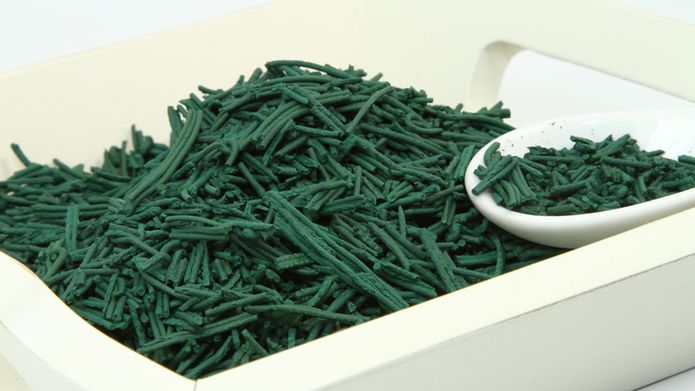
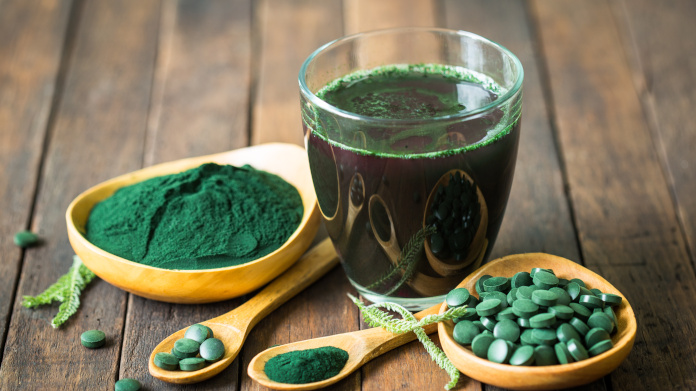
Spirulina comes in the form of powder or flakes, which can be added to food (in smoothies or yoghurts, preparations, sauces, etc.).
But it's not always easy to determine the right amount to take full advantage of its properties.
Targeted supplementation remains the most effective solution for taking full advantage of spirulina's weight-loss benefits.
Warning: spirulina is a cyanobacterium, so its quality is highly dependent on its origin and the conditions in which it is grown. Make sure you choose spirulina from controlled aquaculture, free from contaminants.
 Discover Spirulina, a natural spirulina extract of superior quality, guaranteeing the absence of pollutants such as heavy metals, bromine, radioactive compounds and other contaminants.
3 other useful supplements in a weight-loss programme
Spirulina can be incorporated into an overall weight-loss strategy, in synergy with other natural active ingredients.
Akkermansia muciniphila, a supporter of the microbiota
Akkermansia muciniphila is a bacterium naturally present in the intestinal flora.
Associated with improved regulation of energy metabolism and preservation of the intestinal barrier, it is being studied for its potential benefits in controlling weight and body fat (8-9).
Discover Akkermansia Muciniphila, an ideal probiotic to accompany your slimming regime.
Natural extracts to burn fat
When combined, certain spices and natural substances can effectively support weight loss.
Combining extracts of turmeric, moringa and Murraya koenigii, the patented Slendacor® complex, for example, shows positive effects on weight loss (10).
Discover Lipo Stop, a Slendacor® dietary supplement to reduce waist circumference by burning fat.
GLP-1 to support satiety
GLP-1 (glucagon-like peptide-1) is an intestinal hormone involved in satiety and blood sugar regulation (11).
Several plant extracts can naturally stimulate its secretion (12).
Discover GLP-1 Booster Formula, a natural supplement of plant extracts and chromium designed to stimulate GLP-1 production, reduce blood sugar levels, prevent cravings and lose weight.
SUPERSMART ADVICE
References
- Wu Q, Liu L, Miron A, Klímová B, Wan D, Kuča K. The antioxidant, immunomodulatory, and anti-inflammatory activities of Spirulina: an overview. Arch Toxicol. 2016 Aug;90(8):1817-40. doi: 10.1007/s00204-016-1744-5. Epub 2016 Jun 3. PMID: 27259333.
- DiNicolantonio JJ, Bhat AG, OKeefe J. Effects of spirulina on weight loss and blood lipids: a review. Open Heart. 2020 Mar 8;7(1):e001003. doi: 10.1136/openhrt-2018-001003. PMID: 32201580; PMCID: PMC7061888.
- de Carvalho KMB, Pizato N, Botelho PB, Dutra ES, Gonçalves VSS. Dietary protein and appetite sensations in individuals with overweight and obesity: a systematic review. Eur J Nutr. 2020 Sep;59(6):2317-2332. doi: 10.1007/s00394-020-02321-1. Epub 2020 Jul 10. PMID: 32648023.
- Belza A, Ritz C, Sørensen MQ, Holst JJ, Rehfeld JF, Astrup A. Contribution of gastroenteropancreatic appetite hormones to protein-induced satiety. Am J Clin Nutr. 2013 May;97(5):980-9. doi: 10.3945/ajcn.112.047563. Epub 2013 Mar 6. PMID: 23466396.
- Castro-Gerónimo VD, García-Rodríguez RV, Sánchez-Medina A, Chamorro-Cevallos GA, Sánchez-González DJ, Méndez-Bolaina E. C-Phycocyanin: A Phycobiliprotein from Spirulina with Metabolic Syndrome and Oxidative Stress Effects. J Med Food. 2024 Sep;27(9):807-813. doi: 10.1089/jmf.2022.0113. Epub 2023 Sep 1. PMID: 37668603.
- Liu R, Qin S, Li W. Phycocyanin: Anti-inflammatory effect and mechanism. Biomed Pharmacother. 2022 Sep;153:113362. doi: 10.1016/j.biopha.2022.113362. Epub 2022 Jul 14. PMID: 36076518.
- Firdaus M, Priambodo AF. Impact of Spirulina Supplementation on Obesity, Hypertension, Hyperglycemia, and Hyperlipidemia: A Systematic Review. Scientifica (Cairo). 2025 Mar 27;2025:6637793. doi: 10.1155/sci5/6637793. PMID: 40182955; PMCID: PMC11968159.
- Rodrigues VF, Elias-Oliveira J, Pereira ÍS, Pereira JA, Barbosa SC, Machado MSG, Carlos D. Akkermansia muciniphila and Gut Immune System: A Good Friendship That Attenuates Inflammatory Bowel Disease, Obesity, and Diabetes. Front Immunol. 2022 Jul 7;13:934695. doi: 10.3389/fimmu.2022.934695. PMID: 35874661; PMCID: PMC9300896.
- Depommier C, Everard A, Druart C, Plovier H, Van Hul M, Vieira-Silva S, Falony G, Raes J, Maiter D, Delzenne NM, de Barsy M, Loumaye A, Hermans MP, Thissen JP, de Vos WM, Cani PD. Supplementation with Akkermansia muciniphila in overweight and obese human volunteers: a proof-of-concept exploratory study. Nat Med. 2019 Jul;25(7):1096-1103. doi: 10.1038/s41591-019-0495-2. Epub 2019 Jul 1. PMID: 31263284; PMCID: PMC6699990.
- Dixit K, Kamath DV, Alluri KV, Davis BA. Efficacy of a novel herbal formulation for weight loss demonstrated in a 16-week randomized, double-blind, placebo-controlled clinical trial with healthy overweight adults. Diabetes Obes Metab. 2018 Nov;20(11):2633-2641. doi: 10.1111/dom.13443. Epub 2018 Jul 18. PMID: 29923305.
- Drucker DJ. Mechanisms of Action and Therapeutic Application of Glucagon-like Peptide-1. Cell Metab. 2018 Apr 3;27(4):740-756. doi: 10.1016/j.cmet.2018.03.001. PMID: 29617641.
- Delzenne NM, Cani PD, Neyrinck AM. Modulation of glucagon-like peptide 1 and energy metabolism by inulin and oligofructose: experimental data. J Nutr. 2007 Nov;137(11 Suppl):2547S-2551S. doi: 10.1093/jn/137.11.2547S. PMID: 17951500.




8 Days
I believe in the quality of the products
I believe in the quality of the products
Lucia Keme
18 Days
Thank you guys ,Real and Great Products…
Thank you guys ,Real and Great Products ,fast/tide and clean shipping .I definitly trust you and go for a montly subscription !!!
Mr Mircea Blaj
20 Days
Fast delivery
Fast delivery, no hassle
Trusted
24 Days
Great product
Great product, quick delivery
Jamal
27 Days
Very good helps me everytime
Very good helps me everytime
TAMMINEN Liis
29 Days
it helps a lot on digestion
it helps a lot on digestion
Elisa Fleury
35 Days
Super fast delivery
Super fast delivery. Trying flexismart at the moment, Maybe a bit too soon to see results bit nice tolérance so far.
Maria Angeles Verdu
35 Days
Good service
Supersmart are an efficient company - the order arrived quickly. This is usual for them, though they have occasionally been let down by delivery firms - not a surprise and not their fault.
Barry Humphries
36 Days
Excellent product
Excellent product, quick delivery
FERENCNE Soros
38 Days
High quality, reliable service!
I have been ordering their products for years! They are excellent quality. And despite the international shipping, my order allways arrived pretty fast. The loyalty program is very fair, I get great prices on the products. Imagine: my specialists are asking me what have I been taking that my counts are so good!
Petra Hruskova
39 Days
I purchased Melatonin
I purchased Melatonin, very quick delivery to the UK and product is perfect. Very Happy
Dean Harriss
41 Days
Avis général
Well boxes are white but that puts a bit of serious color for my grey matter. Supersmart is quality products and made myself a pharmacy. Honestly should be remboursed by the health institutes selling pills
LEBORDAIS Thomas
42 Days
Arrives in just five days even to Japan…
Arrives in just five days even to Japan – that’s insanely fast! Amazing lineup of innovative products.
namio
45 Days
Quality and choice of supplements.
Quality and choice of supplements.
Maja
49 Days
perfect great
perfect great
igor janic
of experience
your money back
##montant## purchase