
Histamine intolerance: a study tests dedicated diets
A low-histamine diet is sometimes recommended in cases of intolerance to this molecule. But does this dietary approach have a proven biological impact? A recent scientific study has examined this question.


What is histamine, and what are the key mechanisms of intolerance?
Histamine in a nutshell
Histamine is a biogenic amine, a molecule naturally present in our bodies, where it is produced from the amino acid histidine (1).
This compound is essential for many vital physiological functions, such as neurotransmission, digestion (regulation of gastric acidity) and the immune response (2).
Histamine is also present in varying quantities in many foods.
Unlike the molecule produced by our body, whose synthesis is regulated according to actual needs, the one produced by food must be broken down by our body to avoid overload.
It is DAO (diamine oxidase), a digestive enzyme, which carries out this breakdown in order to neutralise the excess histamine before it causes symptoms.
Causes and symptoms of histamine intolerance
Histamine intolerance (HIT) results from an imbalance between the amount of histamine that accumulates in the body and the body's ability to metabolise it.
It manifests itself as the symptoms of an allergic reaction without actually being one (3). This is known as a pseudo-allergic reaction.
The main reason for this accumulation is a functional deficiency in diamine oxidase (DAO), which allows dietary histamine to pass the intestinal barrier and enter the bloodstream, where it can activate histamine receptors.
The symptoms of histamine intolerance are highly varied and non-specific, making diagnosis difficult and often delayed.
This is partly due to the fact that histamine receptors (H1, H2, H3 and H4) are found throughout the body.
Commonly reported symptoms include (4-5):
- digestive symptoms: diarrhoea, bloating, nausea, vomiting, abdominal pain and cramps. These symptoms are frequently associated with irritable bowel syndrome, which can make the diagnosis particularly challenging
- skin symptoms: sudden flushing, hives, itching or even psoriasis flare-ups
- neurological symptoms: headaches, migraines, dizziness, anxiety and chronic fatigue
- cardiovascular symptoms: low blood pressure, arrhythmias and palpitations
Managing symptoms through diet: the histamine avoidance diet
The dietary approach (in particular through an avoidance diet) is potentially an important element to take into account when managing histamine intolerance.
The aim of this type of diet is to limit the histamine load, with the aim of reducing symptoms.
This approach therefore focuses on eliminating foods that are naturally rich in histamine or that may interfere with the function of the DAO enzyme.
| Foods rich in histamine or DAO inhibitors to avoid | Preferred (low-risk) alternatives |
|---|---|
| Long-ripening cheeses (Emmental, Parmesan, Camembert) | fromage frais, cottage cheese |
| Cold meats, smoked meats (salami, cured ham), tuna, mackerel, sardines | Very fresh or deep-frozen meat and fish (chicken, turkey, cod) |
| Fermented foods (sauerkraut, soy sauce, kombucha) | Fresh vegetables (courgettes, broccoli, carrots) |
| Wine, beer, Champagne (powerful DAO inhibitors) | Water, herbal teas |
| Dried fruit, over-ripe or acidic fruit (citrus fruit, strawberries, pineapple) | Apples, pears, blueberries, watermelon, melon |
| Cocoa and chocolate | Unfermented wholegrain cereals (rice, millet, quinoa) or carob |
| Spinach, tomatoes, aubergine | Potatoes, carrots, pumpkin |
New research on the avoidance diet: its effect on DAO enzyme levels
A clinical study with well-defined objectives
A clinical study conducted in 2024 (7) closely examined the efficacy of the low-histamine diet in intolerant patients.
This research compared the efficacy of a strictly low-histamine diet with a conventional diet in patients diagnosed with intolerance.
One of the most innovative aspects of this study was the measurement of serum levels of the enzyme DAO in participants in both groups to determine whether the diet had an effect on the body's production of this enzyme.
Results and conclusions on the action of DAO
This study shows that the effectiveness of an avoidance diet is not based on an increase in the body's production of the enzyme, but simply on a reduction in the quantity of histamine to be managed.
By limiting histamine intake, the workload on the underproduced DAO enzyme is reduced. This allows the body to function without being overwhelmed, thereby reducing cutaneous and gastrointestinal symptoms.
This scientific discovery reinforces the principle that diet control is a fundamental pillar of intolerance management, as it is not possible to rely on altering enzyme levels by this means alone.
Please note: serum DAO levels do not necessarily reflect intestinal activity of the enzyme.
What are the biological mechanisms of DAO?
Role of DAO and possible causes of a deficiency
Diamine oxidase is an oxidoreductase that acts as a shield against histamine from food.
This enzyme is mainly produced in the intestinal mucosa, where it acts as the first line of defence, preventing exogenous histamine from being absorbed and entering the bloodstream.
A deficiency in this enzyme may be genetic in origin, which explains why intolerance may run in certain families.
Other factors can also modulate its activity or increase the histamine load, such as stress, which releases endogenous histamine via mast cells, or hormonal imbalances, particularly oestrogen dominance (8).
These factors explain why the symptoms of intolerance can fluctuate, even with a controlled diet.
How should DAO deficiency be managed?
The management of DAO deficiency relies primarily on reducing histamine intake through the diet.
However, this may not be sufficient for some people, or may be too restrictive.
This is why there are now dietary supplements based on diamine oxidase. While most of the products available on the market are formulated using pork kidney, there are also vegan alternatives.
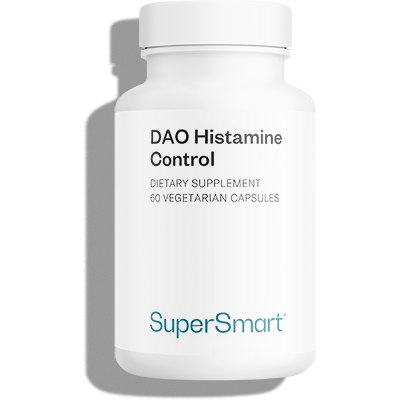
 Discover the DAO Histamine Control food supplement, based on vegan DAO extracted from pea germ, and enriched with quercetin and vitamin C.
SUPERSMART ADVICE
References
- Durak-Dados, A., Michalski, M., & Osek, J. (2020). Histamine and Other Biogenic Amines in Food. Journal of Veterinary Research, 64(2), 281-288. https://pmc.ncbi.nlm.nih.gov/articles/PMC7305651/
- Spires, D. R., Hernández deValle, J., Marrelli, S. P., & Ortiz-Vazquez, S. C. (2023). Renal histaminergic system and acute effects of histamine receptor 2 blockade on renal damage in the Dahl salt-sensitive rat. Frontiers in Pharmacology. https://pmc.ncbi.nlm.nih.gov/articles/PMC10511172/
- Zhao, Y., Zhang, X., Jin, H., Chen, L., & Wang, W. (2022). Histamine Intolerance — A Kind of Pseudoallergic Reaction. Biomolecules, 12(6), 852. https://pmc.ncbi.nlm.nih.gov/articles/PMC8945898/
- Jochum, C., et al. (2024). Histamine Intolerance: Symptoms, Diagnosis, and Beyond. MDPI (Basel, Switzerland). https://pmc.ncbi.nlm.nih.gov/articles/PMC11054089/
- Comas-Basté, O., Sánchez-Pérez, S., Veciana-Nogués, M. T., Latorre-Moratalla, M. L., & Vidal-Carou, M. C. (2020). Histamine Intolerance: The Current State of the Art. Biomolecules, 10(8), 1181. https://pmc.ncbi.nlm.nih.gov/articles/PMC7463562/
- Jochum, C., et al. (2024). Histamine Intolerance: Symptoms, Diagnosis, and Beyond. MDPI (Basel, Switzerland). https://pmc.ncbi.nlm.nih.gov/articles/PMC11054089/
- Rentzos, G., Weisheit, A., Ekerljung, L., & van Odijk, J. (2024). Measurement of diamine oxidase (DAO) during low-histamine or ordinary diet in patients with histamine intolerance. European Journal of Clinical Nutrition, 78(8), 726-731. https://pmc.ncbi.nlm.nih.gov/articles/PMC11300302/
- Comas-Basté, O., Sánchez-Pérez, S., Veciana-Nogués, M. T., Latorre-Moratalla, M. L., & Vidal-Carou, M. C. (2020). Histamine Intolerance: The Current State of the Art. Biomolecules, 10(8), 1181.https://pmc.ncbi.nlm.nih.gov/articles/PMC7463562/
Keywords




3 Days
Adequate info en hoge kwaliteit
Adequate info en hoge kwaliteit
HanS.
13 Days
Supplementen zijn goed.
Supplementen zijn goed. Zachte prijzen. Website met problemen ( altijd ) niet goed voor nieuwe klanten.
Gino RJ
22 Days
Alles op tijd geleverd.
Alles op tijd geleverd. De producten worden alsmaar duurder, terwijl mijn pensioen niet meer stijgt. Vandaar kan ik alsmaar minder vaak bestellen.
Wouters
1092 Days
Great service
Great service
Ryszard
1105 Days
Profesjonalna obsługa
Bardzo dobre i rzeczowe opisy. Profesjonalna obsługa.
PIEKOSZEWSKI Chris
1773 Days
Wszystko OK!
Wszystko poszło jak powinno 🙂
SITKIEWICZ Pawel
2560 Days
Szybko sprawnie bez problemów
Szybko sprawnie bez problemów
Marek
of experience
your money back
##montant## purchase