
Spore-forming probiotics: the secret of their unique effectiveness
With their specific way of working, spore-forming probiotics have a very specific mechanism of action that gives them some very interesting properties, which are now being studied by scientists.

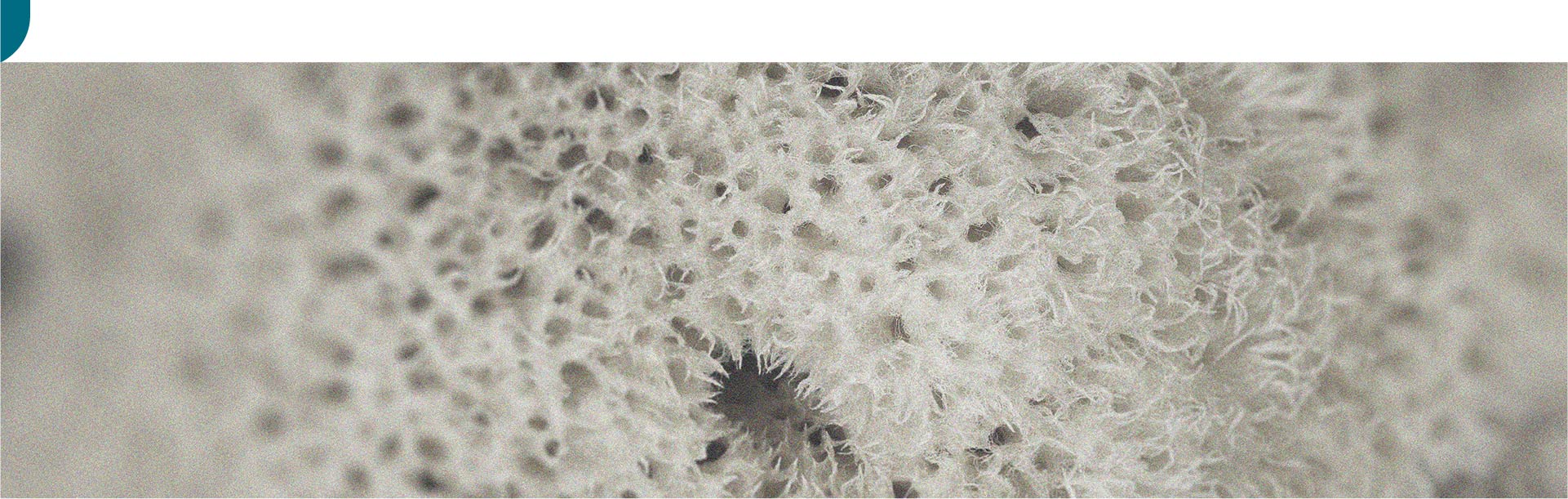
Probiotics like no other
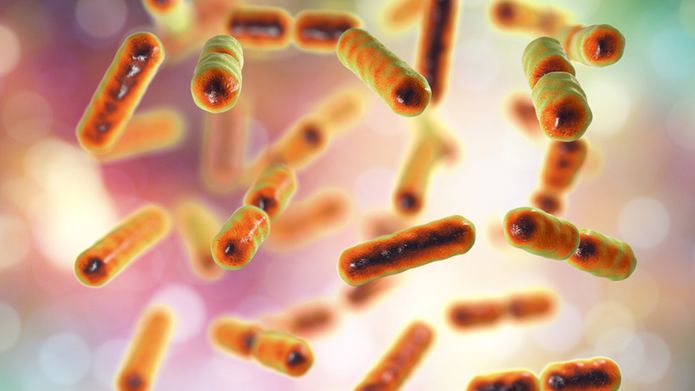
Sporulated probiotics are distinguished from ‘classic’ probiotics by their unique ability to go into ‘survival mode' in a hostile environment (heat, acidity, lack of food, etc.).
Unlike most probiotics, which are live when ingested, spore-forming probiotics transform into spores, a tiny, highly resistant form, as if the bacteria had encased themselves in a protective shell.
In this form, the bacteria can remain dormant, i.e. inactive. This dormancy enables them to survive difficult storage conditions and, crucially, gastric acidity when ingested.
Once they arrive in a favourable environment, such as the colon, they 'wake up' to their active form and once again become living bacteria capable of acting on the intestinal microbiota (1-2).
This unique advantage makes them more stable and effective than live probiotics, which are partially destroyed by gastric acid and only reach the intestines in reduced quantities.
They are found naturally in certain fermented foods (Japanese natto, fermented rice and vegetables, some sourdough breads, fermented drinks, etc.). Today, however, they are most commonly found in the form of food supplements.
These are practical to use (no need for refrigerated storage for most spore-forming strains), survive better in the intestine and have a targeted action, since activation only takes place in the right place.
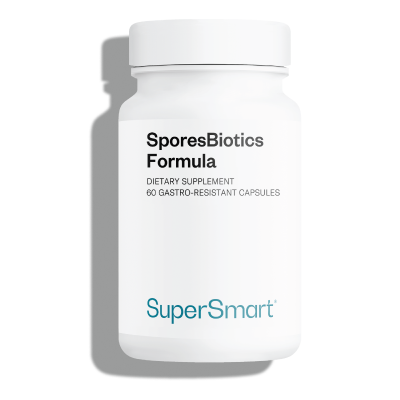
 Discover the SporesBiotics Formula food supplement, a synergy of spore-forming strains selected to support the balance of the intestinal microbiota.
Studied effects on the intestinal microbiota and beyond
Sporulated probiotics and digestive balance
Recent scientific research shows that spore-forming probiotics, such as Bacillus subtilis, Bacillus clausii (or Alkalihalobacillus clausii) and Bacillus coagulans (or Heyndrickxia coagulans), can favourably influence the composition of the intestinal microbiota (3).
By strengthening the digestive balance, these bacteria are thought to contribute to more harmonious intestinal functioning.
For example, Bacillus clausii is being studied in particular for its ability to support the reconstruction of the microbiota after a disturbance, particularly following antibiotic treatment, especially as it is itself resistant to antibiotics (4).
For its part, Bacillus subtilis has been studied for its ability to stimulate certain intestinal defence mechanisms, thereby strengthening the digestive barrier and its interaction with immunity (6).
What's more, a diverse and stable microbiota doesn't just play a role in digestion. It interacts with numerous processes in the body, from the production of vitamins to the modulation of certain metabolic and immune responses.
Some studies have also observed the impact of taking spore-forming probiotics beyond the digestive system.
Potential support for immunity
Several strains appear to have the capacity to modulate the immune response, thereby contributing to better defence against infections and external aggressors.
Studies have looked at the effects of Bacillus subtilis, highlighting that this strain could help inhibit the growth of pathogenic microorganisms, thanks to its natural antibacterial properties (6-7).
Effects on lipid balance?
A fairly recent study also showed a potential effect of a mixture of spore-forming probiotics, containing strains of Bacillus subtilis and Bacillus coagulans, on lipid balance (8).
Research indicates that Bacillus coagulans may promote the production of digestive enzymes and organic acids, thereby improving nutrient absorption (9-10).
This metabolic action could have wider repercussions. It would explain the findings of one clinical trial, which revealed an effect on specific lipid profile parameters linked to the regulation of cholesterol and triglycerides (11).
These results suggest new avenues of research into the regulation of blood lipids.
Sporulated bacteria and skin health
The effects of spore-forming probiotics do not appear to be limited to digestion or metabolism.
A recent clinical trial showed an improvement in the appearance of the skin in acne sufferers after supplementation with spore-forming probiotics (12).
The hypothesis is that rebalancing the gut microbiota could indirectly influence skin health, in what researchers are now calling the gut-skin axis.
These results open up interesting prospects, but still need to be confirmed by larger clinical trials. For the moment, what we do know is that this type of probiotic supports the balance of the intestinal microbiota.
Simple supplementation and interesting applications for the future
Taking spore-forming probiotics is generally well tolerated and fairly simple to administer, since the products used do not require any special storage conditions.
Today, research is exploring new applications in various areas of health (13):
- the possibility of combining spore strains and specific prebiotics to encourage the production of beneficial metabolites, such as butyrate, and to modulate the microbiota in a targeted way
- potential effects on lipid and glycaemic profiles via action on nutrient metabolism
- the use of inactivated strains (postbiotics) as an alternative or complement to live probiotics
- relief of mild functional digestive disorders such as bloating, gas and abdominal discomfort
- modulation of immunity thanks to a supposed action on the immune system
Today, it is possible to take advantage of the specific effects of certain isolated strains by supplementation.
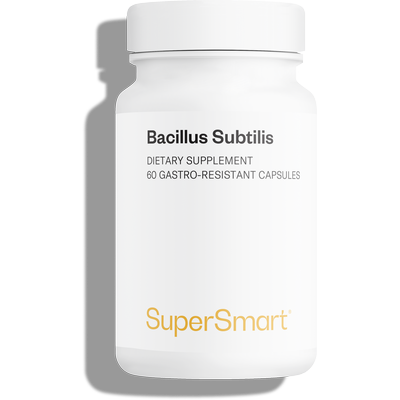
For example, if you want to support the balance of your intestinal microbiota while benefiting from a potential effect on immunity, you could opt for the Bacillus subtilis strain.
Discover the Bacillus Subtilis food supplement, with its studied effects on digestive balance and immunity.
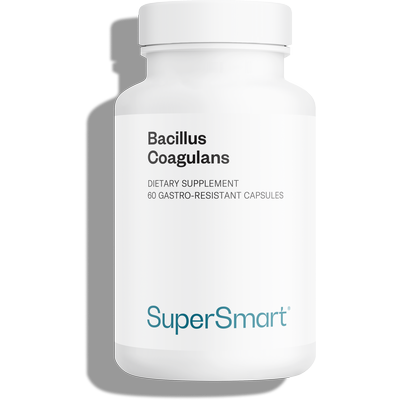
If you want to test a probiotic studied for its specific effects on bacterial growth and the immune system, you might consider the Bacillus coagulans strain.
Discover the Bacillus Coagulans food supplement, a spore-forming bacterium with a broad spectrum of action.
You can also combine the benefits of several spore-forming probiotics by using a product made up of several species.
Discover the synergistic SporesBiotics Formula, which combines several spore-forming strains for complementary action.
SUPERSMART ADVICE
References
- Cho WI, Chung MS. Bacillusspores: a review of their properties and inactivation processing technologies. Food Sci Biotechnol. 2020 Oct 6;29(11):1447-1461. doi: 10.1007/s10068-020-00809-4. PMID: 33041624; PMCID: PMC7538368.
- Majeed M, Majeed S, Arumugam S, Ali F, Beede K. Comparative evaluation for thermostability and gastrointestinal survival of probiotic Bacillus coagulans MTCC 5856. Biosci Biotechnol Biochem. 2021 Mar 24;85(4):962-971. doi: 10.1093/bbb/zbaa116. PMID: 33580694.
- Mazkour S, Shekarforoush SS, Basiri S. The effects of supplementation of Bacillus subtilisand Bacillus coagulans spores on the intestinal microflora and growth performance in rat. Iran J Microbiol. 2019 Jun;11(3):260-266. PMID: 31523411; PMCID: PMC6711872.
- Pirozzi C, Opallo N, Coretti L, Lama A, Annunziata C, Comella F, Melini S, Buommino E, Mollica MP, Aviello G, Mattace Raso G, Lembo F, Meli R. Alkalihalobacillus clausii (formerly Bacillus clausii) spores lessen antibiotic-induced intestinal injury and reshape gut microbiota composition in mice. Biomed Pharmacother. 2023 Jul;163:114860. doi: 10.1016/j.biopha.2023.114860. Epub 2023 May 15. PMID: 37196540.
- Rhayat L, Maresca M, Nicoletti C, Perrier J, Brinch KS, Christian S, Devillard E and Eckhardt E (2019) Effect of Bacillus subtilis Strains on Intestinal Barrier Function and Inflammatory Response. Front. Immunol. 10:564. doi: 10.3389/fimmu.2019.00564
- Jung HS, Lee HW, Kim KT, Lee NK, Paik HD. Anti-inflammatory, antioxidant effects, and antimicrobial effect of Bacillus subtilis P223. Food Sci Biotechnol. 2023 Nov 1;33(9):2179-2187. doi: 10.1007/s10068-023-01445-4. PMID: 39130667; PMCID: PMC11315835.
- Mazkour S, Shekarforoush SS, Basiri S. The effects of supplementation of Bacillus subtilis and Bacillus coagulans spores on the intestinal microflora and growth performance in rat. Iran J Microbiol. 2019 Jun;11(3):260-266. PMID: 31523411; PMCID: PMC6711872.
- Campbell AW, Sinatra D, Zhang Z, Sinatra ST. Efficacy of Spore Forming Bacilli Supplementation in Patients with Mild to Moderate Elevation of Triglycerides: A 12 week, Randomized, Double-Blind, Placebo Controlled Trial. Integr Med (Encinitas). 2020 Apr;19(2):22-27. PMID: 33041703; PMCID: PMC7482325.
- Majeed M, Nagabhushanam K, Paulose S, Arumugam S, Mundkur L. The effects of Bacillus coagulans MTCC 5856 on functional gas and bloating in adults: A randomized, double-blind, placebo-controlled study. Medicine (Baltimore). 2023 Mar 3;102(9):e33109. doi: 10.1097/MD.0000000000033109. PMID: 36862903; PMCID: PMC9982755.
- Jäger R, Purpura M, Farmer S, Cash HA, Keller D. Probiotic Bacillus coagulans GBI-30, 6086 Improves Protein Absorption and Utilization. Probiotics Antimicrob Proteins. 2018 Dec;10(4):611-615. doi: 10.1007/s12602-017-9354-y. PMID: 29196920; PMCID: PMC6208742.
- Kallur RK, Madapati S, Banerjee M, Mathur A, Bhattacharya S. Evaluation of Bacillus coagulansLMG S-31876 for immunomodulation and stress: a double-blind, placebo-controlled clinical trial. Front Nutr. 2025 Jan 15;11:1484499. doi: 10.3389/fnut.2024.1484499. PMID: 39882040; PMCID: PMC11774721.
- Rybak I, Haas KN, Dhaliwal SK, Burney WA, Pourang A, Sandhu SS, Maloh J, Newman JW, Crawford R, Sivamani RK. Prospective Placebo-Controlled Assessment of Spore-Based Probiotic Supplementation on Sebum Production, Skin Barrier Function, and Acne. J Clin Med. 2023 Jan 23;12(3):895. doi: 10.3390/jcm12030895. PMID: 36769543; PMCID: PMC9918080.
- Williams, N.; Weir, T.L. Spore-Based Probiotic Bacillus subtilis: Current Applications in Humans and Future Perspectives. Fermentation 2024, 10, 78. https://doi.org/10.3390/fermentation10020078.
Keywords



7 Days
Prodotti eccezionali
Prodotti eccezionali! Consegna rapida e precisa
paola
18 Days
Heldere info
Heldere info
HanS.
18 Days
Snelle levering
Snelle levering
harrie
23 Days
Adequate info en hoge kwaliteit
Adequate info en hoge kwaliteit
HanS.
33 Days
Supplementen zijn goed.
Supplementen zijn goed. Zachte prijzen. Website met problemen ( altijd ) niet goed voor nieuwe klanten.
Gino RJ
42 Days
Alles op tijd geleverd.
Alles op tijd geleverd. De producten worden alsmaar duurder, terwijl mijn pensioen niet meer stijgt. Vandaar kan ik alsmaar minder vaak bestellen.
Wouters
1112 Days
Great service
Great service
Ryszard
1125 Days
Profesjonalna obsługa
Bardzo dobre i rzeczowe opisy. Profesjonalna obsługa.
PIEKOSZEWSKI Chris
1793 Days
Wszystko OK!
Wszystko poszło jak powinno 🙂
SITKIEWICZ Pawel
2580 Days
Szybko sprawnie bez problemów
Szybko sprawnie bez problemów
Marek
of experience
your money back
##montant## purchase