
Osteoarthritis and diet: what to eat to protect your joints
Diet can influence the biological mechanisms involved in joint pain and mobility. Eating certain foods can help to keep your joints comfortable, without replacing medical treatment.

What is osteoarthritis, and how does it develop?
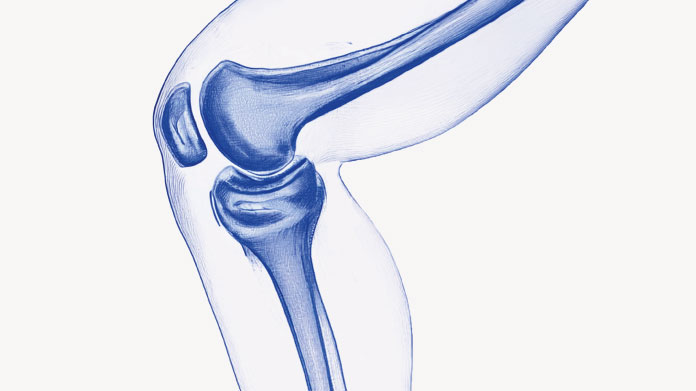
Osteoarthritis is a chronic joint disorder characterised by a progressive deterioration in bone cartilage.
This smooth tissue covers the ends of the bones and facilitates movement by helping the bones to slide over each other within the same joint.
Cartilage acts as a shock absorber. Thanks to its flexibility and very smooth surface, it distributes mechanical pressure and limits friction during movement.
Unfortunately, over time, it can lose its flexibility and thickness, altering its protective function and compromising bone health.
This progressive degeneration encourages microtrauma, local inflammation and joint stiffness.
The joints most affected are generally those that are subject to the greatest stress, i.e. the knees, hips, hands, spine and shoulders (1).
The best-known risk factors for osteoarthritis include:
- age, associated with cellular ageing
- excess weight, which increases the load on the joints
- repeated mechanical stress linked to certain physical or professional activities
- genetic predisposition, which influences cartilage quality
Osteoarthritis and diet: undeniable links
The influence of diet on chronic inflammation
Chronic low-grade inflammation is a central factor in the development of joint disorders (2).
In particular, it sustains the progressive degradation of cartilage and impairs the quality of synovial fluid, which is essential for lubricating joints.
An unbalanced diet, rich in refined sugars, saturated fats and ultra-processed foods, could encourage this type of inflammation.
Conversely, adopting an anti-inflammatory diet, rich in sources of omega-3 and antioxidants, can help limit the activation of inflammatory pathways.
The impact of oxidative stress on cartilage degradation
Oxidative stress is caused by the excessive production of free radicals, which are capable of damaging the body's various cells.
In the joints, they accelerate the ageing of cartilage and disrupt the regeneration of chondrocytes, the cells that compose it.
They could also weaken collagen fibres, which are essential for maintaining the integrity and strength of bone cartilage (3).
This phenomenon, engendered by various factors such as age or exposure to pollution, can also be caused by nutritional imbalances, in particular by a diet too low in fruit and vegetables, sources of antioxidants.
Nutrients contributing to the formation of bone cartilage
The integrity of cartilage is based on a complex extracellular matrix composed of different elements (4).
Collagen provides the structural framework, while glycosaminoglycans such as hyaluronic acid and chondroitin ensure hydration and resistance to compression.
It is therefore important to supply the body with the amino acids it needs to synthesise these molecules.
Certain minerals, such as calcium, magnesium, zinc and manganese, are also involved in bone and cartilage strength.
The links between excess weight and joint disorders
Being overweight, and even more so obesity, puts a great deal of mechanical stress on weight-bearing joints such as the hips, knees and ankles.
This overload accelerates the wear and tear of cartilage and encourages the onset of joint pain.
At the same time, adipose tissue (i.e. body fat) acts as an endocrine organ. It releases pro-inflammatory cytokines that can amplify general inflammation in the body (5).
This dual mechanical and metabolic action maintains a vicious circle. Pain limits physical activity, which encourages weight gain and worsens the joint burden.
A balanced diet contributes to weight management and the maintenance of a metabolism more favourable to joint health.
Intestinal flora and joint inflammation: what we know
The intestinal microbiota plays a central role in regulating immunity. In fact, its balance has a direct influence on systemic inflammation.
A modern diet, low in fibre and high in processed products, alters this flora.
Imbalances in the intestinal microbiota can be associated with increased intestinal permeability and inflammatory phenomena.
This phenomenon thus sustains chronic low-grade inflammation, which can affect joint tissue (6).
Osteoarthritis and diet: what should we eat to maintain joint comfort?
A balanced diet, aimed at limiting inflammation and supporting joint tissue, includes:
- oily fish, rich in omega-3 fatty acids
- spices such as turmeric and ginger, which provide bioactive compounds involved in modulating oxidation and inflammation
- red berries and colourful vegetables, which are sources of antioxidants, particularly polyphenols
- vegetable oils rich in unsaturated fatty acids, such as virgin olive oil
- green vegetables rich in minerals and fibre
- seeds and legumes, sources of fibre, vegetable proteins and minerals
- fermented dairy products (yoghurt, fromage frais, fermented milk), sources of probiotics that support a balanced intestinal microbiota
At the same time, certain products should be consumed in moderation to avoid aggravating inflammation:
- sugar, which is responsible for glycaemic peaks and inflammation
- ultra-processed products, which are low in protective nutrients
- cold meats, fatty meats and fried foods, which encourage weight gain
- excess alcohol, which is pro-oxidant and pro-inflammatory
- oils rich in industrially-produced omega-6s, which promote lipid imbalance
And what about food supplements?
Although a varied and balanced diet is the basis of good joint comfort, certain situations justify a targeted intake of specific nutrients, as part of an overall approach to well-being.
Dietary supplements can therefore provide support, without ever replacing medical advice.
This type of formula generally aims to support joint mobility, tissue resistance and the management of chronic inflammation.
It often contains collagen, a key component in the structure of cartilage and connective tissue.
PEA, for its part, is an interesting compound in this type of formula, as it is found naturally in our bodies, where it helps to modulate inflammation.
Rich in bioactive compounds, ginger can also help soothe inflammatory reactions.
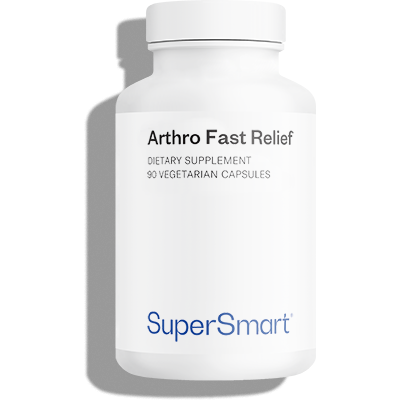
 Discover Arthro Fast Relief, a dietary supplement containing patented, clinically validated collagen and PEA, plus Ferzinger® ginger extract, for a 2-in-1 action (rapid soothing & support for cartilage structure).
SUPERSMART ADVICE
References
- Loeser RF, Goldring SR, Scanzello CR, Goldring MB. Osteoarthritis: a disease of the joint as an organ. Arthritis Rheum. 2012 Jun;64(6):1697-707. doi: 10.1002/art.34453. Epub 2012 Mar 5. PMID: 22392533; PMCID: PMC3366018.
- Sachdeva M, Aggarwal A, Sharma R, Randhawa A, Sahni D, Jacob J, Sharma V, Aggarwal A. Chronic inflammation during osteoarthritis is associated with an increased expression of CD161 during advanced stage. Scand J Immunol. 2019 Jul;90(1):e12770. doi: 10.1111/sji.12770. Epub 2019 May 14. PMID: 31017304.
- Zahan OM, Serban O, Gherman C, Fodor D. The evaluation of oxidative stress in osteoarthritis. Med Pharm Rep. 2020 Jan;93(1):12-22. doi: 10.15386/mpr-1422. Epub 2020 Jan 31. PMID: 32133442; PMCID: PMC7051818.
- Sophia Fox AJ, Bedi A, Rodeo SA. The basic science of articular cartilage: structure, composition, and function. Sports Health. 2009 Nov;1(6):461-8. doi: 10.1177/1941738109350438. PMID: 23015907; PMCID: PMC3445147.
- King LK, March L, Anandacoomarasamy A. Obesity & osteoarthritis. Indian J Med Res. 2013;138(2):185-93. PMID: 24056594; PMCID: PMC3788203.
- Marchese L, Contartese D, Giavaresi G, Di Sarno L, Salamanna F. The Complex Interplay between the Gut Microbiome and Osteoarthritis: A Systematic Review on Potential Correlations and Therapeutic Approaches. Int J Mol Sci. 2023 Dec 21;25(1):143. doi: 10.3390/ijms25010143. PMID: 38203314; PMCID: PMC10778637.
Keywords




6 Days
Prodotti eccezionali
Prodotti eccezionali! Consegna rapida e precisa
paola
17 Days
Heldere info
Heldere info
HanS.
17 Days
Snelle levering
Snelle levering
harrie
22 Days
Adequate info en hoge kwaliteit
Adequate info en hoge kwaliteit
HanS.
32 Days
Supplementen zijn goed.
Supplementen zijn goed. Zachte prijzen. Website met problemen ( altijd ) niet goed voor nieuwe klanten.
Gino RJ
42 Days
Alles op tijd geleverd.
Alles op tijd geleverd. De producten worden alsmaar duurder, terwijl mijn pensioen niet meer stijgt. Vandaar kan ik alsmaar minder vaak bestellen.
Wouters
1112 Days
Great service
Great service
Ryszard
1124 Days
Profesjonalna obsługa
Bardzo dobre i rzeczowe opisy. Profesjonalna obsługa.
PIEKOSZEWSKI Chris
1793 Days
Wszystko OK!
Wszystko poszło jak powinno 🙂
SITKIEWICZ Pawel
2580 Days
Szybko sprawnie bez problemów
Szybko sprawnie bez problemów
Marek
of experience
your money back
##montant## purchase