
Cranberry capsules and urinary tract infection: what's in it for me?
Cranberry capsules are often associated with urinary comfort. But what do we really know about their link with urinary tract infections? What does science have to say? And how can you make sense of all the cranberry supplements available on the market?


What is a urinary tract infection?
A urinary tract infection occurs when bacteria are present and proliferate abnormally in the urinary tract.
In the majority of cases, this is Escherichia coli, a bacterium naturally present in the intestine, which migrates to the bladder.
A number of factors can contribute to its onset:
- unbalanced bacterial flora
- errors in intimate hygiene (insufficient hygiene or, on the contrary, use of products that are too aggressive)
- sexual relations (always urinate immediately afterwards)
- urinary retention
- insufficient hydration
Both men and women can be affected by urinary tract infections and cystitis, but women are more affected because their urethra is shorter, making it easier for bacteria to reach the bladder.
The most common symptoms include:
- burning during urination
- a frequent and urgent need to urinate
- pain in the lower abdomen, or even in the kidneys
Warning: an untreated urinary infection can affect the kidneys. It is therefore important to always consult a health professional to determine the origin of the infection and receive antibiotic treatment if cystitis is confirmed.
Cranberry and the urinary tract: what are the links?
We often hear about cranberries being used to treat urinary tract disorders. But what is the basis for this association?
The cranberry is a perennial plant with red berries native to North America. Traditionally, it was consumed by the Amerindian peoples, both for its nutritional qualities and in ancestral medicinal preparations (1).
Since then, scientists have turned their attention to the fruit's active compounds, in particular the type A proanthocyanidins (PACs) it contains. These molecules are being studied for their ability to limit the adhesion of certain bacteria to bladder walls.
Several studies have shown that the proanthocyanidins present in cranberries can reduce the ability of Escherichia coli, the main bacteria involved in cystitis, to adhere to bladder walls (2-4).
The researchers found that the higher the dose of proanthocyanidins from cranberries, the more substances the urine contained that were able to prevent bacteria from sticking to the bladder walls.
According to the authors, this action could limit the very first stage of a urinary infection, i.e. the adhesion of bacteria to the cells lining the urinary tract.
Another study compared the anti-adhesion effect of proanthocyanidins from cranberries with that of other plant sources (5).
The results show that type A PACs present in cranberries are capable, in vitro, of reducing the adhesion of uropathogenic Escherichia coli to bladder cells. In comparison, type B PACs from grapes, apples and green tea showed little or no anti-adhesion activity.
The researchers also observed this effect in human urine after consumption of cranberry juice, whereas no similar activity was detected after ingestion of the other products tested.
These various clinical studies highlight a potential effect of cranberry proanthocyanidins on urinary tract infections at the first stage of the infectious process.
It should be remembered, however, that although the data (in vitro, on urine after consumption of cranberry) suggest an anti-adhesion effect of cranberry PACs on E. coli, they are not yet sufficient to conclude that there is a preventive effect on urinary tract infections.
How do I choose the right cranberry supplement?
The range of food supplements on offer is vast, and not always easy to decipher. Here are three tips for choosing a quality cranberry supplement.
Check the type A proanthocyanidin content
The percentage of type A proanthocyanidins should be clearly indicated on the packaging, ideally with a standardised figure (e.g. "7.2% PAC").
Combined with the total amount of extract contained in a dose, this information gives a precise indication of the amount of PAC per dose.
Prefer capsules to juice
While cranberry juice is appreciated for its tangy flavour, it often contains a lot of sugar and an unmeasurable PAC content.
Supplementing with capsules allows you to know what dosage you are taking.
Cranberry food supplements also have a longer shelf life, and are easy to incorporate into a daily routine.
Opt for technology that protects the active compounds
Some supplements go a step further by using an encapsulation process designed to protect the phytonutrients until they reach the lower intestinal tract, where they are best absorbed.
This technology preserves the integrity of the active compounds until they are released.
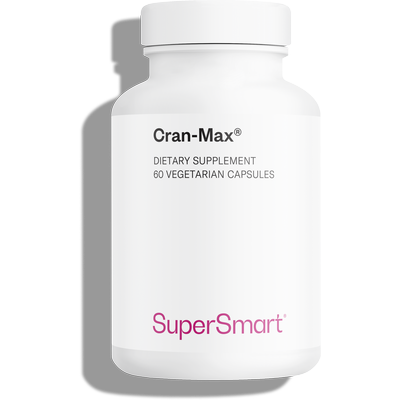
Discover the Cran-Max® supplement, a cranberry extract standardised to 7.2% type A proanthocyanidins, encapsulated with Bio-Shield® technology for maximum effectiveness.
SUPERSMART ADVICE
References
- Neto CC, Vinson JA. Cranberry. In: Benzie IFF, Wachtel-Galor S, editors. Herbal Medicine: Biomolecular and Clinical Aspects. 2nd ed. Boca Raton (FL): CRC Press/Taylor & Francis; 2011. Chapter 6. PMID: 22593931.
- Howell AB, Botto H, Combescure C, Blanc-Potard AB, Gausa L, Matsumoto T, Tenke P, Sotto A, Lavigne JP. Dosage effect on uropathogenic Escherichia coli anti-adhesion activity in urine following consumption of cranberry powder standardized for proanthocyanidin content: a multicentric randomized double blind study. BMC Infect Dis. 2010 Apr 14;10:94. doi: 10.1186/1471-2334-10-94. PMID: 20398248; PMCID: PMC2873556.
- Sobota AE. Inhibition of bacterial adherence by cranberry juice: potential use for the treatment of urinary tract infections. J Urol. 1984 May;131(5):1013-6. doi: 10.1016/s0022-5347(17)50751-x. PMID: 6368872.
- Di Martino P, Agniel R, David K, Templer C, Gaillard JL, Denys P, Botto H. Reduction of Escherichia coli adherence to uroepithelial bladder cells after consumption of cranberry juice: a double-blind randomized placebo-controlled cross-over trial. World J Urol. 2006 Feb;24(1):21-7. doi: 10.1007/s00345-005-0045-z. Epub 2006 Jan 6. PMID: 16397814.
- Howell AB, Reed JD, Krueger CG, Winterbottom R, Cunningham DG, Leahy M. A-type cranberry proanthocyanidins and uropathogenic bacterial anti-adhesion activity. Phytochemistry. 2005 Sep;66(18):2281-91. doi: 10.1016/j.phytochem.2005.05.022. PMID: 16055161.
Keywords




2 Days
Adequate info en hoge kwaliteit
Adequate info en hoge kwaliteit
HanS.
12 Days
Supplementen zijn goed.
Supplementen zijn goed. Zachte prijzen. Website met problemen ( altijd ) niet goed voor nieuwe klanten.
Gino RJ
21 Days
Alles op tijd geleverd.
Alles op tijd geleverd. De producten worden alsmaar duurder, terwijl mijn pensioen niet meer stijgt. Vandaar kan ik alsmaar minder vaak bestellen.
Wouters
1091 Days
Great service
Great service
Ryszard
1104 Days
Profesjonalna obsługa
Bardzo dobre i rzeczowe opisy. Profesjonalna obsługa.
PIEKOSZEWSKI Chris
1772 Days
Wszystko OK!
Wszystko poszło jak powinno 🙂
SITKIEWICZ Pawel
2559 Days
Szybko sprawnie bez problemów
Szybko sprawnie bez problemów
Marek
of experience
your money back
##montant## purchase