
Organic silicon and hair: what effect on hair health?
Organic silicon is attracting growing interest, particularly in the field of hair beauty. But what role does this nutrient really play in the body?


What is silicon, and how is it supplied to the body?
Silicon is a trace element naturally present in the body, particularly in connective tissues such as skin, bones and certain support structures.
Unlike other compounds, the body does not synthesise it itself: silicon must be provided by the diet.
It is found in certain plant-based foods, particularly wholemeal cereals, vegetables and certain silicon-rich mineral waters.
However, these intakes can vary according to eating habits, food quality and processing methods.
This is why some people turn to food supplements to supplement their intake.
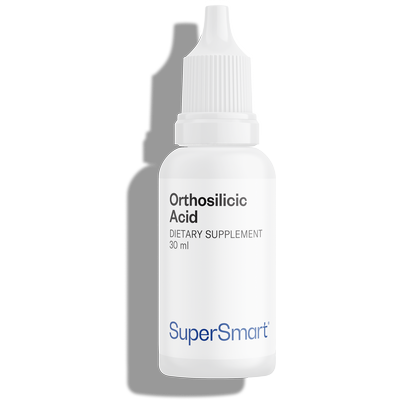
 Discover Orthosilicic Acid 5 mg, a dietary supplement containing orthosilicic acid rich in silicon and zinc.
Organic silicon and hair: what is the link with hair structure?
The main interest in organic silicon for hair lies in its potential role in the structure and quality of the tissues involved in hair growth.
Hair structure closely linked to its environment
Hair is a complex structure, composed mainly of keratin, a fibrous protein.
But its quality is also closely linked to the condition of the scalp and surrounding tissues.
These tissues are supported by what is known as the extracellular matrix, a support network made up mainly of collagen and structural fibres.
This network plays an essential role in maintaining a favourable environment for hair development.
The role of silicon in connective tissue
In this context, silicon is being studied for its involvement in certain biological functions linked to connective tissue (1-2).
It may play an indirect role in the organisation or stabilisation of the extracellular matrix, particularly in relation to collagen (3-4).
Collagen is a key component of the dermis, including the scalp. Well-structured connective tissue contributes to the quality of the hair's anchorage in the hair follicle, as well as to the overall balance of its environment.
Without directly influencing the hair growth cycle, silicon could help to maintain this environment.
Tissue resistance and hair strength: an indirect link
Some experimental work also suggests a link between silicon and the mechanical properties of tissues, such as their strength and elasticity.
These elements could indirectly influence hair strength (5).
However, these observations must be interpreted with caution. The precise mechanisms are not yet fully understood, and the scientific data available on humans remains limited and sometimes heterogeneous.
Some research has explored the effect of bioavailable forms of silicon on parameters such as hair thickness or strength. However, the results vary depending on the protocols used, the populations studied and the overall nutritional context.
So, rather than attributing silicone to having a direct effect on hair growth or loss, it is preferable to consider it as an element that can be integrated into the overall balance of tissues.
A balance on which hair quality indirectly depends.
When should you consider taking silicon for your hair?
An intake of organic silicon can be considered as part of an overall approach to hair beauty, particularly when dietary intake is unbalanced or insufficient.
Certain everyday situations can also influence tissue balance and, by extension, hair quality: natural ageing, chronic stress, unbalanced lifestyle habits or prolonged periods of fatigue (6-8).
In these contexts, ensuring an appropriate nutritional intake can help maintain a favourable environment for connective tissue.
Beyond the hair sphere, silicon is being researched for its potential role in the structure of skin, nails and bone tissue, again in connection with its involvement in the body's support matrices (9).
With this in mind, some formulations combine silicon with other micronutrients.
Discover Orthosilicic Acid 5 mg, a formula rich in organic silicon combined with synergistic nutrients (choline, carnitine, MSM and several minerals), specifically selected to support connective tissues, as well as skin, nails, hair and bones.
Organic silicon can therefore be incorporated into an overall approach, combining a balanced diet, a healthy lifestyle and targeted nutritional supplements.
In addition, certain nutrients have better-documented effects on hair.
In particular, they are involved in recognised biological functions, such as protein synthesis and protecting cells against oxidative stress, both of which are important for maintaining normal hair.
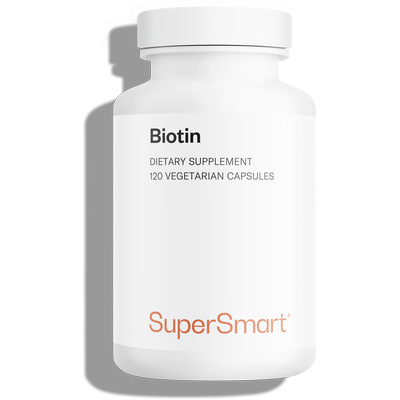
Discover Biotin, a vitamin B8 (or vitamin H) supplement that helps maintain normal hair.
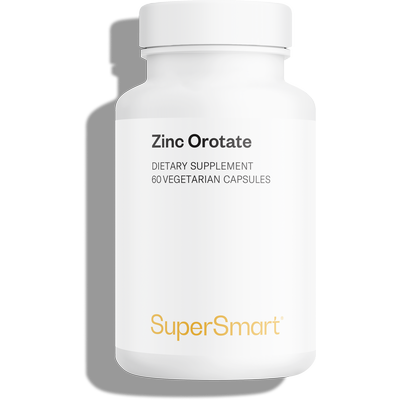
Discover Zinc Orotate, a dietary supplement containing zinc orotate, which helps to maintain normal hair and protect cells against oxidative stress.
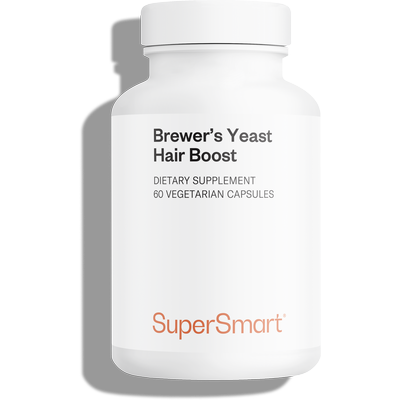
Discover Brewer's Yeast Hair Boost, a brewer's yeast supplement enriched with zinc bisglycinate, biotin and vitamin B6, which contributes to the synthesis of cysteine (a constituent of keratin).
SUPERSMART ADVICE
References
- Carlisle EM. In vivo requirement for silicon in articular cartilage and connective tissue formation in the chick. J Nutr. 1976 Apr;106(4):478-84. doi: 10.1093/jn/106.4.478. PMID: 1255267.
- Jugdaohsingh R, Watson AI, Pedro LD, Powell JJ. The decrease in silicon concentration of the connective tissues with age in rats is a marker of connective tissue turnover. Bone. 2015 Jun;75:40-8. doi: 10.1016/j.bone.2015.02.004. Epub 2015 Feb 14. PMID: 25687224; PMCID: PMC4406186.
- Rondanelli M, Faliva MA, Peroni G, Gasparri C, Perna S, Riva A, Petrangolini G, Tartara A. Silicon: A neglected micronutrient essential for bone health. Exp Biol Med (Maywood). 2021 Jul;246(13):1500-1511. doi: 10.1177/1535370221997072. Epub 2021 Mar 9. PMID: 33715532; PMCID: PMC8283247.
- Zhang F, Zhang Z, Duan X, Song W, Li Z, Yao B, Kong Y, Huang X, Fu X, Chang J, Huang S. Integrating zinc/silicon dual ions with 3D-printed GelMA hydrogel promotes in situ hair follicle regeneration. Int J Bioprint. 2023 Mar 8;9(3):703. doi: 10.18063/ijb.703. PMID: 37273992; PMCID: PMC10236330.
- Araújo LA, Addor F, Campos PM. Use of silicon for skin and hair care: an approach of chemical forms available and efficacy. An Bras Dermatol. 2016 May-Jun;91(3):331-5. doi: 10.1590/abd1806-4841.20163986. PMID: 27438201; PMCID: PMC4938278.
- Thom E. Stress and the Hair Growth Cycle: Cortisol-Induced Hair Growth Disruption. J Drugs Dermatol. 2016 Aug 1;15(8):1001-4. PMID: 27538002.
- Piérard-Franchimont C, Piérard GE. Les cheveux et leur environnement [Hair and their environment]. Rev Med Liege. 2015 Feb;70(2):70-2. French. PMID: 26011990.
- Du F, Li J, Zhang S, Zeng X, Nie J, Li Z. Oxidative stress in hair follicle development and hair growth: Signalling pathways, intervening mechanisms and potential of natural antioxidants. J Cell Mol Med. 2024 Jun;28(12):e18486. doi: 10.1111/jcmm.18486. PMID: 38923380; PMCID: PMC11196958.
- Nielsen FH. Update on the possible nutritional importance of silicon. J Trace Elem Med Biol. 2014 Oct;28(4):379-82. doi: 10.1016/j.jtemb.2014.06.024. Epub 2014 Jul 11. PMID: 25081495.





3 Days
Prodotti eccezionali
Prodotti eccezionali! Consegna rapida e precisa
paola
13 Days
Heldere info
Heldere info
HanS.
13 Days
Snelle levering
Snelle levering
harrie
19 Days
Adequate info en hoge kwaliteit
Adequate info en hoge kwaliteit
HanS.
29 Days
Supplementen zijn goed.
Supplementen zijn goed. Zachte prijzen. Website met problemen ( altijd ) niet goed voor nieuwe klanten.
Gino RJ
38 Days
Alles op tijd geleverd.
Alles op tijd geleverd. De producten worden alsmaar duurder, terwijl mijn pensioen niet meer stijgt. Vandaar kan ik alsmaar minder vaak bestellen.
Wouters
1108 Days
Great service
Great service
Ryszard
1121 Days
Profesjonalna obsługa
Bardzo dobre i rzeczowe opisy. Profesjonalna obsługa.
PIEKOSZEWSKI Chris
1789 Days
Wszystko OK!
Wszystko poszło jak powinno 🙂
SITKIEWICZ Pawel
2576 Days
Szybko sprawnie bez problemów
Szybko sprawnie bez problemów
Marek
of experience
your money back
##montant## purchase