
Is it dangerous to take melatonin every day?
Melatonin is increasingly popular with those suffering from sleep problems. But does taking it every day cause any side-effects?


What is melatonin?
What role does melatonin play in sleep?
Melatonin is a hormone secreted directly into the bloodstream by the pineal gland (a small cone-shaped area in the centre of the brain, also known as the epiphysis cerebri).
It helps to stabilise circadian rhythms and regulate certain physiological processes such as sleep and food intake.
Once in the bloodstream, it activates a number of vascular receptors and supports a state of ‘quiet wakefulness’ conducive to falling asleep, by lowering body temperature and reducing the secretion of cortisol (the stress hormone).
Melatonin production increases sharply at the end of the day, as natural light starts to fade. This is the signal that the ‘normal’ time to go to bed is approaching.
Its concentration in the blood continues to increase, reaching a peak at around 3am or 4am, before returning to minimum levels after sunrise, at around 8am.
Why take melatonin?
Although melatonin is produced naturally by the body, many people who experience disturbed sleep (insomnia, jetlag, night shift work, circadian rhythm disorders…) choose to take a melatonin supplement to boost their levels of this hormone at the right moment, in order to fall asleep faster and readjust their biological clock (1-2).
Melatonin supplementation may be helpful for those who regularly spend time looking at screens in the evening, as the light intensity of digital devices affects melatonin secretion and delays the circadian clock.
Are there any risks associated with taking melatonin?
Can you expect to suffer side-effects from taking melatonin?
In healthy individuals, taking melatonin in the afternoon or early evening can produce feelings of fatigue, lack of energy, drowsiness, and the desire to sleep, effects which are mostly consistent and desired.
If too much melatonin is taken, these effects can persist the following day (with a residual presence in the blood), but they usually disappear when supplementation ceases.
If melatonin is taken earlier in the day, there’s a risk of disrupting the sleep-wake cycle (which may also be the desired effect in the case of jet-lag).
Unlike benzodiazepines, melatonin supplementation will not, in principle, lead to any changes in sleep architecture at the maximum dose recommended (2mg a day for an adult), at least when taken for short periods.
What are the potential effects over the long-term?
Although most of melatonin’s known adverse effects and potential interactions are not serious, and preliminary studies on its long-term impact are reassuring, it is not advisable to take it for long periods, as research data is still limited (3).
This is particularly so for at-risk population groups, such as women who are pregnant or breastfeeding, children, and adolescents (a potential effect on puberty has yet to be ruled out), those suffering from auto-immune inflammatory diseases, epilepsy, asthma, mood, behaviour or personality disorders, as well as those on long-term medication (including antidepressants).
Several possible risks from persistent, daily use still need to be completely ruled out: an unlikely bone fragility effect, a potential effect on growth (4) and a possible link to depression (5).
However, except in the case of repeated, very high-dose use (hundreds of mg a day), melatonin is not associated with any impact on the liver or heart, and neither does it promote weight gain (6).
Short-term use of melatonin: our tips for safe and effective supplementation
For the time being, the advice is to take melatonin supplements on a short-term basis, for a few days to a few weeks (usually 1-2 months maximum), the time it takes to ‘recalibrate’.
In addition to this model, occasional, isolated use is also possible.
Be sure to seek advice from a health professional if necessary.
Is melatonin a drug?
Melatonin is different from other hormones. In contrast to the majority of molecules with endocrine functions, it is not subject to negative feedback (no risk of addiction).
In other words, long-term supplementation with melatonin does not lead to atrophy of the pineal gland nor a reduction in endogenous production (7-9).
Once melatonin supplementation ceases, there is no rebound insomnia effect, nor withdrawal syndrome (10). Melatonin is therefore not a drug.
How should melatonin supplements be taken?
Dose and time of day
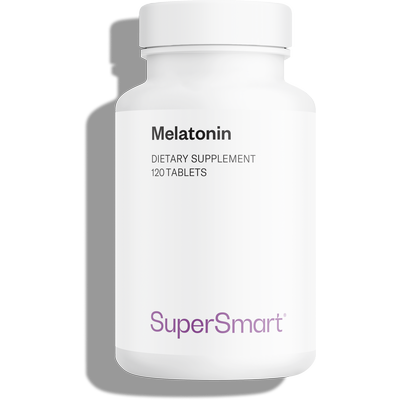
The melatonin dose recommended is between 1mg and 2mg a day (as offered by Melatonin 1mg, 2 tablets of which provide 2mg of melatonin a day).
In terms of the right time to take it, some recommend 2 hours before bed to facilitate a gradual build-up of the ‘sleep hormone’, while others advise 15 minutes to an hour before bed, believing that we absorb melatonin more rapidly … If in doubt, follow the instructions on the label.
Other forms of melatonin
Melatonin can also be taken in the form of a spray (such as the product Melatonin Spray) to promote its entry into the bloodstream via the oral mucosa and thus maximise its absorption.
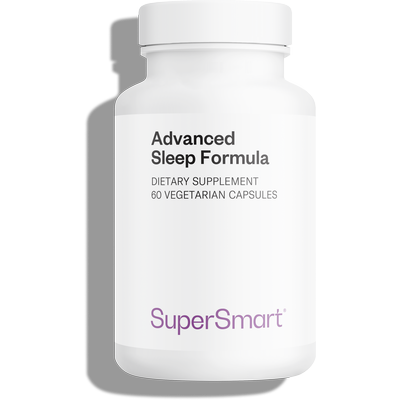
You can also take specific sleep formulations in which melatonin is combined with other natural compounds (such as Advanced Sleep Formula rich in relaxing plant extracts).
SUPERSMART ADVICE

References
- Buscemi N et al. The efficacy and safety of exogenous melatonin for primary sleep disorders. A meta-analysis. J Gen Intern Med. 2005 Dec;20(12):1151–8. doi: 10.1111/j.1525-1497.2005.0243.x.
- Ferracioli-Oda, E.; Qawasmi, A.; Bloch, M. H. Meta-Analysis: Melatonin for the Treatment of Primary Sleep Disorders. PLoS One 2013, 8 (5). https://doi.org/10.1371/journal.pone.0063773.
- Mélatonine: bilan des notifications d’effets indésirables en France. La Revue Prescrire 2018;38: 835-6
- Melatonin Effect on Seizures in Children with Severe Neurologic Deficit Disorders—PubMed. [(accessed on 9 March 2023)
- Hansen M., Danielsen A., Hageman I., Rosenberg J., Gögenur I. The therapeutic or prophylactic effect of exogenous melatonin against depression and depressive symptoms: A systematic review and meta-analysis. Neuropsychopharmacol. J. Eur. Coll. Neuropsychopharmacol. 2014;24:1719–1728. doi: 10.1016/j.euroneuro.2014.08.008.
- Agil A, Navarro-Alarcón M, Ruiz R, Abuhamadah S, El-Mir MY, Vázquez GF. Beneficial effects of melatonin on obesity and lipid profile in young Zucker diabetic fatty rats. J Pineal Res. 2011 Mar;50(2):207-12. doi: 10.1111/j.1600-079X.2010.00830.x. Epub 2010 Nov 19. PMID: 21087312.
- Claustrat, B.; Leston, J. Melatonin: Physiological Effects in Humans. Neurochirurgie 2015, 61 (2– 3), 77–84. https://doi.org/10.1016/j.neuchi.2015.03.002.
- Tordjman, S.; Chokron, S.; Delorme, R.; Charrier, A.; Bellissant, E.; Jaafari, N.; Fougerou, C. Melatonin: Pharmacology, Functions and Therapeutic Benefits. Curr Neuropharmacol 2017, 15 (3), 434–443. https://doi.org/10.2174/1570159X14666161228122115.
- Amaral, F. G. do; Cipolla-Neto, J. A Brief Review about Melatonin, a Pineal Hormone. Arch Endocrinol Metab 2018, 62 (4), 472–479. https://doi.org/10.20945/2359-3997000000066.
- Hoebert M., Van Der Heijden K.B., van Geijlswijk I.M., Smits M.G. Long-term follow-up of melatonin treatment in children with ADHD and chronic sleep onset insomnia. J. Pineal Res. 2009;47:1–7. doi: 10.1111/j.1600-079X.2009.00681.x.
Keywords





1 Days
I have been ordering supplements from…
I have been ordering supplements from SuperSmart for many years now. They are one, among the very few suppliers of Nutraceutical medicines, whom I trust implicitly. They produce supplements which align with the latest biochemical research in the field of natural medicines which is wonderful for a person like myself, since I loathe the drugs produced by big pharma. I shall continue to order from SuperSmart.
Wayne Chandler
8 Days
I’m really satisfied with SuperSmart
I’m really satisfied with SuperSmart. I’ve ordered from them many times, and the products are definitely worth every penny. Their customer service is excellent. They respond very quickly, are always professional. The only thing that could be improved is the order confirmation email, as it doesn’t always arrive in my inbox and I sometimes have to request it from customer support.
T Marina
14 Days
Always a winner
Always a winner Best of products. Delivers on time. What more do you want?
David Walsh
16 Days
Very fast delivery
The delivery was unexpectedly very fast and !
SADDEM Nadia
22 Days
tres efficace
tres efficace
KR
22 Days
Great to be able to buy a pure BHB…
Great to be able to buy a pure BHB powder at Supersmart. Thanks.
BusyBee
30 Days
There is one thing you need to be very…
There is one thing you need to be very aware of with Supersmart. The content described on the box - is based on a daily dosage - which means you have to look for how many tablets is described as a daily dosage. If is says 1000mg on the box - it might mean taht you have i.e. to take 3 tablets dayly to get your daily dosage. And 90 tablets equals i.e. 30 days.
Trusted
30 Days
Excellent performance
Excellent performance
David Walsh
44 Days
Fast delivery
Fast delivery, good products but relatively high prices
Ezio m Insinna
47 Days
My family and I have been using…
My family and I have been using SuperSmart supplements for a while now, and we’re genuinely impressed. The quality is consistently excellent, and we’ve noticed real benefits, both for everyday wellness support and during more challenging health issues (bc/artemisinin), where they’ve been a valuable part of our overall care and healing routine. Highly recommend for anyone looking for a trustworthy supplement brand to support their health.
VUKOTIC Sonja
47 Days
Good quality but way too expensive
Good quality, but way too expensive. 70 euros for a 2-week supply is excessive. If there'd be another supplier to sell these, I'd definitely switch because of costs.
Laura
48 Days
All good products and service
All good products and service
Trusted
59 Days
I believe in the quality of the products
I believe in the quality of the products
Lucia Keme
70 Days
Thank you guys ,Real and Great Products…
Thank you guys ,Real and Great Products ,fast/tide and clean shipping .I definitly trust you and go for a montly subscription !!!
Mr Mircea Blaj
71 Days
Fast delivery
Fast delivery, no hassle
Trusted
of experience
your money back
##montant## purchase