
Can you take vitamin D every day?
Immunity, muscle contraction, heart function, bone health... Although it contributes to a number of essential functions in the body, more than one in two people in the world lacks vitamin D. But can we take it every day? But can you take it every day?


What is vitamin D used for?
Vitamin D is involved in a number of fundamental biological functions in the human body: it is essential for health and vitality at all ages.
- Vitamin D contributes to the normal absorption and use of calcium and phosphorus, two minerals essential for a strong skeleton.
- It contributes to the maintenance of normal bones and teeth, by facilitating the integration of calcium into the dental enamel.
- It contributes to normal blood levels of calcium, essential for muscle contraction, transmission of nerve impulses and certain heart functions.
- Vitamin D also plays a role in the process of cell division, which is important for growth, tissue renewal and cell repair.
- It contributes to the normal functioning of the immune system by supporting the activity of the cells responsible for defending the body.
- Finally, vitamin D helps reduce the risk of falls associated with postural instability and muscular weakness, a risk factor for bone fractures in men and women aged 60 and over.
What are the daily vitamin D requirements?
For adults, the recommended daily intake of vitamin D is 15 µg/d (600 IU/d) (1).
But recommended intakes vary according to certain criteria: age and state of health, skin colour, geographical location, lifestyle and exposure to the sun, etc.
Conducted between 2020 and 2022 on a global scale, a meta-analysis involving more than 7.9 million participants in 81 countries showed that almost 48% of participants had insufficient serum vitamin D levels, and that 15.7% were severely deficient (2).
And it's not just people in the Northern Hemisphere—or those with little exposure to the sun—who are affected: even in the sunniest places, such as Saudi Arabia and Australia, 30% to 50% of adults and children are said to be deficient in vitamin D (3).
Several studies carried out in recent years have confirmed that a large proportion of the population has insufficient vitamin D status (4-5).
Some have shown that 1000 IU/d would be needed for adults to reach levels considered sufficient, and that 2000 IU/d would enable these levels to be exceeded.
In 2025, the Groupe de Recherche et d'Information sur les Ostéoporoses (GRIO) (Research and Information Group on Osteoporosis) once again stressed the importance of daily supplementation in adults, pointing out that this remains the most effective strategy for maintaining good vitamin D status (6).
Vitamin D3 spray is a practical alternative to capsules or tablets, which are sometimes poorly tolerated: its sublingual form means it is rapidly absorbed via the bloodstream, and is optimally available to the body.
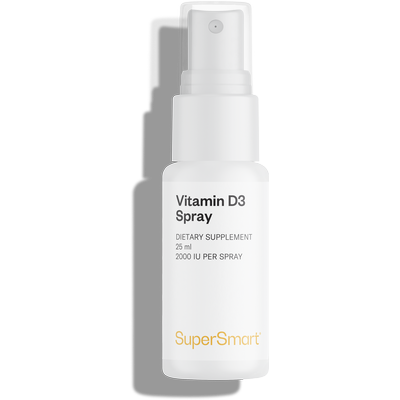
 Discover Vitamin D3 Spray 2000 IU, a sublingual spray supplement with a precise, powerful dose, recommended for people with sensitive stomachs.
Can I take vitamin D every day?
Taking vitamin D every day is not only possible, it is even recommended in certain situations (as long as the dosage is adapted to individual needs).
For example, if you spend 2 months outdoors during the summer, you don't need to supplement during this period, as the body's main source of vitamin D is exposure to the sun.
But it remains difficult to synthesise enough vitamin D through the skin throughout the year to reach the recommended levels (7).
During the winter, daily vitamin D supplementation can help to support an immune system that is more vulnerable to cold, damp and increased infections (8).
However, it is advisable to take a break of one or two weeks every 3 months to allow the body to regulate itself naturally (this applies to all food supplements).
You should also be careful not to confuse doses suitable for daily use with the large doses offered in the form of ampoules (intended to be taken occasionally and never continuously, with a risk of hypercalcaemia in the event of an overdose).
Another point to remember is that vitamin D is fat-soluble, which means that it is better absorbed when taken with a meal containing fat (9).
Vitamin D-based food supplements: which ones to choose?
A distinction is made between:
- vitamin D2 (or ergocalciferol) of plant origin
- vitamin D3 (or cholecalciferol) of animal origin, synthesised when the skin is exposed to sunlight
Several studies have shown that vitamin D3 is more effective than vitamin D2 in increasing vitamin D levels in the body, due to its much greater bioavailability: D2 is thought to break down too quickly in the body to play its role (10-11).
To adapt to different needs, food supplements come in a range of dosages (most often between 1,000 and 2,000 IU per day, which corresponds to the generally recommended intake for adults).
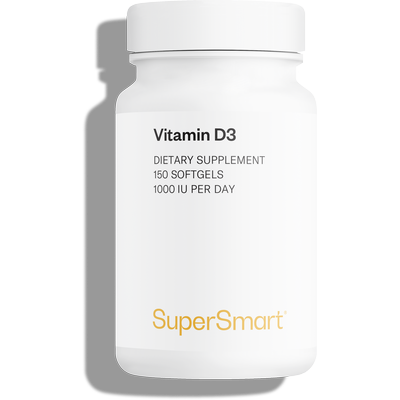
Discover Vitamin D3 1000 IU, a vitamin D3 food supplement packaged in an oily capsule for maximum absorption, with a dosage to suit all profiles.
While doses of 1000 IU are suitable for the majority of adults, certain situations require a higher intake to maintain good vitamin D status (during the winter, in the event of low sun exposure, in old age, etc.).
Discover Vitamin D3 Spray 2000 IU, a practical, well-dosed spray supplement that combines a higher daily intake with excellent bioavailability.
Certain more concentrated formulas are designed for occasional use or periods of increased need, to rapidly boost vitamin D levels.
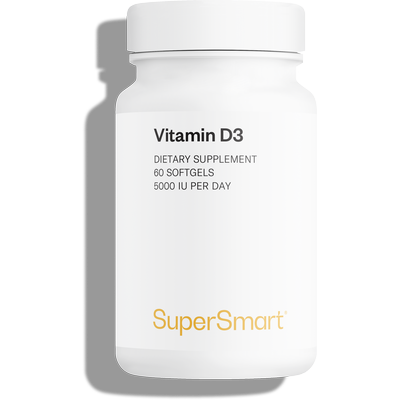
Discover Vitamin D3 5000 IU, a high-dose dietary supplement that rapidly boosts circulating levels of vitamin D.
Finally, some complexes combine vitamin D with other vitamins for a synergistic effect.
For example, a combination of vitamins K and D3 facilitates the absorption and transport of calcium, while reinforcing the action of vitamin K in post-menopausal women, with or without osteoporosis.
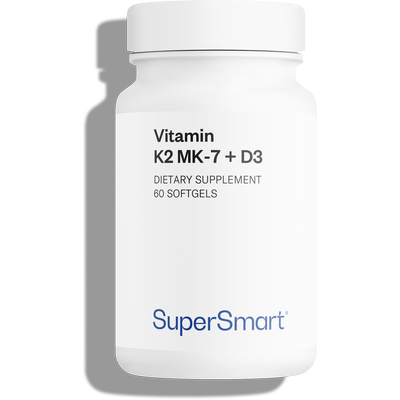
Discover Vitamin K2 MK-7 + Vitamin D3, a complete complex combining two vitamins in their most bioavailable and active forms.
SUPERSMART ADVICE
References
- Les références nutritionnelles en vitamines et minéraux, ANSES, 2025
- Cui A, Zhang T, Xiao P, Fan Z, Wang H, Zhuang Y. Global and regional prevalence of vitamin D deficiency in population-based studies from 2000 to 2022: A pooled analysis of 7.9 million participants. Front Nutr. 2023 Mar 17;10:1070808. doi: 10.3389/fnut.2023.1070808. PMID: 37006940; PMCID: PMC10064807.
- Bosomworth NJ. Atténuer la carence épidémique en vitamine D: La tourmente des données scientifiques. Can Fam Physician. 2011 Jan;57(1):e1–6. French. PMCID : PMC3024173.
- Étude de santé sur l’environnement, la biosurveillance, l’activité physique et la nutrition (Esteban2014-2016), Santé Publique France, 2019
- Étude individuelle nationale des consommations alimentaires3 (INCA 3), Santé Publique France, 2017
- Pickering ME, Souberbielle JC, Boutten A, Breuil V, Briot K, Chapurlat R, Fardellone P, Javier RM, Koumakis E, Cortet B; Groupe de Recherche et d’Information sur les Ostéoporoses (GRIO). Daily or intermittent vitamin D supplementation in patients with or at risk of osteoporosis: Position statement from the GRIO. Joint Bone Spine. 2025 May;92 (3): 105858. doi: 10.1016/j.jbspin.2025.105858. Epub 2025 Feb 18. PMID: 39978583.
- Webb AR, Kline L, Holick MF. Influence of season and latitude on the cutaneous synthesis of vitamin D3: exposure to winter sunlight in Boston and Edmonton will not promote vitamin D3 synthesis in human skin. J Clin Endocrinol Metab. 1988 Aug;67(2):373-8. doi: 10,121 0/jcem-67-2-373. PMID: 2839537.
- Taqarort N, Chadli S. Vitamine D et risque des infections respiratoires aiguës : grippe et COVID-19 [Vitamin D and risk of acute respiratory infections: Influenza and COVID-19]. Nutrition Clinique et Metabolisme. 2020 Oct ; 34 (3) : 211– French. doi: 10.1016/j.nupar.2020.05.003. Epub 2020 Jul 23. PMCID : PMC7377790.
- Dawson-Hughes B, Harris SS, Lichtenstein AH, Dolnikowski G, Palermo NJ, Rasmussen H. Dietary fat increases vitaminD-3 absorption. J Acad Nutr Diet. 2015 Feb;115(2):225-230. doi: 10.1016/j.jand.2014.09.014. Epub 2014 Nov 17. PMID: 25441954.
- Mistretta VI, Delanaye P, Chapelle JP, Souberbielle JC, Cavalier E. Vitamine D2 ou vitamine D3? [Vitamin D2 or vitamin D3?]. Rev Med Interne. 2008 Oct ; 29 (10) : 815-20. French. doi: 10.1016/j.revmed.2008.03.003. Epub 2008 Apr 11. PMID: 18406498.
- Balachandar R, Pullakhandam R, Kulkarni B, Sachdev HS. Relative Efficacy of Vitamin D2 and Vitamin D3 in Improving Vitamin D Status: Systematic Review and Meta-Analysis. Nutrients. 2021 Sep 23 ; 13 (10) : 3328. doi: 10.3390/nu13103328. PMID: 34684328; PMCID: PMC8538717.
Keywords





5 Days
Adequate info en hoge kwaliteit
Adequate info en hoge kwaliteit
HanS.
15 Days
Supplementen zijn goed.
Supplementen zijn goed. Zachte prijzen. Website met problemen ( altijd ) niet goed voor nieuwe klanten.
Gino RJ
24 Days
Alles op tijd geleverd.
Alles op tijd geleverd. De producten worden alsmaar duurder, terwijl mijn pensioen niet meer stijgt. Vandaar kan ik alsmaar minder vaak bestellen.
Wouters
1094 Days
Great service
Great service
Ryszard
1107 Days
Profesjonalna obsługa
Bardzo dobre i rzeczowe opisy. Profesjonalna obsługa.
PIEKOSZEWSKI Chris
1775 Days
Wszystko OK!
Wszystko poszło jak powinno 🙂
SITKIEWICZ Pawel
2562 Days
Szybko sprawnie bez problemów
Szybko sprawnie bez problemów
Marek
of experience
your money back
##montant## purchase