
8 Natural stomach coating agents to protect and soothe the stomach
Burning, acidity, irritation... Is your stomach sounding the alarm? Discover 8 natural stomach coating agents to gently soothe digestive discomfort and protect the mucous membrane.


What is a stomach coating agent?
A stomach coating agent is a swallowable preparation designed to protect the gastric mucosa.
This substance generally acts by lining the stomach and creating a temporary barrier on the inner walls to relieve the burning, pain or discomfort associated with excessive acidity.
This type of product can be useful in the event of temporary stomach pains, reflux or difficult digestion, or after a copious or excessively fatty meal.
There are 2 main categories of stomach coating agents:
- medicated stomach coating agents, available in pharmacies, generally made up of substances of mineral or chemical origin, and medically supervised
- natural stomach coating agents, derived from food or plants, which can offer gentle relief
Stomach coating agents have an almost immediate effect, but the effects are short-lived.
The 8 best natural stomach coating agents
1. Ultra-ventilated green clay: an exceptional natural coating?
Ultra-ventilated montmorillonite green clay is commonly recommended by naturopaths to promote digestive comfort.
It absorbs excess acidity and gas in the stomach, helping to reduce bloating and digestive discomfort.
At the same time, it forms a protective layer on the stomach walls, helping to soothe occasional burning and discomfort.
However, this potentially powerful gastric coating should be used at least 2 hours before taking medication, as it may interfere with their absorption.
2. Aloe vera gel: an emollient for mucous membranes
Aloe vera gel, which comes from the inner pulp and therefore contains no aloin (an irritant substance found in the plant's skin), is traditionally used for its emollient and soothing effects on mucous membranes, including the stomach (1).
It also helps to support digestion, thanks in particular to its mucilage, which facilitates the passage of food through the digestive tract and helps to gently regulate transit.
It is available in liquid form for drinking, often as a course of treatment lasting several weeks.
3. Lithothamnion: a remineralising anti-acidity algae?
Lithothamnion (Lithothamnium calcareum) is a small calcareous seaweed naturally rich in calcium and magnesium, which is thought to have a strong buffering effect against excess stomach acid.
Its action is gentle and gradual, and it is recommended for sensitive stomachs or those with acidic stomachs.
It is commonly used in naturopathy to improve the digestive system over the long term.
4. Marshmallow root: the ultimate plant-based soothing agent
Marshmallow root (Althaea officinalis) contains mucilage which can form a protective film on irritated mucous membranes.
Marshmallow is traditionally used to soothe stomach pains and reduce inflammation of the digestive tract.
It can be found, for example, in infusions or as a powder to be diluted in lukewarm water.
5. DGL liquorice: a powerful shield for the gastric mucosa
Liquorice (Glycyrrhiza glabra) is a herbaceous plant that helps to maintain the normal functioning of the mucous membranes of the stomach and small intestine.
More specifically, it works by stimulating the production of protective mucus, which helps line the stomach lining and soothe acid-related irritations.
Opt for deglycyrrhizinated liquorice (DGL), a special form of liquorice from which glycyrrhizin, a molecule that can increase blood pressure, has been removed.
 Discover the DGL 500 deglycyrrhizinated liquorice supplement, a concentrated formula to support your stomach every day.
6. Chios mastic: a resin known since time immemorial
Chios mastic or mastiha (Pistacia lentiscus) is a resin from the pistachio tree, used since ancient times to prevent and relieve digestive problems.
Thanks to its resinous texture, it is thought to form a protective layer on the gastric mucosa, helping to soothe burns and irritations.
What's more, some recent studies suggest that it may limit the adhesion and proliferation of Helicobacter pylori, a bacterium frequently associated with gastric imbalances (2).
Discover the Mastic Gum food supplement, derived from the Chios mastic tree and standardised to 12% masticonic acids.
7. L-carnosine zinc: a complex particularly appreciated in cases of reflux
Zinc-L-carnosine is a chelated complex that combines zinc with L-carnosine, a small peptide naturally present in the body.
This complex is often appreciated in cases of reflux, irritation or chronic gastric problems.
Studies suggest that zinc-L-carnosine acts:
- by binding directly to the gastric mucosa, where it forms a protective barrier
- by promoting cell repair, as zinc contributes to normal cell division, a process that is essential for tissue renewal
- by reducing inflammation linked to oxidative stress (3)
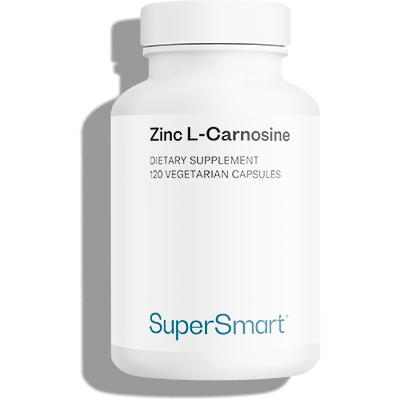
Discover the Zinc-L-Carnosine dietary supplement.
8. Sodium bicarbonate: ideal for neutralising acidity?
Long used to treat heartburn, sodium bicarbonate is renowned for its alkalising effect.
It is thought to work by neutralising excess stomach acid, which can provide rapid relief after an overly rich or acidic meal.
Studies indicate that it may even reduce gastric irritation induced by aspirin or excessive acidity (4).
Without being directly a stomach coating agent, sodium bicarbonate therefore acts as an immediate antacid rather than as a protector of the mucous membrane.
However, it is preferable to use it only occasionally and with caution, as regular use can unbalance the pH of the stomach or cause an acid rebound effect.
Synergistic formulas for complete stomach support
Ingredients to combat gastro-oesophageal reflux disease (GERD)
Some formulas intelligently combine several active ingredients to act synergistically on gastric imbalances.
For example, they may be dedicated to combating acid reflux, the cause of heartburn and irritation of the oesophagus.
These supplements combine several ingredients that could limit acid reflux while strengthening the gastric barrier: zinc-L-carnosine, liquorice extract, potassium bicarbonate, etc.
Discover the Anti-Acid Reflux Formula food supplement, which combines these different natural ingredients tested against gastric reflux.
Natural compounds effective against Helicobacter pylori?
Helicobacter pylori is a bacterium commonly present in the body, but which can, in certain cases, disturb the balance of the gastric mucosa.
Certain substances have been studied for their ability to bind to H. pylori or reduce its adhesion to the stomach wall (5).
They have been used in specific supplements:
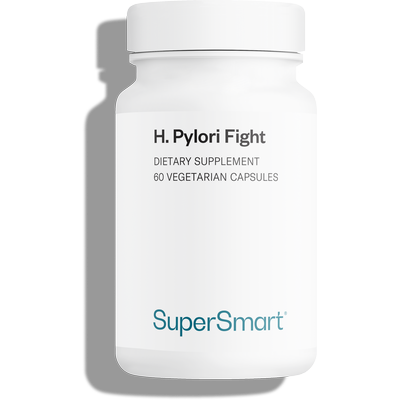
Discover the H. Pylori Fight dietary supplement, a postbiotic tested against Helicobacter pylori, or its enriched version H. Pylori Fight Advanced Formula.
SUPERSMART ADVICE
References
- Park CH, Son HU, Yoo CY, Lee SH. Low molecular-weight gel fraction of Aloe vera exhibits gastroprotection by inducing matrix metalloproteinase-9 inhibitory activity in alcohol-induced acute gastric lesion tissues. Pharm Biol. 2017 Dec;55(1):2110-2115. doi: 10.1080/13880209.2017.1371770. PMID: 28874080; PMCID: PMC6130566.
- Dabos KJ, Sfika E, Vlatta LJ, Giannikopoulos G. The effect of mastic gum on Helicobacter pylori: a randomized pilot study. Phytomedicine. 2010 Mar;17(3-4):296-9. doi: 10.1016/j.phymed.2009.09.010. Epub 2009 Oct 29. PMID: 19879118.
- Efthymakis K, Neri M. The role of Zinc L-Carnosine in the prevention and treatment of gastrointestinal mucosal disease in humans: a review. Clin Res Hepatol Gastroenterol. 2022 Aug-Sep;46(7):101954. doi: 10.1016/j.clinre.2022.101954. Epub 2022 Jun 2. PMID: 35659631.
- Bowen BK, Krause WJ, Ivey KJ. Effect of sodium bicarbonate on aspirin-induced damage and potential difference changes in human gastric mucosa. Br Med J. 1977 Oct 22;2(6094):1052-5. doi: 10.1136/bmj.2.6094.1052. PMID: 922417; PMCID: PMC1631808.
- de Brito BB, da Silva FAF, Soares AS, Pereira VA, Santos MLC, Sampaio MM, Neves PHM, de Melo FF. Pathogenesis and clinical management of Helicobacter pylori gastric infection. World J Gastroenterol. 2019 Oct 7;25(37):5578-5589. doi: 10.3748/wjg.v25.i37.5578. PMID: 31602159; PMCID: PMC6785516.
Keywords




8 Days
Prodotti eccezionali
Prodotti eccezionali! Consegna rapida e precisa
paola
18 Days
Heldere info
Heldere info
HanS.
18 Days
Snelle levering
Snelle levering
harrie
24 Days
Adequate info en hoge kwaliteit
Adequate info en hoge kwaliteit
HanS.
33 Days
Supplementen zijn goed.
Supplementen zijn goed. Zachte prijzen. Website met problemen ( altijd ) niet goed voor nieuwe klanten.
Gino RJ
43 Days
Alles op tijd geleverd.
Alles op tijd geleverd. De producten worden alsmaar duurder, terwijl mijn pensioen niet meer stijgt. Vandaar kan ik alsmaar minder vaak bestellen.
Wouters
1113 Days
Great service
Great service
Ryszard
1126 Days
Profesjonalna obsługa
Bardzo dobre i rzeczowe opisy. Profesjonalna obsługa.
PIEKOSZEWSKI Chris
1794 Days
Wszystko OK!
Wszystko poszło jak powinno 🙂
SITKIEWICZ Pawel
2581 Days
Szybko sprawnie bez problemów
Szybko sprawnie bez problemów
Marek
of experience
your money back
##montant## purchase