
Coconut drinks: what’s their nutritional value?
Coconut water, coconut milk, coconut oil: from fans of the keto diet to the biggest Hollywood stars, it seems everyone’s addicted to coconut! SuperSmart gives you the lowdown on whether these products are good for our health.

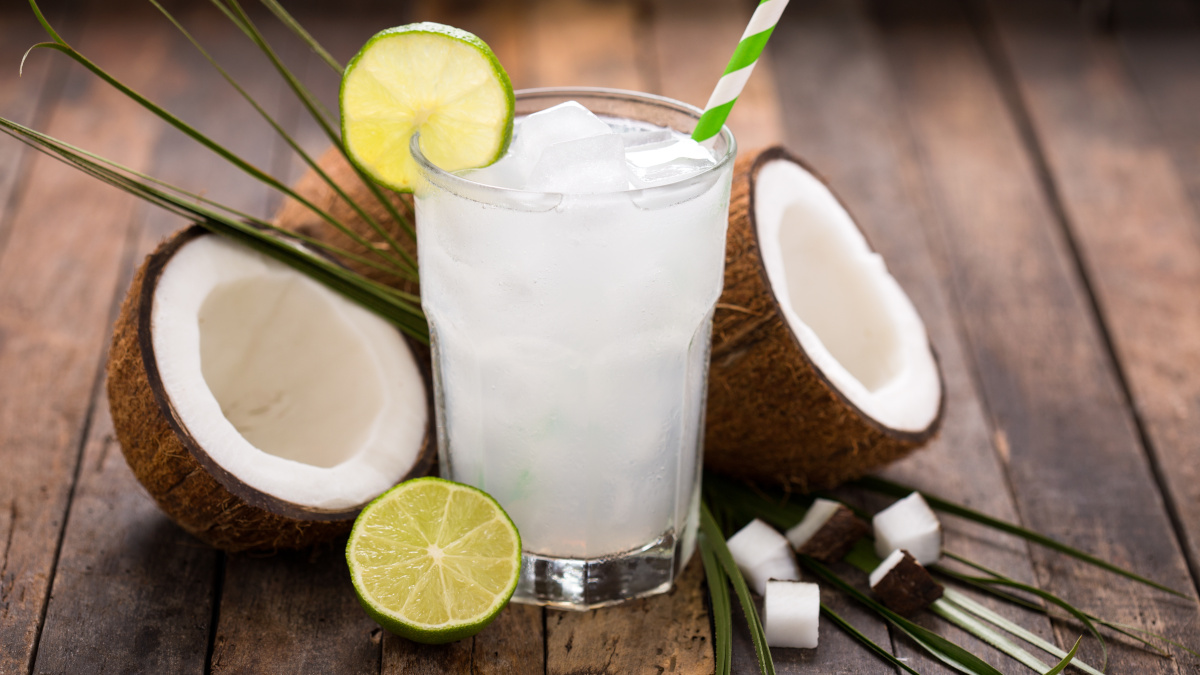
Brief description of the coconut
A brown shell and pearly white pulp: this is the form in which the coconut graces our supermarket shelves. But it bears little resemblance to the coconut fruit (Cocos nucifera) you’d find growing on a palm tree.
Weighing up to 1.5kg, this impressive, near-spherical drupe bears a smooth, green skin (exocarp) before it ripens. This conceals a fibrous husk (mesocarp), usually referred to as ‘coir’, which protects the inner, woody shell (endocarp).
This three-layered casing thus safeguards the heart of the coconut, the hollow kernel, which holds the famous coconut water. Its pristine walls constitute the pulp, from which we get coconut milk and coconut oil.
Originating from the biogeographical region of Malesia, this exotic fruit now grows in most tropical countries. Indeed, Indonesia, India and the Philippines are responsible for 70% of current global production.
Coconut water, the on-trend drink for maintaining good hydration
Often confused with coconut milk, coconut water (or coconut juice) is the liquid found in the kernel. Highly refreshing and thirst-quenching, it is marked by a near-absence of fats in favour of carbohydrates (3.33g/100ml), the body’s main fuel, responsible for its characteristic sweet taste.
In addition, coconut water has a high level of bioactive enzymes and minerals. It is particularly rich in, amongst others,potassium (200mg/100ml), a mineral which supports normal nervous system and muscle function (1).
It also contains a small amount of sodium (20mg/100ml), and is therefore a popular alternative to isotonic drinks for post-exercise recovery, for helping to compensate for the water and minerals lost through sweating (2).
Despite these many benefits, however, coconut water should never be used as a replacement for normal table water: drinking too much of it (say, several litres a day) can lead to excess potassium in the blood (hyperkalaemia), with adverse effects on kidney and heart function (3).
Coconut milk, for a touch of the exotic
The star ingredient in golden lattes and vegetarian curries, coconut milk brings a welcome exotic element to our menus.
But how does it fare nutritionally? Despite its description as a ‘milk’, the coconut variety differs significantly from animal milks. Much more calorific, at 188 kcal/100g, it also contains less calcium (just 18mg/100g) and a higher fat content – close to 18g per 100g – 90% of which is saturated fat.
So should you avoid it? Not necessarily, as coconut milk offers benefits too: an appreciable level of potassium (220mg/100g), magnesium (46mg/100g) and iron (3.3mg/100g), a small amount of selenium (3mcg/100g), protective phenolic compounds, and no lactose or cholesterol (4).
In fact the only caveat is that you should avoid drinking it like standard milk (pouring yourself a large helping every morning). But it’s fine to mix it with another, lighter plant milk (such as almond) or use it as a 30% fat substitute for crème fraîche.
MCT coconut oil, an excellent keto aid
On paper, coconut oil tops the league when it comes to saturated fat content (86% of its composition), way ahead of butter (55%). That’s quite a scary percentage, given the apparent risk to cardiovascular health posed by saturated fats.
But that ignores the fact that not all saturated fatty acids are the same. Coconut oil actually contains medium-chain triglycerides (MCTs), formed from caprylic acid (C8), capric acid (C10) and lauric acid (C12) (5).
These unique molecules circumvent the traditional lipid metabolism pathway (6): bypassing bile and the pancreas, they head straight for the liver, before entering the bloodstream in the form of medium-chain fatty acids (MCFAs), which then serve as a source of instant energy for our cells.
So unlike long-chain triglycerides, MCTs do not end up being stored in adipose tissue (7). What’s more, oxidation of MCTs by liver cells creates ketone bodies, a valuable source of compensatory energy for anyone with a low intake of carbohydrates, hence the huge popularity of coconut oil among those following the keto diet (8).
Unfortunately, standard coconut oil contains just 5% caprylic acid, though it is still valued for its ability to cross cell membranes and its excellent digestive tolerance (9). Composed solely of medium-chain triglycerides, MCT coconut oils get round this deficit by isolating only the most beneficial lipid fractions (the product Organic MCT Oil Pure C8, for example, contains an exceptional 98%caprylic acid).
How should they be consumed? Because of their concentrated formulation, a dose of 10ml-20ml a day is sufficient. However, they are not as good at withstanding high temperature cooking as standard coconut oils and are therefore best consumed cold, such as in a smoothie, vinaigrette, or a vegan mayo!
References
- Kuberski T, Roberts A, Linehan B, Bryden RN, Teburae M. Coconut water as a rehydration fluid. N Z Med J. 1979 Aug 8;90(641):98-100. PMID: 290921.
- Kalman DS, Feldman S, Krieger DR, Bloomer RJ. Comparison of coconut water and a carbohydrate-electrolyte sport drink on measures of hydration and physical performance in exercise-trained men. J Int Soc Sports Nutr. 2012 Jan 18;9(1):1. doi: 10.1186/1550-2783-9-1. PMID: 22257640; PMCID: PMC3293068.
- Hemachandra KHDT, Chandimal Dayasiri MBK, Kannangara T. Acute Ascending Flaccid Paralysis Secondary to Multiple Trigger Factor Induced Hyperkalemia. Case Rep Neurol Med. 2018 May 29;2018:6360381. doi: 10.1155/2018/6360381. PMID: 30002937; PMCID: PMC5996444.
- Karunasiri AN, Gunawardane M, Senanayake CM, Jayathilaka N, Seneviratne KN. Antioxidant and Nutritional Properties of Domestic and Commercial Coconut Milk Preparations. Int J Food Sci. 2020 Aug 1;2020:3489605. doi: 10.1155/2020/3489605. PMID: 32832538; PMCID: PMC7422486.
- Boateng L, Ansong R, Owusu WB, Steiner-Asiedu M. Coconut oil and palm oil's role in nutrition, health and national development: A review. Ghana Med J. 2016 Sep;50(3):189-196. PMID: 27752194; PMCID: PMC5044790.
- Symersky T, Vu MK, Frölich M, Biemond I, Masclee AA. The effect of equicaloric medium-chain and long-chain triglycerides on pancreas enzyme secretion. Clin Physiol Funct Imaging. 2002 Sep;22(5):307-11. doi: 10.1046/j.1475-097x.2002.00435.x. PMID: 12487002.
- Mumme K, Stonehouse W. Effects of medium-chain triglycerides on weight loss and body composition: a meta-analysis of randomized controlled trials. J Acad Nutr Diet. 2015 Feb;115(2):249-263. doi: 10.1016/j.jand.2014.10.022. PMID: 25636220.
- Norgren J, Sindi S, Sandebring-Matton A, Kåreholt I, Daniilidou M, Akenine U, Nordin K, Rosenborg S, Ngandu T, Kivipelto M. Ketosis After Intake of Coconut Oil and Caprylic Acid-With and Without Glucose: A Cross-Over Study in Healthy Older Adults. Front Nutr. 2020 Apr 15;7:40. doi: 10.3389/fnut.2020.00040. PMID: 32351966; PMCID: PMC7175812.
- Lin TY, Liu HW, Hung TM. The Ketogenic Effect of Medium-Chain Triacylglycerides. Front Nutr. 2021 Nov 18;8:747284. doi: 10.3389/fnut.2021.747284. PMID: 34888335; PMCID: PMC8650700.




1 Days
Excellent product
Excellent product, quick delivery
FERENCNE Soros
3 Days
High quality, reliable service!
I have been ordering their products for years! They are excellent quality. And despite the international shipping, my order allways arrived pretty fast. The loyalty program is very fair, I get great prices on the products. Imagine: my specialists are asking me what have I been taking that my counts are so good!
Petra Hruskova
4 Days
I purchased Melatonin
I purchased Melatonin, very quick delivery to the UK and product is perfect. Very Happy
Dean Harriss
6 Days
Avis général
Well boxes are white but that puts a bit of serious color for my grey matter. Supersmart is quality products and made myself a pharmacy. Honestly should be remboursed by the health institutes selling pills
LEBORDAIS Thomas
7 Days
Arrives in just five days even to Japan…
Arrives in just five days even to Japan – that’s insanely fast! Amazing lineup of innovative products.
namio
9 Days
Quality and choice of supplements.
Quality and choice of supplements.
Maja
14 Days
perfect great
perfect great
igor janic
19 Days
Good products and speedy delivery
Good products and speedy delivery
Jim
23 Days
Very good
Very good, fast delivery
Paddy
23 Days
Excellent products
Excellent products. Excellent servce.
MIFSUD Joseph
23 Days
It was sent expediently
It was sent expediently, the tracking worked nicely!
Roger De Backer
25 Days
Everything okay
Quality products people can account on. Fast shipping.
Fred Laan
36 Days
Good products
Good products
Emmanuel
40 Days
Always great service coupled with the…
Always great service coupled with the best of products Olive and David
David Walsh
42 Days
Products with quality
Products truly help.
Sari
of experience
your money back
##montant## purchase