
Can the body make vitamin D from the sun through a window?
We’re often told to expose our skin to the sun for 20-30 minutes a day to ensure we get enough vitamin D, but can this be done from behind a window?


Reminder: what role does vitamin D play in the body? What are its benefits?
Considered to be an essential hormone for maintaining the body’s calcium and phosphate homeostasis (the balance between calcium and phosphate ions, in crystal form in the bones and dissolved in the blood), vitamin D helps to maintain:
- normal immune system function (1-4);
- normal muscle function;
- normal calcium levels in the blood;
- normal bones and teeth;
- normal cell division ;
- and to reduce the risk of falls associated with postural instability and muscle weakness (a risk factor for bone fractures in those aged 60 and over), etc.
Vitamin D is thus essential in order for the body to function properly and we therefore need to maintain adequate levels if we want to remain healthy.
What are the different sources of vitamin D?
There are two main forms of vitamin D:
- ergocalciferol or vitamin D2, which comes from plant-source foods (cereals, mushrooms, yeasts, etc.);
- cholecalciferol or vitamin D3, which comes from animal-source foods (oily fish, dairy products, etc.), certain algae, and production by the skin on exposure to ultraviolet light (but only UVB rays).
The amount of ergocalciferol we get from the diet is very low. Indeed, most of the vitamin D in the body comes from an endogenous source: it is the combination of the skin and the sun which provide most of the body’s bioavailable vitamin D.
So can we synthesise vitamin D (and get a suntan) from behind a window?
Well, no – that’s where the problem lies. In fact, vitamin D biosynthesis is initiated in the skin when UVB rays react with 7-dehydrocholesterol (pro-vitamin D in the epidermis) to produce pre-vitamin D3, which is then isomerised into cholecalciferol (vitamin D3) (5).
Now, windows let UVA rays through... but they block UVB. So while the sun is still able to damage the skin through a pane of glass by generating oxidative stress which accelerates skin ageing, it cannot provide any benefits. We can neither synthesise vitamin D nor get a suntan from behind a window (because it’s also UVB rays that have this tanning effect).
What’s more, the ratio between UVA and UVB from the sun varies throughout the year (7). When we who live in the northern hemisphere go outside in the winter months, we receive very little UVB, but a lot of UVA. Conversely, the UVB percentage increases in summer - though UVB has its bad side too. It poses a risk to our skin and health in general, so it’s important to be careful about directly exposing your skin to the sun. To give itself some protection from UVB, the body also makes melanin which produces a kind of barrier in the form of a suntan.
Vitamin D deficiency is extremely common
Broadly speaking, lack of vitamin D is one of the most common deficiencies in Western countries. According to a 2012 report by the French Academy of Medicine, previously referred to in our article on the most common dietary deficiencies, 80% of people in France were deficient in vitamin D (8), and the Academy therefore recommended supplementation for the whole population.
It’s important to realise that deficiency in vitamin D can:
- cause problems with bone mineralisation in adults, and predispose to weakening of bones in elderly individuals (9-10);
- have a damaging effect on muscles;
- and lead to low mood, etc.
Which vitamin D supplement should you take?
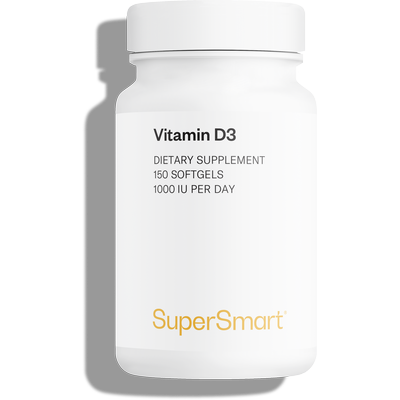
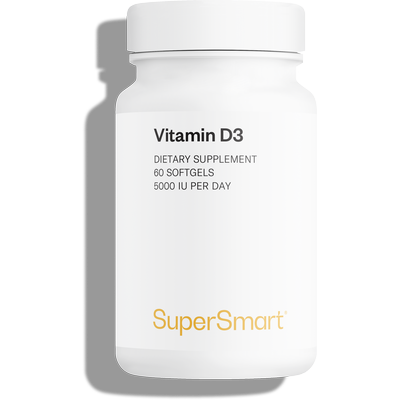
It is therefore well worth considering taking a course of cholecalciferol (D3) supplements, such as the product Vitamin D3 1000 IU for a medium dose, or Vitamin D3 5000 IU for a higher dose.
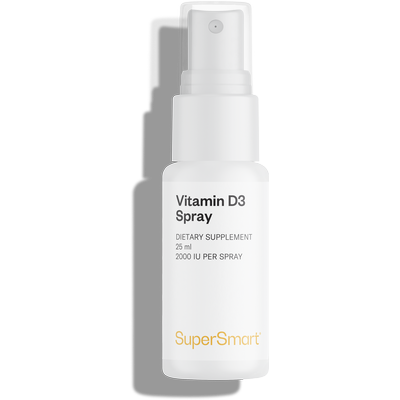
Those with a sensitive stomach can opt for Vitamin D3 Spray 2000 IU, which is sprayed under the tongue.
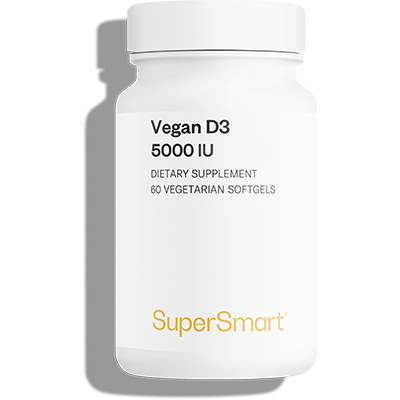
If you’d prefer a plant-source vitamin D supplement, choose Vegan D3, an excellent source of cholecalciferol extracted from algae, combined with coconut oil MCTs for optimal absorption.
SUPERSMART ADVICE
References
- (1)GRANT, William B. et HOLICK, Michael F. Benefits and requirements of vitamin D for optimal health: a review. Altern Med Rev, 2005, vol. 10, no 2, p. 94-111.
- Liu PT, Stenger S, et al. Toll like receptor triggering of a vitamin D mediated human antimicrobial response. Science, 2006, 311 : 1770.
- Rapport de l’Académie nationale de médecine. Statut vitaminique, rôle extra osseux et besoins quotidiens en vitamine D. Bull Acad Natle Med. 2012, 196, 1011.
- Laird E, Rhodes JM and Kenny RA. Vitamin D and inflammation : potential implications for severity of Covid-19. Irish med J, 2020, 113 : 81.
- Vitamine D : métabolisme, régulation et maladies associées, Emilie Tissandié, Yann Guéguen, Jean-Marc A. Lobaccaro, Jocelyne Aigueperse, Maâmar Souidi, MEDECINE/SCIENCES 2006 ; 22 : 1095-100
- O'DONOVAN, Peter, PERRETT, Conal M., ZHANG, Xiaohong, et al. UVA light generate mutagenic oxidative DNA damage. Science, 2005, vol. 309, no 5742, p. 1871-1874.
- NISHIMURA, Kazuki, IKEHATA, Hironobu, DOUKI, Thierry, et al. Seasonal Differences in the UVA/UVB Ratio of Natural Sunlight Influence the Efficiency of the Photoisomerization of (6‐4) Photoproducts into their Dewar Valence Isomers. Photochemistry and Photobiology, 2020.
- Statut vitaminique, rôle extra osseux et besoins quotidiens en vitamine D, Bernard Salle, Bull. Acad. Natle Méd., 2012, 196, nos 4-5, 1011-1015, séance du 15 mai 2012
- Maugars Y, Glémarec J, Guillot P, et al. Métabolisme phosphocalcique et ostéomalacie. Rev Rhum 2000 ; 67 (suppl 2) : 95-8.
- Breuil V, Euller-Ziegler. Nutrition et vieillissement osseux : l’ostéoporose. Nutr Clin Metab 2004 ; 18 : 212-8
Keywords





5 Days
Prodotti eccezionali
Prodotti eccezionali! Consegna rapida e precisa
paola
16 Days
Heldere info
Heldere info
HanS.
16 Days
Snelle levering
Snelle levering
harrie
22 Days
Adequate info en hoge kwaliteit
Adequate info en hoge kwaliteit
HanS.
31 Days
Supplementen zijn goed.
Supplementen zijn goed. Zachte prijzen. Website met problemen ( altijd ) niet goed voor nieuwe klanten.
Gino RJ
41 Days
Alles op tijd geleverd.
Alles op tijd geleverd. De producten worden alsmaar duurder, terwijl mijn pensioen niet meer stijgt. Vandaar kan ik alsmaar minder vaak bestellen.
Wouters
1111 Days
Great service
Great service
Ryszard
1123 Days
Profesjonalna obsługa
Bardzo dobre i rzeczowe opisy. Profesjonalna obsługa.
PIEKOSZEWSKI Chris
1792 Days
Wszystko OK!
Wszystko poszło jak powinno 🙂
SITKIEWICZ Pawel
2579 Days
Szybko sprawnie bez problemów
Szybko sprawnie bez problemów
Marek
of experience
your money back
##montant## purchase