
Weight loss: a study explains why GLP-1 has become indispensable
From celebrities to social media, GLP-1 has become a real media phenomenon. But what mechanisms explain the success of this intestinal hormone in weight loss? A recent scientific study offers some answers.


Why has GLP-1 become essential for weight loss?
A recent scientific review published in 2025 reports that the effects of GLP-1 on weight loss are based on a combination of several physiological and behavioural mechanisms, including (1):
- a reduction in appetite and a spontaneous reduction in food intake;
- increased satiety;
- slower gastric emptying;
- better regulation of blood glucose levels and energy metabolism.
How does GLP-1 promote weight loss?
GLP-1 (short for glucagon-like peptide-1) is a hormone naturally produced by certain intestinal cells in the ileum and colon in response to a meal. Its main role is to signal to the body that food has been consumed, thereby coordinating various physiological responses involved in digestion, nutrient management and appetite regulation (2).
Effects on appetite and eating behaviour
GLP-1’s effect on the brain centres involved in appetite regulation is one of the best-documented aspects of the hormone.
Once released by the gut, this hormone is thought to target several brain regions involved in controlling food intake, including the hypothalamus, which regulates hunger and satiety (3).
It is thought to promote the activity of neurons that send anorexigenic signals and reduce appetite, particularly those expressing pro-opiomelanocortin (POMC), whilst inhibiting the activity of orexigenic neurons that produce neuropeptide Y (NPY) and AgRP, two powerful hunger stimulators (4–5). The balance would thus ultimately tip in favour of satiety.
Furthermore, GLP-1 is thought to modulate certain brain circuits involved in motivation and food reward (6). In particular, it is thought to reduce the craving for foods very high in sugar or fat, which would help to spontaneously reduce energy intake.
A sufficient release of GLP-1 is therefore associated with:
- a reduction in cravings and snacking;
- a reduction in portion sizes;
- a reduced appetite for high-calorie foods;
Prolonged satiety due to slowed gastric emptying
GLP-1 also acts directly on the digestive system by slowing gastric emptying, i.e. by reducing the rate at which the stomach’s contents pass into the intestine (7).
However, when food remains in the stomach for longer:
- digestion is more gradual;
- the feeling of fullness lasts longer;
- the signals of satiety persist for longer after a meal.
This prolonged feeling of fullness therefore indirectly helps to limit subsequent food intake.
A role in metabolic regulation
GLP-1 is also involved in several mechanisms related to metabolic balance.
In particular, this hormone helps regulate blood glucose levels. It promotes insulin secretion when blood glucose levels rise after a meal, whilst reducing the release of glucagon, which stimulates glucose production by the liver (8). This dual action helps the body to better moderate fluctuations in blood sugar following a meal.
Beyond blood glucose control alone, GLP-1 is thought to play a role in energy homeostasis, a set of physiological processes that enable the body to maintain a balance between dietary intake and its energy requirements (9).
Can certain GLP-1-related mechanisms be supported naturally?
Before becoming a therapeutic target, GLP-1 remains first and foremost an endogenous hormone, synthesised by the body in response to various nutritional signals. Certain dietary strategies and natural compounds are currently the subject of intensive research into their potential interaction with its secretion or associated biological functions.
It is, however, essential to distinguish these approaches from GLP-1 receptor agonist drugs. The latter, which directly interfere with the signalling pathways of this hormone, produce much more pronounced physiological responses, but at the cost of side effects that can sometimes be significant (particularly gastrointestinal) (10).
Nutritional approaches are not intended to replicate these pharmacological effects, but rather to support certain processes involved in GLP-1 production, and more specifically those relating to satiety, food intake and metabolic balance.
Among the ingredients most extensively studied for these properties are, amongst others:
- chromium, an essential trace element that helps maintain normal blood glucose levels and supports the normal metabolism of macronutrients (11);
- green tea, which helps to reduce appetite, maintain normal blood glucose levels and control weight. Its best-known active compound, EGCG, may also increase GLP-1 production by interacting with certain signalling pathways, such as AMPK (12);
- berberine, the active compound in Berberis vulgaris, which promotes glucose metabolism. Some studies suggest that it may stimulate GLP-1 production by activating the AMPK pathway and inhibiting an enzyme called DPP-4 (which breaks down GLP-1) (13);
- Ceylon cinnamon, which helps maintain normal blood glucose levels. Rich in cinnamaldehyde, it may improve insulin sensitivity and modulate the gut microbiota in a way that promotes the release of GLP-1 (14);
- the Metabolaid® complex, which combines extracts of hibiscus (Hibiscus sabdariffa) and lemon verbena (Aloysia citrodora). It forms the basis of seven clinical studies focusing on the stimulation of GLP-1 synthesis (15).
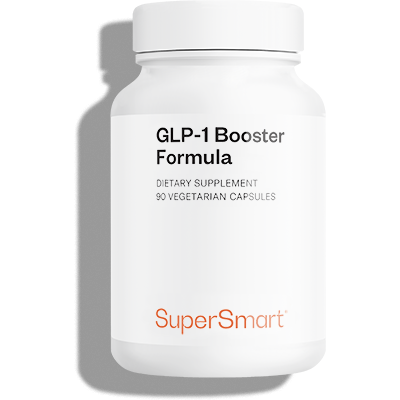
 All these valuable ingredients are combined in the natural synergy of the GLP-1 Booster Formula.
SUPERSMART ADVICE
References
- Moiz A, Filion KB, Tsoukas MA, Yu OH, Peters TM, Eisenberg MJ. Mechanisms of GLP-1 Receptor Agonist-Induced Weight Loss: A Review of Central and Peripheral Pathways in Appetite and Energy Regulation. Am J Med. 2025 Jun;138(6):934-940. doi: 10.1016/j.amjmed.2025.01.021. Epub 2025 Jan 31. PMID: 39892489.
- Müller TD, Finan B, Bloom SR, D'Alessio D, Drucker DJ, Flatt PR, Fritsche A, Gribble F, Grill HJ, Habener JF, Holst JJ, Langhans W, Meier JJ, Nauck MA, Perez-Tilve D, Pocai A, Reimann F, Sandoval DA, Schwartz TW, Seeley RJ, Stemmer K, Tang-Christensen M, Woods SC, DiMarchi RD, Tschöp MH. Glucagon-like peptide 1 (GLP-1). Mol Metab. 2019 Dec;30:72-130. doi: 10.1016/j.molmet.2019.09.010. Epub 2019 Sep 30. PMID: 31767182; PMCID: PMC6812410.
- Hwang E, Portillo B, Williams KW. Glucagon-Like Peptide 1 (GLP-1) Action on Hypothalamic Feeding Circuits. Endocrinology. 2025 Sep 8;166(10):bqaf125. doi: 10.1210/endocr/bqaf125. PMID: 40911609; PMCID: PMC12641536.
- Péterfi Z, Szilvásy-Szabó A, Farkas E, Ruska Y, Pyke C, Knudsen LB, Fekete C. Glucagon-Like Peptide-1 Regulates the Proopiomelanocortin Neurons of the Arcuate Nucleus both Directly and Indirectly via Presynaptic Action. Neuroendocrinology. 2021;111(10):986-997. doi: 10.1159/000512806. Epub 2020 Nov 5. PMID: 33152734.
- Shen J, Wang M, Pang G, Zhang Y, Zhang J, Shi Y, Liu J, Zhan C. GLP-1 receptor agonist exendin-4 suppresses food intake by inhibiting hindbrain orexigenic NPY neurons. Am J Physiol Endocrinol Metab. 2025 May 1;328(5):E661-E674. doi: 10.1152/ajpendo.00528.2024. Epub 2025 Mar 24. PMID: 40126941.
- Jensen ME, Galli A, Thomsen M, Jensen KL, Thomsen GK, Klausen MK, Vilsbøll T, Christensen MB, Holst JJ, Owens A, Robertson S, Daws L, Zanella D, Gether U, Knudsen GM, Fink-Jensen A. Glucagon-like peptide-1 receptor regulation of basal dopamine transporter activity is species-dependent. Neurochem Int. 2020 Sep;138:104772. doi: 10.1016/j.neuint.2020.104772. Epub 2020 May 25. PMID: 32464226; PMCID: PMC7452124.
- Shankar A, Sharma A, Vinas A, Chilton RJ. GLP-1 receptor agonists and delayed gastric emptying: implications for invasive cardiac interventions and surgery. Cardiovasc Endocrinol Metab. 2024 Dec 4;14(1):e00321. doi: 10.1097/XCE.0000000000000321. PMID: 39649679; PMCID: PMC11620716.
- Fisman EZ, Tenenbaum A. The dual glucose-dependent insulinotropic polypeptide (GIP) and glucagon-like peptide-1 (GLP-1) receptor agonist tirzepatide: a novel cardiometabolic therapeutic prospect. Cardiovasc Diabetol. 2021 Nov 24;20(1):225. doi: 10.1186/s12933-021-01412-5. PMID: 34819089; PMCID: PMC8613929.
- Salehi M, Purnell JQ. The Role of Glucagon-Like Peptide-1 in Energy Homeostasis. Metab Syndr Relat Disord. 2019 May;17(4):183-191. doi: 10.1089/met.2018.0088. Epub 2019 Feb 5. PMID: 30720393; PMCID: PMC6610028.
- Kommu S, Whitfield P. Semaglutide. [Updated 2024 Feb 11]. In: StatPearls [Internet]. Treasure Island (FL): StatPearls Publishing; 2026 Jan-. Available from: https://www.ncbi.nlm.nih.gov/books/NBK603723/
- Asbaghi O, Fatemeh N, Mahnaz RK, Ehsan G, Elham E, Behzad N, Damoon AL, Amirmansour AN. Effects of chromium supplementation on glycemic control in patients with type 2 diabetes: a systematic review and meta-analysis of randomized controlled trials. Pharmacol Res. 2020 Nov;161:105098. doi: 10.1016/j.phrs.2020.105098. Epub 2020 Jul 28. PMID: 32730903.
- Song WY, Aihara Y, Hashimoto T, Kanazawa K, Mizuno M. (-)-Epigallocatechin-3-gallate induces secretion of anorexigenic gut hormones. J Clin Biochem Nutr. 2015 Sep;57(2):164-9. doi: 10.3164/jcbn.15-50. Epub 2015 Sep 1. PMID: 26388676; PMCID: PMC4566026.
- Araj-Khodaei M, Ayati MH, Azizi Zeinalhajlou A, Novinbahador T, Yousefi M, Shiri M, Mahmoodpoor A, Shamekh A, Namazi N, Sanaie S. Berberine-induced glucagon-like peptide-1 and its mechanism for controlling type 2 diabetes mellitus: a comprehensive pathway review. Arch Physiol Biochem. 2024 Dec;130(6):678-685. doi: 10.1080/13813455.2023.2258559. Epub 2023 Nov 3. PMID: 37921026.
- Tjandrawinata RR, Rosari BP, Syahputra RA, Surya R, Nurkolis F. Cinnamon-Derived Phytonutrients as Modulators of Ion Channels and G Protein-Coupled Receptor Signaling in Metabolic Diseases. Nutrients. 2026 Feb 6;18(3):547. doi: 10.3390/nu18030547. PMID: 41683369; PMCID: PMC12899492.
- Serna A, Marhuenda J, Arcusa R, Pérez-Piñero S, Sánchez-Macarro M, García-Muñoz AM, Victoria-Montesinos D, Cánovas F, López-Román FJ. Effectiveness of a polyphenolic extract (Lippia citriodora and Hibiscus sabdariffa) on appetite regulation in overweight and obese grade I population: an 8-week randomized, double-blind, cross-over, placebo-controlled trial. Eur J Nutr. 2022 Mar;61(2):825-841. doi: 10.1007/s00394-021-02678-x. Epub 2021 Sep 30. PMID: 34591168; PMCID: PMC8854308.




1084 Days
Great service
Great service
Ryszard
1096 Days
Profesjonalna obsługa
Bardzo dobre i rzeczowe opisy. Profesjonalna obsługa.
PIEKOSZEWSKI Chris
1764 Days
Wszystko OK!
Wszystko poszło jak powinno 🙂
SITKIEWICZ Pawel
2551 Days
Szybko sprawnie bez problemów
Szybko sprawnie bez problemów
Marek
of experience
your money back
##montant## purchase