Limited quantity
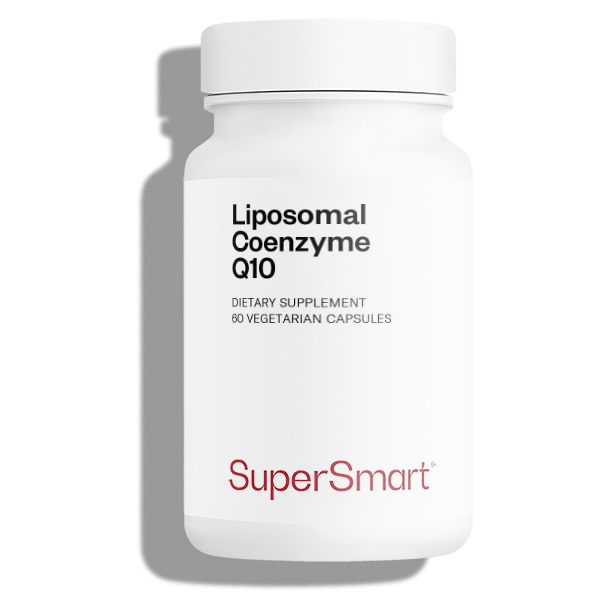
Liposomal Coenzyme Q10
Liposomal Coenzyme Q10 + Vitamins C/E | Heart, Antioxidant


Complete your selection
Liposomal Coenzyme Q10 is a dietary supplement containing liposomal coenzyme Q10.
Coenzyme Q10 is a compound naturally produced by the body, which plays a role in cellular energy production and is particularly abundant in the heart.
This product stands out by providing coenzyme Q10 encapsulated in liposomes, which enhance its bioavailability, whilst combining it with the antioxidant vitamins C and E.
Coenzyme Q10: definition, decline with age and the benefits of the liposomal form
What is coenzyme Q10?
Coenzyme Q10 (CoQ10) is a fat-soluble molecule naturally produced by the body.
Concentrated particularly in the mitochondria (the cells’ powerhouses), it is involved in the mitochondrial respiratory chain and thus plays an essential role in the production of ATP, the main form of energy usable by cells (1).
It is found in high concentrations in organs with high energy requirements, particularly the heart, kidneys and liver.
Decline in CoQ10 production with age
The body’s natural production of coenzyme Q10 gradually decreases with age and can also be affected by physiological stress or certain medicines (2).
As a reduction in its levels can affect mitochondrial function and cellular energy production, CoQ10 supplementation is being investigated for its potential role in maintaining adequate levels.
Liposomal coenzyme Q10: how do liposomes enhance its intestinal absorption?
Coenzyme Q10 is highly lipophilic (fat-soluble) and poorly soluble in water, which can limit its dispersion and absorption in aqueous digestive fluids.
Liposomal technology therefore encapsulates CoQ10 within vesicles made up of phospholipids, the hydrophilic part of which interacts with the aqueous environment whilst the lipophilic part keeps the CoQ10 within a lipid environment.
This structure allows for better distribution of coenzyme Q10 within the digestive tract and promotes its intestinal absorption, thereby increasing the amount that reaches the systemic circulation (3).
Furthermore, this molecule is susceptible to oxidation and degradation during digestion.
Encapsulating it within liposomal phospholipid bilayers also helps to protect it from environmental degradation and oxidative damage throughout the gastrointestinal tract.
Composition and benefits of this liposomal coenzyme Q10 dietary supplement
A combination of liposomal coenzyme Q10, vitamin C and vitamin E
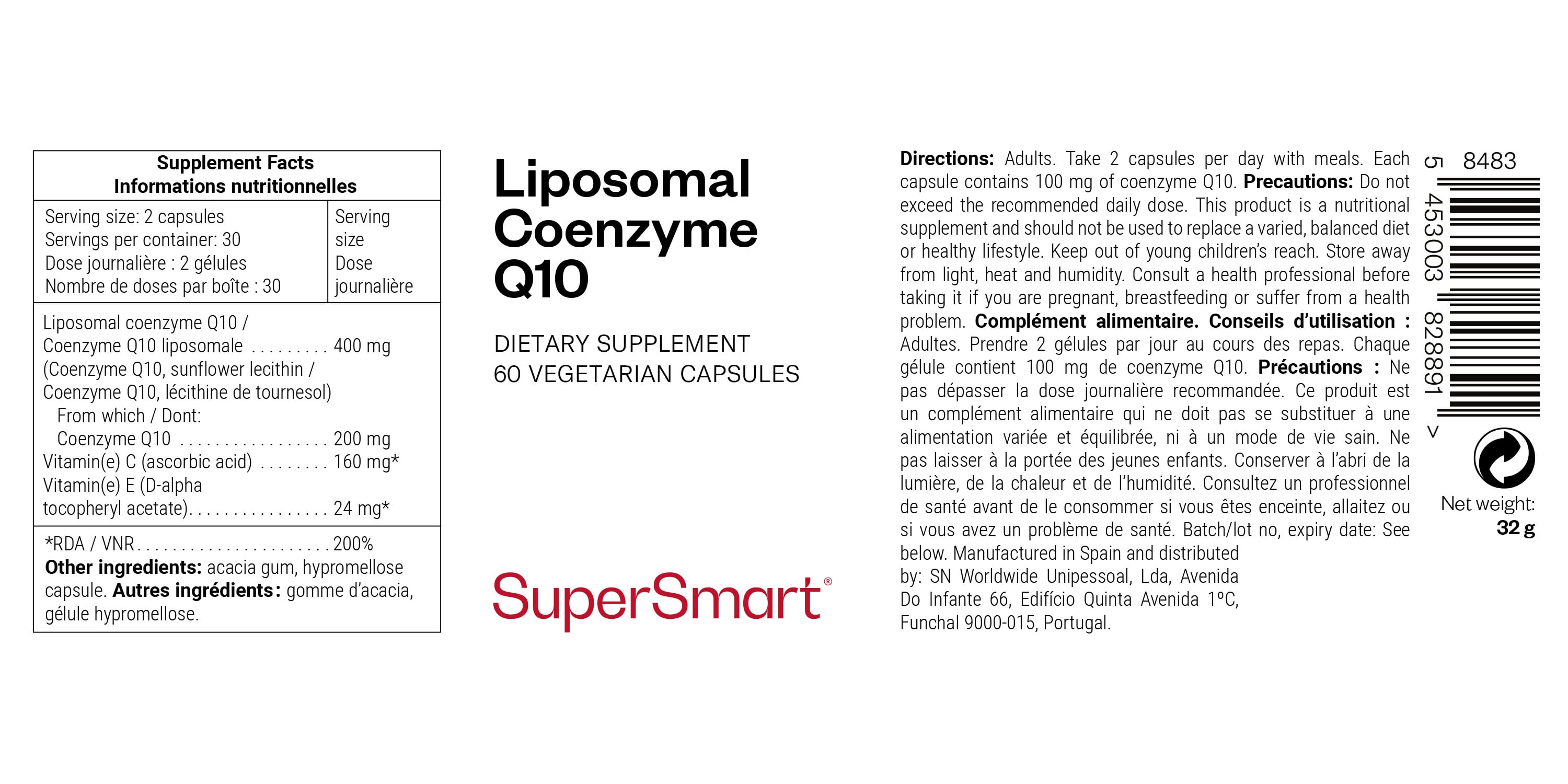
At a dose of 2 capsules daily, Liposomal Coenzyme Q10 provides you with 3 key ingredients:
- 400 mg of liposomal coenzyme Q10 per day (a combination of coenzyme Q10 and sunflower lecithin forming the liposomes), of which 200 mg is coenzyme Q10;
- 160 mg of vitamin C (ascorbic acid) per day;
- and 24 mg of vitamin E (D-alpha-tocopheryl acetate) per day.
Benefits of this liposomal formula for mitochondrial and cardiovascular health and oxidative stress
The components of this formula act at several levels within the body:
- cellular energy and mitochondria: coenzyme Q10 is a component of the mitochondrial electron transport chain, where it plays a part in the transfer of electrons necessary for cellular energy production (4). Vitamin C, for its part, contributes to normal energy metabolism and helps reduce fatigue. In particular, it is involved in reactions that enable the body to convert nutrients into energy (5);
- the heart’s energy requirements: the heart has significant energy requirements to ensure its continuous contractions. It is one of the organs with the highest levels of CoQ10, hence the scientific interest in this molecule in the cardiovascular field (6);
- antioxidant defences and redox balance: vitamins C and E help protect cells against oxidative stress by helping to neutralise free radicals that can damage cellular components (7–8). CoQ10 is involved in redox reactions and, due to its fat-soluble nature, is found mainly in lipid environments such as cell and mitochondrial membranes (9), much like vitamin E. Vitamin C, which is water-soluble, is active in aqueous environments. Vitamin C also helps to regenerate the reduced form of vitamin E by donating an electron to it after it has been oxidised, thereby enabling it to regain its antioxidant activity;
- maintaining CoQ10 levels as we age: as levels of this coenzyme tend to decline over the years, supplementation is being investigated for its potential role in maintaining adequate levels (10).
5 key benefits and reasons to buy our liposomal coenzyme Q10 with vitamins C and E
Our Liposomal Coenzyme Q10 dietary supplement stands out for 5 key benefits:
- a liposomal technology particularly suited to coenzyme Q10: CoQ10 is encapsulated in tiny lipid vesicles called liposomes, which facilitate the diffusion and absorption of this lipophilic molecule into aqueous digestive fluids, whilst protecting it from the stresses of the gastrointestinal environment;
- a formula combining liposomal CoQ10 with vitamins C and E: unlike many supplements that focus solely on CoQ10, our formula combines it with 160 mg of vitamin C and 24 mg of vitamin E per day, two complementary antioxidant vitamins;
- a high daily dose of 200 mg of coenzyme Q10: each daily dose of this product provides 400 mg of liposomal coenzyme Q10, including 200 mg of CoQ10, thus combining bioavailability with a high concentration;
- sunflower lecithin for the liposomal formulation: the liposomes are made from sunflower lecithin, an alternative to formulations using soya lecithin;
- a simple, refined composition: apart from the active ingredients and the lecithin required for the liposomal form, the formula contains only acacia gum and vegetable-based hypromellose capsules (a derivative of cellulose, a natural fibre), thus avoiding any unnecessary ingredients.
Who is it for?
Liposomal Coenzyme Q10 is particularly suitable for people who wish to support their coenzyme Q10 intake, notably:
- older adults: the body’s own production of coenzyme Q10 gradually decreases with age, even though this molecule plays an essential role in energy production within the mitochondria;
- people wishing to support their energy metabolism: CoQ10 plays a direct role in the mitochondrial respiratory chain and in ATP production, whilst vitamin C contributes to normal energy metabolism and helps reduce fatigue;
- people who are particularly mindful of their cardiovascular health: coenzyme Q10 is naturally present in high concentrations in the heart, an organ with significant energy requirements;
- people exposed to significant oxidative stress: the formula also provides vitamins C and E, both of which help protect cells against oxidative stress;
- and anyone looking for an optimised form of coenzyme Q10: its encapsulation in liposomes is designed to improve the dispersion and bioavailability of this molecule, which is naturally difficult to absorb.
Which synergistic dietary supplements should be taken alongside our liposomal coenzyme Q10?
L-carnitine and cellular energy
L-carnitine is an amino acid derivative that plays a key role in transporting long-chain fatty acids to the mitochondria, where they can be used to produce ATP.
It therefore works in conjunction with coenzyme Q10, which also plays a role in cellular energy production at the mitochondrial level.
For a more comprehensive approach to energy metabolism, you can therefore combine Liposomal Coenzyme Q10 with an L-carnitine supplement (for example, L-Carnitine Formula, which combines two complementary forms of carnitine).
Complementary nutrients for mitochondrial health
Other compounds can be combined with coenzyme Q10 to have a complementary effect on the mitochondria.
This is particularly true of R-alpha-lipoic acid, which plays a role in mitochondrial metabolism and antioxidant defences, and PQQ, which is being studied for its potential role in mitochondrial biogenesis, i.e. the formation of new mitochondria.
A formula combining PQQ, R-alpha-lipoic acid and L-carnitine can therefore effectively complement the effects of CoQ10 (see Mitochondrial Formula).
The role of urolithin A in mitophagy (mitochondrial recycling)
Urolithin A is a metabolite being studied for its potential role in mitophagy, the mechanism that enables cells to eliminate and recycle damaged or dysfunctional mitochondria.
Its benefits therefore complement those of coenzyme Q10: whilst the latter plays a part in the energy metabolism of mitochondria, urolithin A may help to maintain their health and support their renewal (you can therefore buy Urolithin A).
Coenzyme Q10 deficiency: possible causes and consequences
Why might coenzyme Q10 levels decrease?
Several factors can contribute to a decrease in CoQ10 levels:
- the body’s natural production of this coenzyme tends to decline with age;
- certain states of physiological stress may be associated with lower CoQ10 concentrations;
- certain medicines can also reduce its levels, particularly statins, which inhibit the mevalonate pathway, involved in both cholesterol and CoQ10 synthesis.
What are the potential consequences of low CoQ10 levels?
An insufficient supply of coenzyme Q10 may be associated with, amongst other things:
- impaired cellular energy production, due to its central role in the mitochondrial respiratory chain;
- impaired functioning of tissues with high energy requirements, particularly the heart, kidneys, liver and muscles;
- reduced protection against oxidative stress, as CoQ10 also plays a part in the antioxidant mechanisms of cell membranes.
Quality control, purity and traceability
Our Liposomal Coenzyme Q10 combines 200 mg of coenzyme Q10 per daily dose with liposomal technology based on sunflower lecithin (and therefore soya-free), as well as vitamins C and E.
Its composition is deliberately simple: apart from the active ingredients and the lecithin required for the liposomal formulation, it contains only acacia gum and a vegetable-based hypromellose capsule.
Each batch undergoes rigorous quality controls to ensure it complies with the established specifications.
Certificates of analysis (COAs) for the batches sold are available to view directly on this page, in the interests of transparency and traceability.
What is in Liposomal Coenzyme Q10
Any questions?
Our team of nutrition experts and scientists has the answers.
Liposomal coenzyme Q10 offers the best bioavailability.
In the aqueous digestive environment, the hydrophilic part of the liposomes orients itself towards the water, whilst the lipophilic part forms a lipid environment within the structure, in which CoQ10 is retained.
This structure facilitates the dispersion of CoQ10 in the digestive tract and its absorption in the gut.
Coenzyme Q10 should, above all, be taken with a meal.
As it is lipophilic (fat-soluble), the presence of fats can indeed aid its absorption.
It may be preferable to take one in the morning or during the day if you have particular sensitivity relating to sleep.
Coenzyme Q10 exists in two main forms:
- ubiquinone (its oxidised form), generally used in supplements labelled simply ‘coenzyme Q10’;
- and ubiquinol (its reduced form), often valued for its high bioavailability.
The body can naturally convert these two forms into one another.
Liposomal CoQ10 takes a different approach: coenzyme Q10 (ubiquinone) is encapsulated within lipid structures designed to enhance its absorption and bioavailability.
CoQ10 is generally well tolerated.
Mild side effects, particularly digestive ones, have occasionally been reported.
This coenzyme may also interact with certain medicines.
If you are undergoing medical treatment, it is recommended that you seek advice from a healthcare professional.
Need help?
You may also like
of experience
your money back
##montant## purchase