
The alkaline diet to combat acidification of the body
We often hear about ‘acidifying’ or ‘alkalising’ foods, but what do these terms actually mean? Does the alkaline diet really affect our acid-base balance? We take a closer look.
- ✓The alkaline diet aims to reduce the acid load from food, not to directly alter the pH of the blood.
- ✓The PRAL index is used to estimate the acidifying or alkalising potential of foods after they have been metabolised.
- ✓Fruit and vegetables generally have a negative PRAL, whilst meat, fish and cheese often have a positive PRAL.
- ✓A balanced diet, without any specific restrictions, is generally sufficient to maintain the body’s acid-base balance.


What is the body’s acid-base balance?
Blood pH: a tightly regulated balance
As a reminder, pH (short for ‘potential hydrogen’) measures the acidity or alkalinity of a medium. A value of 7 is considered ‘neutral’; below this, the medium is described as ‘acidic’; above this, it is described as ‘alkaline’ or ‘basic’.
Within the body, pH varies depending on the tissue and biological fluid. The pH of arterial blood is normally maintained within a narrow range, between 7.35 and 7.45 (1).
This balance is maintained by several complementary mechanisms: buffer systems, based on the bicarbonate/carbonic acid pair; the lungs, which regulate the elimination of carbon dioxide; and the kidneys, which, amongst other things, ensure the excretion of acids.
In a healthy person, these various physiological processes normally prevent ordinary meals from causing significant acidification of the blood.
Modern diet: why do we talk about acid load?
The metabolism of food produces substances that influence the amount of acids our body must eliminate.
Proteins rich in sulphur-containing amino acids, in particular, contribute to acid formation. Conversely, many fruits and vegetables provide potassium salts combined with certain organic acids which, once metabolised, produce bicarbonates (2).
A diet rich in animal products and low in plant-based foods can therefore result in a high dietary acid load, leading to increased excretion of acids by the kidneys. In the long term, this strain may prove problematic for people whose kidney function is already impaired (3).
Please note: an acidifying diet does not necessarily lead to a state of metabolic acidosis. This medical condition, which can occur in particular in cases of kidney failure, is characterised by a reduction in blood bicarbonate levels, usually associated with a drop in blood pH (4).
Alkaline diet: how does it work?
The PRAL index: a useful indicator
To understand the alkaline diet, it is important to distinguish between two concepts that are often confused.
The pH of a food measures its acidity before consumption. The PRAL (Potential Renal Acid Load) index, on the other hand, estimates the acid or alkalising load that a food is likely to generate after it has been metabolised, which the kidneys will then have to process.
Expressed in milliequivalents per 100 g of food (mEq/100 g), it depends in particular on the food’s content of protein, phosphorus, potassium, magnesium and calcium (5).
There are thus three main categories of food:
- those with a positive PRAL, which have an acid-forming potential;
- those with a negative PRAL, which have an alkalising potential;
- those with a PRAL close to 0, which have a neutral potential.
A food can therefore perfectly well have an acidic pH and a negative PRAL. This is particularly the case with lemons. Conversely, a food can have a positive PRAL and a basic or neutral pH, such as certain cheeses.
The PRAL is therefore not a measure of blood pH, but a tool for estimating the acid load of food.
Which foods are acidifying or alkalising?
Here are some examples of indicative PRAL values per 100 g of food, based on the tables by Remer and Manz (6). The more positive the value, the greater the food’s acidifying potential. Conversely, the more negative the value, the greater its alkalising potential.
Foods with acidifying potential (positive PRAL)
| Food | PRAL (mEq/100 g) |
|---|---|
| Parmesan | +34.2 |
| Cheddar | ≈ +20 |
| Camembert | ≈ +15 |
| Meat (approximate value) | ≈ +8 |
| Fish (approximate value) | ≈ +8 |
| White, dry pasta | ≈ +8 |
| White bread | ≈ +6 |
| White rice, uncooked | ≈ +4.5 |
| Eggs (approximate value) | ≈ +4 |
Foods with alkalising potential (negative PRAL)
| Food | PRAL (mEq/100 g) |
|---|---|
| Sultanas | −21 |
| Potatoes | ≈ −4 |
| Fresh fruit (average) | ≈ −3 |
| Vegetables (average) | ≈ −2.8 |
These values are indicative. They vary depending on the variety, composition and preparation of the food. Pasta and rice are considered here in their dry or uncooked state.
These scores do not, on their own, determine the nutritional quality of foods. Despite having a positive PRAL, fish provide protein and valuable nutrients, as do whole grains, which are sources of fibre and minerals. Conversely, refined sugar, which has a PRAL close to zero, is not necessarily the best choice. It is therefore far more relevant to consider the overall balance of meals than to classify each food as ‘good’ or ‘bad’ based on its acid load.
What are the potential benefits of a less acid-forming diet?
Acid load and kidney health: what the studies show
Research has explored the links between dietary acid load and kidney function. In particular, a meta-analysis of observational studies reported an association between high acid load and an increased risk of chronic kidney disease, although this alone did not demonstrate a causal link (7).
Clinical trials conducted in people with chronic kidney disease have also shown that a higher intake of fruit and vegetables can reduce acid load and improve certain kidney parameters (8).
However, these results relate to populations under medical supervision. They do not imply that an alkaline diet systematically prevents or treats kidney disease in healthy people.
Alkaline diets and bone health: what are the benefits?
The alkaline diet is often presented as a way of maintaining bone health.
This hypothesis is based on the role of bones in acid-base balance. As they are rich in minerals, they can theoretically help to neutralise excess acids. In the long term, this mobilisation could therefore lead to bone demineralisation and weakening.
Some studies have indeed observed an association between a high dietary acid load and lower bone density (9). Others have noted beneficial effects of alkalising supplements on certain markers of bone metabolism (10). However, the results remain mixed and do not allow us to conclude that an acid-forming diet directly causes osteoporosis, nor that an alkaline diet is sufficient to prevent it.
The value of this approach therefore lies more in the nutritional benefits of a plant-based diet, which provides vitamins, minerals, fibre and various health-promoting compounds.
How can you adopt an alkaline diet in your daily life?
In practice, the alkaline diet does not require any drastic cut-outs. It mainly involves making plants a bigger part of your meals, whilst maintaining a varied diet.
A few simple habits can help:
- serve meat, fish or eggs with a generous portion of vegetables;
- vary your fruit and vegetable choices with the seasons;
- regularly include potatoes and pulses in your meals;
- limit your intake of excess salt and ultra-processed foods;
- stay well-hydrated, without necessarily seeking out water with a high pH.
A balanced meal with a moderate acid load might, for example, consist of a fillet of fish served with potatoes, broccoli and a piece of fresh fruit for dessert.
The important thing, therefore, is not to mathematically balance the PRAL of each food, but to build a varied diet with a sufficient proportion of plant-based foods.
What role do alkalising dietary supplements play?
As a complement to a suitable diet, certain formulations combine mineral salts and plant extracts.
Citrates are of particular interest for acid-base balance: when taken in the form of mineral salts, their metabolism can generate bicarbonate equivalents, which help to ‘buffer’ the body’s acid load (11).
Calcium and magnesium, meanwhile, help maintain normal bones, whilst potassium helps maintain normal blood pressure, which is important for kidney health (12).
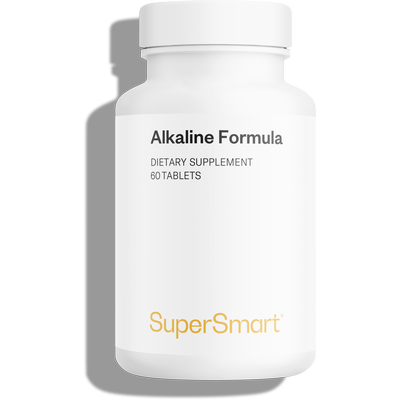
 Discover SuperSmart’s Alkaline Formula, which combines calcium and magnesium citrates, potassium phosphate and several plant-based ingredients such as ginger, chamomile, parsley and liquorice in a 100% natural formulation.
FAQs on the alkaline diet
Is lemon acidic or alkalising?
Lemons, which taste sour, have a low pH. However, their renal potential after metabolism is generally alkalising. This illustrates why one should not confuse a food’s pH with its PRAL index.
Is cider vinegar acidifying or alkalising?
Although it is naturally acidic, cider vinegar is not necessarily acidifying for the body. In particular, it contains small amounts of minerals that could give it a slightly alkalising potential. However, there is currently insufficient scientific evidence to confirm a significant alkalising effect.
Can an alkaline diet alter blood pH?
In a healthy person, not significantly. Blood pH is tightly regulated by the lungs, kidneys and buffering systems. Diet can mainly affect the acid load excreted by the kidneys and the pH of urine.
Should all acid-forming foods be avoided?
No. Foods with a positive PRAL, such as eggs, fish or cereals, can provide essential nutrients. The alkaline diet is more about combining them with sufficient quantities of fruit and vegetables, without unnecessary restrictions.
SUPERSMART ADVICE
References
- Hopkins E, Sanvictores T, Sharma S. Physiology, Acid Base Balance. In: StatPearls [Internet]. Treasure Island (FL): StatPearls Publishing; mise à jour du 12 septembre 2022. PMID: 29939584. 🔗
- Schwalfenberg GK. The Alkaline Diet: Is There Evidence That an Alkaline pH Diet Benefits Health? Journal of Environmental and Public Health. 2012;2012:727630. doi: 10.1155/2012/727630. 🔗
- Goraya N, Wesson DE. Dietary management of chronic kidney disease: protein restriction and beyond. Current Opinion in Nephrology and Hypertension. 2012;21(6):635–640. doi: 10.1097/MNH.0b013e328357a69b. PMID: 23079747. 🔗
- Hopkins E, Sanvictores T, Sharma S. Physiology, Acid Base Balance. In: StatPearls [Internet]. Treasure Island (FL): StatPearls Publishing; mise à jour du 12 septembre 2022. PMID: 29939584. 🔗
- Remer T, Manz F. Potential renal acid load of foods and its influence on urine pH. Journal of the American Dietetic Association. 1995;95(7):791–797. doi: 10.1016/S0002-8223(95)00219-7. PMID: 7797810. 🔗
- Remer T, Manz F. Potential renal acid load of foods and its influence on urine pH. Journal of the American Dietetic Association. 1995;95(7):791–797. doi: 10.1016/S0002-8223(95)00219-7. PMID: 7797810. 🔗
- Dietary acid load, kidney function and risk of chronic kidney disease: a systematic review and meta-analysis of observational studies. 2019. PMID: 30987546. 🔗
- Goraya N, Simoni J, Jo C, Wesson DE. Dietary acid reduction with fruits and vegetables or bicarbonate attenuates kidney injury in patients with a moderately reduced glomerular filtration rate due to hypertensive nephropathy. Kidney International. 2012;81(1):86–93. doi: 10.1038/ki.2011.313. PMID: 21881553. 🔗
- Gholami F, Naghshi S, Samadi M, Rasaei N, Mirzaei K. Dietary Acid Load and Bone Health: A Systematic Review and Meta-Analysis of Observational Studies. Frontiers in Nutrition. 2022;9:869132. doi: 10.3389/fnut.2022.869132. PMID: 35600825. 🔗
- Jehle S, Zanetti A, Muser J, Hulter HN, Krapf R. Partial neutralization of the acidogenic Western diet with potassium citrate increases bone mass in postmenopausal women with osteopenia. Journal of the American Society of Nephrology. 2006;17(11):3213–3222. doi: 10.1681/ASN.2006030233. PMID: 17035614. 🔗
- Lew SQ, Kohn OF, Cheng YL, Kjellstrand CM, Ing TS. Three-Stream, Bicarbonate-Based Hemodialysis Solution Delivery System Revisited: With an Emphasis on Some Aspects of Acid-Base Principles. Artificial Organs. 2017;41(6):509–518. doi: 10.1111/aor.12947. 🔗
- Commission européenne. Règlement (UE) nº 432/2012 de la Commission du 16 mai 2012 établissant une liste des allégations de santé autorisées portant sur les denrées alimentaires, autres que celles faisant référence à la réduction du risque de maladie ainsi qu'au développement et à la santé infantiles. Journal officiel de l'Union européenne. 2012;L136:1–40. Annexe : allégations relatives au calcium, au magnésium et au potassium. 🔗
Keywords





38 Minutes
Productos de muy buena calidad
Productos de muy buena calidad
JIMENEZ GARRIDO Teresa
2 Days
Buena
Buenas, pero han subido bastante los precios
PASTOR MONTELL Jose Vicente
40 Days
Prodotti eccezionali
Prodotti eccezionali! Consegna rapida e precisa
paola
51 Days
Heldere info
Heldere info
HanS.
51 Days
Snelle levering
Snelle levering
harrie
56 Days
Adequate info en hoge kwaliteit
Adequate info en hoge kwaliteit
HanS.
66 Days
Supplementen zijn goed.
Supplementen zijn goed. Zachte prijzen. Website met problemen ( altijd ) niet goed voor nieuwe klanten.
Gino RJ
75 Days
Alles op tijd geleverd.
Alles op tijd geleverd. De producten worden alsmaar duurder, terwijl mijn pensioen niet meer stijgt. Vandaar kan ik alsmaar minder vaak bestellen.
Wouters
1145 Days
Great service
Great service
Ryszard
1158 Days
Profesjonalna obsługa
Bardzo dobre i rzeczowe opisy. Profesjonalna obsługa.
PIEKOSZEWSKI Chris
1826 Days
Wszystko OK!
Wszystko poszło jak powinno 🙂
SITKIEWICZ Pawel
2613 Days
Szybko sprawnie bez problemów
Szybko sprawnie bez problemów
Marek
of experience
your money back
##montant## purchase