


Complete your selection


Potential benefits of probiotics for the immune system
A probiotic formula focused on the microbiota-immunity axis
ImmunoBiotics Formula combines six probiotic strains selected for their scientific significance in various mechanisms of the microbiota-immunity axis:
- Bifidobacterium lactis BB-12™, a strain that has been extensively studied in humans for its influence on systemic and mucosal immune responses;
- SuperSmart ImmunoBiotics Proprietary Blend™, our blend of five probiotic strains: Lactobacillus rhamnosus GG (LGG), which has been extensively studied in clinical trials for its role in immune modulation and respiratory health, as well as L. plantarum, L. brevis, L. johnsonii and B. infantis, which have been studied in preclinical trials for their effects on various immune mechanisms.
Innate immunity and the first line of defence
In humans, BB-12™ has been studied for its potential influence on NK cells, which are capable of eliminating certain infected cells (1).
LGG, for its part, has been the subject of studies demonstrating its possible beneficial effects on the intestinal mucosa, the interferons involved in antiviral defences, and the repair of the intestinal wall (2).
In preclinical studies, L. brevis and L. plantarum influenced IL-1β, TNF-α and IL-6, which are involved in the activation of innate immunity, whilst B. infantis has been associated with a reduction in IL-8, a pro-inflammatory cytokine, as well as potential effects on the intestinal barrier.
Adaptive immunity and antibody production
In a randomised, double-blind, placebo-controlled trial involving 211 adults, BB-12™ was associated, following influenza vaccination, with an increase in certain IgG antibodies in the blood and secretory IgA in the mucous membranes (3).
The dose studied was at least 1 billion CFU per day, which is the dose used in ImmunoBiotics Formula.
LGG has also been the subject of clinical trials suggesting an increase in antibody production, particularly specific IgA (4–5).
In preclinical studies, L. brevis and B. infantis influenced IL-12 and IFN-γ, which are involved in the Th1 immune response, a key component of the body’s defences against intracellular pathogens.
Potential benefits for respiratory health
BB-12™ and LGG have also been clinically studied in adults in the context of respiratory disorders:
- BB-12™ has been associated with fewer days of upper respiratory tract infection symptoms (6);
- LGG has shown encouraging results regarding respiratory infections and symptoms (7).
Regulation and balance of the immune response
Finally, L. johnsonii has been studied in preclinical settings for its influence on IL-10, an anti-inflammatory cytokine, and regulatory T cells (Tregs), which limit excessive immune responses.
5 key benefits and reasons to buy the best probiotic for immunity
Our ImmunoBiotics Formula dietary supplement stands out for 5 key benefits:
- a probiotic strain that is particularly well-documented and clinically studied: Bifidobacterium lactis BB-12™ is described in around 600 scientific publications, including more than 250 publications relating to human studies. In particular, it has been the subject of a randomised, double-blind, placebo-controlled clinical trial investigating systemic and mucosal immune responses at a dose of at least 1 billion CFU per day – the amount provided by ImmunoBiotics Formula;
- a multi-strain approach targeting different immune mechanisms: BB-12™ is combined with SuperSmart ImmunoBiotics Proprietary Blend™, our proprietary blend comprising 5 complementary strains, including Lactobacillus rhamnosus GG, selected on the basis of excellent clinical and pre-clinical data relating to innate and adaptive immunity, immune regulation and the intestinal barrier;
- 15 billion CFU per day: each daily dose provides 1 billion CFU of BB-12™ and 14 billion CFU of SuperSmart ImmunoBiotics Proprietary Blend™;
- gastro-resistant capsules for better protection of the probiotics: the design of our capsules minimises the strains’ exposure to gastric acidity, thereby promoting their survival until they reach the intestine;
- a simple, carefully controlled formulation: apart from its probiotics, ImmunoBiotics Formula contains only acacia gum as an excipient, as well as a capsule made from hypromellose and pectin, with no unnecessary additional ingredients.
What is the composition of this probiotic dietary supplement for immunity?
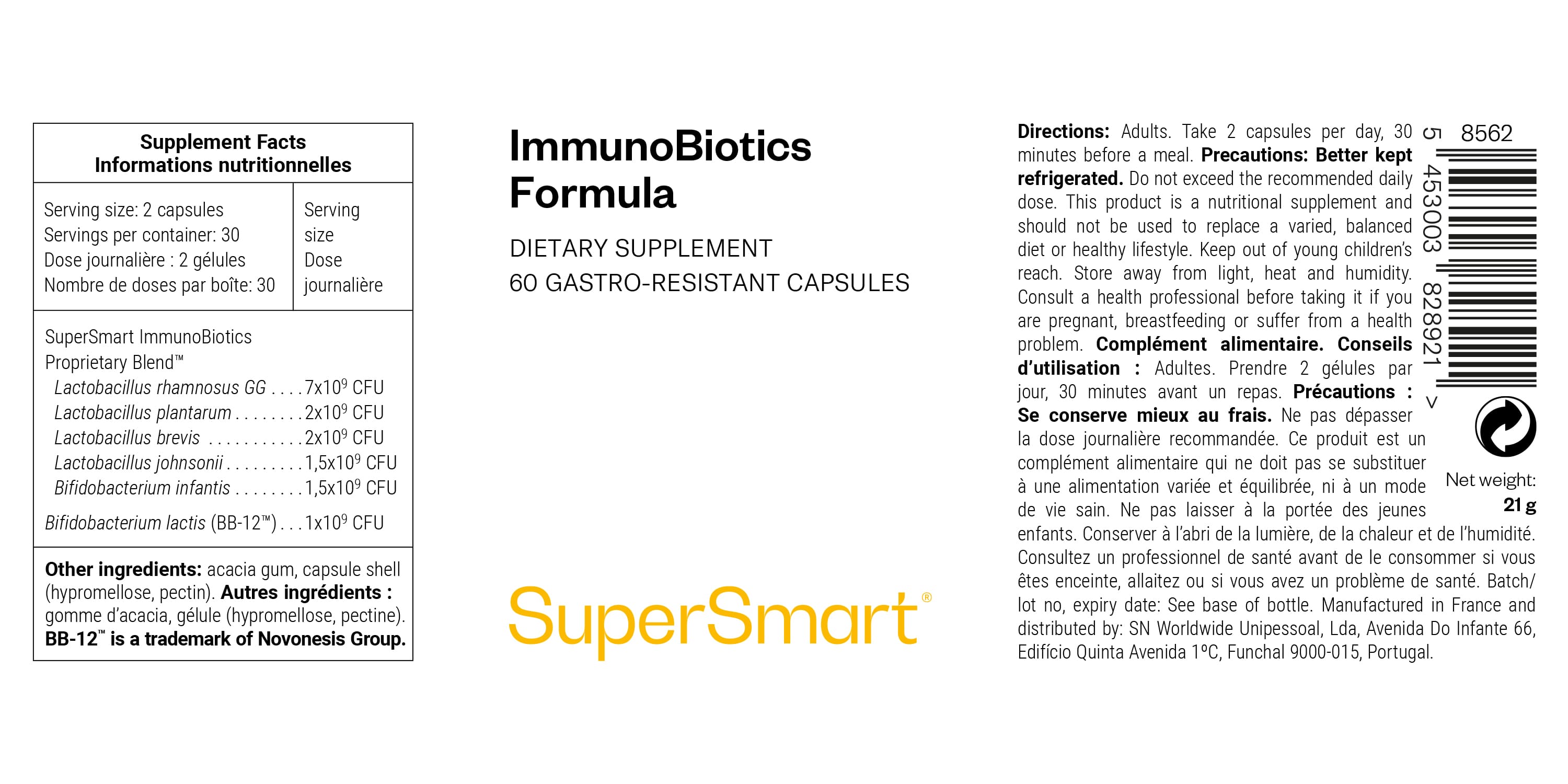
| Daily dose: 2 capsules Number of doses per pack: 30 | Daily dose |
| SuperSmart ImmunoBiotics Proprietary Blend™: | |
| Lactobacillus rhamnosus GG | 7 × 10⁹CFU |
| Lactobacillus plantarum | 2 × 10⁹ CFU |
| Lactobacillus brevis | 2 × 10⁹ CFU |
| Lactobacillus johnsonii | 1.5 × 10⁹ CFU |
| Bifidobacterium infantis | 1.5 × 10⁹ CFU |
| Bifidobacterium lactis (BB-12™) | 1 × 10⁹ CFU |
| Other ingredients: acacia gum, capsule (hypromellose, pectin). BB-12™ is a registered trademark of the Novonesis Group. | |
What is the link between gut microbiota, immunity and probiotics?
The gut microbiota: much more than just a player in digestion
The gut microbiota refers to the collection of microorganisms living in the gut, mainly bacteria, but also viruses, fungi and other microorganisms.
Far from being limited to digestion, this ecosystem interacts closely with the immune system.
A large proportion of the body’s immune cells are in fact found in the gut, particularly in the gut-associated lymphoid tissue (GALT), where they are exposed to signals from the microorganisms in the microbiota.
The microbiota-immunity axis: an ongoing dialogue
The ongoing interactions between commensal bacteria (i.e. bacteria that live in the gut without normally causing harm to the body) and immune cells help to shape immune responses.
Microbial signals play a key role in educating the immune system, promoting tolerance towards harmless elements and triggering appropriate responses to pathogenic microorganisms.
It is this ongoing dialogue that is known as the microbiota-immunity axis.
It is based on several complementary mechanisms:
- stimulation of innate immunity: commensal bacteria can stimulate innate immune defences by promoting the production of antimicrobial peptides, strengthening the integrity of the intestinal barrier and competing with pathogenic microorganisms for nutrients and attachment sites. Certain microbial metabolites, notably short-chain fatty acids (SCFAs) such as butyrate, also support mucosal immunity and strengthen the first line of defence against infections;
- regulation of adaptive immunity: the microbiota modulates adaptive immunity by influencing T-cell differentiation and cytokine production. In particular, it promotes the development of regulatory T cells (Tregs) and the production of anti-inflammatory cytokines such as IL-10, thereby helping to maintain immune tolerance and prevent excessive immune activation;
- management of inflammation and immune balance: a balanced microbiota helps to control systemic inflammation. Certain microbial metabolites can reduce the activity of pro-inflammatory pathways such as NF-κB and help maintain immune homeostasis (the balance of the immune system). Conversely, dysbiosis (an imbalance in the microbiota) is associated with increased intestinal permeability and low-grade chronic inflammation.
What is a probiotic?
According to the standard definition, probiotics are live microorganisms which, when administered in adequate quantities, confer a health benefit on the host.
However, their properties are strain-specific: the results obtained with a given strain cannot be automatically extrapolated to all bacteria belonging to the same species, nor to all probiotics.
The effects observed may also vary depending on the strain used, the dose, the population studied and the clinical context.
This is why the selection of precisely identified strains backed by scientific data is a key criterion in the formulation of a probiotic food supplement.
Who is it for?
ImmunoBiotics Formula is particularly suitable for:
- people who wish to look after their gut microbiota and their immune system: the formula provides six selected probiotic strains and specifically targets the microbiota-immunity axis;
- people concerned about their respiratory health: BB-12™ and Lactobacillus rhamnosus GG have been the subject of human studies in the context of respiratory tract infections;
- people who wish to support their immune system during the winter months: the formula combines strains studied for various aspects of the immune response and respiratory health, which are particularly relevant during the colder months;
- people looking for well-researched probiotics: the formula contains, in particular, BB-12™ and Lactobacillus rhamnosus GG, two strains backed by a substantial body of scientific evidence in humans.
What can disrupt the gut microbiota?
The main factors causing an imbalance in the gut microbiota
The gut microbiota is a dynamic ecosystem whose composition can change under the influence of numerous factors:
- diet;
- stress;
- taking antibiotics;
- certain infections;
- or even ageing.
When this balance is disrupted, the condition is known as dysbiosis.
These changes may relate, in particular, to the diversity of the microbiota, the abundance of certain bacterial populations and the metabolites they produce.
However, there is no single ‘ideal’ microbiota: its composition varies considerably from one individual to another, and dysbiosis cannot be defined solely by the presence or absence of a bacterial species.
What are the potential consequences of dysbiosis?
An imbalance in the microbiota is being studied in particular for its links to an impairment of the intestinal barrier, changes in the production of certain microbial metabolites, and the regulation of inflammatory and immune responses.
Maintaining the balance of the gut microbiota is therefore of interest beyond the digestive system alone, given the close interactions between the microbiota, the intestinal barrier and the immune system.
What is the recommended dosage for this probiotic formula?
Each daily dose of ImmunoBiotics Formula provides 15 billion CFU, comprising 1 billion CFU of Bifidobacterium lactis BB-12™ and 14 billion CFU of SuperSmart ImmunoBiotics Proprietary Blend™.
It is recommended to take 2 capsules a day, 30 minutes before a meal.
One box provides a 30-day supply.
Which synergistic dietary supplements should be taken with ImmunoBiotics Formula?
Vitamin D3
Vitamin D contributes to the normal functioning of the immune system.
In particular, it plays a role in the functioning of various cells of the innate and adaptive immune systems, making it a complementary approach to probiotics that target the microbiota-immunity axis.
 You can therefore complement your intake of ImmunoBiotics Formula with our Vitamin D3 1000 IU dietary supplement.
Zinc
Zinc also contributes to the normal functioning of the immune system.
This trace element is involved in numerous cellular processes and also helps to protect cells against oxidative stress.
Would you like to buy zinc, ideally in the form of bisglycinate for better absorption? Discover Zinc Bisglycinate, our zinc bisglycinate lozenges.
Beta-1,3/1,6-glucans
Beta-1,3/1,6-glucans are polysaccharides naturally found in the cell walls of certain yeasts.
They are the subject of research into their potential interactions with various cells and pathways of the innate immune system.
If you’d like to buy a beta-1,3/1,6-glucan dietary supplement, discover Beta 1,3/1,6 Glucan, which can be taken alongside ImmunoBiotics Formula.
Quality, purity and traceability
ImmunoBiotics Formula provides 15 billion CFU per daily dose, comprising 1 billion CFU of Bifidobacterium lactis BB-12™ and 14 billion CFU of the 5 strains in SuperSmart ImmunoBiotics Proprietary Blend™.
The formula includes, in particular, BB-12™, a precisely identified strain that has been extensively documented in scientific literature, as well as Lactobacillus rhamnosus GG.
The probiotics are encapsulated in enteric-coated capsules, designed to limit their exposure to gastric acid and promote their survival until they reach the intestine.
The composition is deliberately kept simple: apart from the probiotics, ImmunoBiotics Formula contains only acacia gum and a capsule made from hypromellose and pectin.
What is in ImmunoBiotics Formula
Any questions?
Our team of nutrition experts and scientists has the answers.
The gut microbiota interacts closely with the immune system: in particular, it helps maintain the intestinal barrier, supports mucosal immunity and communicates with various immune cells.
Some probiotics are therefore being researched for their potential effects on the immune response, but their effects depend heavily on the strain being studied, and it cannot be concluded that all probiotics ‘boost’ immunity in the same way.
In ImmunoBiotics Formula, Bifidobacterium lactis BB-12™ has, in particular, been studied in humans for its potential influence on the production of certain antibodies, both within the body and in the mucous membranes.
The effectiveness of a probiotic cannot be judged simply by the number of billions of CFU or the number of species present in a formula.
It depends above all on the specific strain, the dose used, its viability, the intended purpose and, above all, the studies carried out on that strain: a probiotic documented as having a particular effect cannot automatically be considered effective for all other uses.
This is one of the main reasons why ImmunoBiotics Formula combines carefully selected strains, including BB-12™ and Lactobacillus rhamnosus GG, rather than relying solely on a high number of strains or CFU.
There is no single ‘best probiotic for immunity’: the effects of probiotics are strain-specific, and two bacteria belonging to the same species may have different properties.
When choosing a probiotic that has been studied in relation to immunity, it is therefore important to consider the precise identification of the strains, the extent of scientific evidence supporting them, the number of CFU provided, and their ability to survive passage through the stomach.
ImmunoBiotics Formula has been designed with this in mind, providing 15 billion CFU per day, including the clinically studied strain B. lactis BB-12™, L. rhamnosus GG and four other selected strains, all in enteric-coated capsules.
There is no single product capable of ‘boosting’ the immune system on its own: its functioning depends in particular on diet, sleep, physical activity and sufficient intake of essential micronutrients.
Certain nutrients, however, play a well-established role in immunity: vitamins C and D, zinc, selenium, iron, copper, and vitamins A, B6, B9 and B12, in particular, contribute to the normal functioning of the immune system.
Probiotics operate on a different principle: certain strains are being studied for their potential interactions with the immune system via the microbiota-immunity axis, as part of a complementary approach to immune defences.
Need help?
You may also like



of experience
your money back
##montant## purchase