
Vitamin B12 reference ranges: how to interpret your blood test results?
Vitamin B12, or cobalamin, contributes to cell division and the functioning of the nervous system. With changing dietary habits, monitoring your B12 status is becoming essential. But how do you interpret your blood test results?
- ✓Vitamin B12 contributes, amongst other things, to the normal functioning of the nervous system, the normal formation of red blood cells and the process of cell division.
- ✓A level below 180 pg/mL may indicate a vitamin B12 deficiency, whilst a level between 180 and 350 pg/mL may suggest a possible deficiency.
- ✓Holotranscobalamin, methylmalonic acid (MMA) and homocysteine can supplement the blood test when the results are unclear.
- ✓Vegetarians, vegans, older people and those with malabsorption disorders are at greater risk of vitamin B12 deficiency.
- ✓Foods of animal origin are the primary source of B12. Supplementation tailored to individual needs may be considered where intake is insufficient or in certain high-risk situations.


- 01.Why have a vitamin B12 blood test?›
- 02.Vitamin B12 standards: laboratory reference values›
- 03.Vitamin B12 deficiency: causes and absorption mechanisms›
- 04.High vitamin B12 levels: is there cause for concern?›
- 05.How to maintain optimal vitamin B12 levels?›
- 06.Key points to remember about cobalamin reference ranges›
Why have a vitamin B12 blood test?
Vitamin B12 test: who should have it?
A blood test for vitamin B12, or cobalamin, is usually carried out when a deficiency is suspected:
- severe and persistent fatigue;
- abnormal blood count results (anaemia, macrocytosis, etc.);
- nervous system disorders (tingling, brain fog, balance problems, muscle weakness, etc.).
As vitamin B12 is found mainly in foods of animal origin, a blood test may also be relevant for people following a strict vegan or vegetarian diet.
A review published in 2026 highlights the need to monitor B12 intake and status in these populations (1).
When dietary intake is insufficient, the body’s vitamin B12 stores gradually diminish. Supplementation then provides the vitamin B12 that is not supplied by the diet.
 Discover the dietary supplement ‘ , which provides 1mg of vitamin B12 in the form of methylcobalamin – its bioactive form – per sublingual tablet (to be allowed to dissolve under the tongue for direct absorption).
Age is another factor to take into account. In older people, the risk of deficiency increases, particularly because the digestive absorption of vitamin B12 can become less efficient, regardless of the amounts consumed (2).
Certain situations also warrant particular vigilance, such as long-term use of metformin or medicines that reduce stomach acidity, as well as certain diseases or procedures affecting the stomach or gut.
What is the procedure for measuring vitamin B12 levels in the blood?
To check the level of vitamin B12 in the blood, a venous blood sample is required.
You do not need to fast for this test, although some laboratories may recommend fasting for six to eight hours beforehand.
Any recent vitamin B12 supplementation must be reported, as it may affect the test result.
Vitamin B12 standards: laboratory reference values
Normal, borderline and deficient levels: total blood test
Results are usually expressed in pg/mL (picograms per millilitre) or pmol/L (picomoles per litre).
| Total vitamin B12 levels | Interpretation |
|---|---|
| Less than 180 pg/mL (133 pmol/L) | Confirmed vitamin B12 deficiency |
| 180 to 350 pg/mL (133 to 258 pmol/L) | Indeterminate result – possible vitamin B12 deficiency |
| More than 350 pg/mL (>258 pmol/L) | Vitamin B12 deficiency unlikely |
Source: Interpretation of total or active vitamin B12 test results, National Institute for Health and Care Excellence (NICE), 2024 (3).
Additional tests: holotranscobalamin, MMA and homocysteine
However, the level of vitamin B12 measured in the blood does not always reflect the actual availability of vitamin B12 at the cellular level (4).
Other markers may be required to complete the assessment:
- Holotranscobalamin (holoTC), also known as ‘active B12’, corresponds to the amount of cobalamin actually available to the body’s cells (approximately a quarter of circulating cobalamin). Measuring this allows an estimate of the amount of B12 that cells can actually utilise (5).
- Methylmalonic acid (MMA) provides further insight by indirectly assessing what is happening inside the cells: this marker increases when cells are actually deficient in vitamin B12.
- Homocysteine is another useful marker, as its levels can rise when the body is deficient in vitamin B12. However, an deficiency in folate (vitamin B9) can also lead to elevated levels. Vitamin B12 and folate status can therefore be assessed together.
A study involving 545 people suggests that measuring total B12 levels may fail to detect a functional deficiency: among vegetarians, for example, 60% had elevated MMA levels and 72% had low holoTC levels, compared with only 30% who had low total B12 levels. The authors conclude that holotranscobalamin and MMA provide a better reflection of vitamin B12 status than total blood B12 levels, although there are limitations in people with renal impairment (6).
Vitamin B12 deficiency: causes and absorption mechanisms
Absorption problems
In the body, vitamin B12 follows a complex pathway involving several digestive mechanisms:
- In the stomach, the vitamin B12 contained in food is first released by gastric acid. It then binds to haptocorrin, a protein that transports it to the intestine (7).
- In the intestine, enzymes contained in pancreatic juices break down haptocorrin, thereby releasing vitamin B12. This can then bind to intrinsic factor, a protein produced by the stomach that is essential for its absorption.
- The complex formed by the binding of vitamin B12 and intrinsic factor then continues its journey to the final section of the small intestine. It is here that vitamin B12 can be absorbed by the body.
- Once it has entered the bloodstream, some of the vitamin B12 binds to another protein, transcobalamin II, which transports it to the cells. It is this combination that forms holotranscobalamin, or ‘active B12’, as mentioned earlier.
If any of these stages is disrupted, the absorption or transport of vitamin B12 in the body may be compromised.
Who is at risk?
Certain people are at higher risk of vitamin B12 deficiency due to insufficient intake or reduced absorption:
- Vegetarians and vegans, as vitamin B12 is found almost exclusively in foods of animal origin.
- Older people with hypochlorhydria, i.e. insufficient production of hydrochloric acid, which disrupts the normal digestion of food.
- People taking medication, particularly metformin (used to treat type 2 diabetes) or proton pump inhibitors (PPIs) (used to treat acid reflux). Clinical data suggest that these medicines may impair the absorption of vitamin B12 during long-term treatment (8).
- People who have undergone bariatric surgery or certain stomach or bowel operations, which may alter the mechanisms necessary for its absorption (9).
- People with Biermer’s disease, an autoimmune condition that prevents the body from producing sufficient intrinsic factor, which is necessary for the absorption of vitamin B12.
A scientific review published in 2025 suggests that age, a diet low in vitamin B12, certain malabsorption problems, and the use of medicines such as metformin or PPIs are among the main risk factors for vitamin B12 deficiency (10).
The consequences of low levels
Low vitamin B12 levels can affect several bodily functions.
Vitamin B12 contributes to the normal formation of red blood cells, the normal functioning of the nervous system and normal energy metabolism. It also helps to reduce fatigue.
Consequences of low levels include:
- Haematological abnormalities such as macrocytosis, which is characterised by an increase in the size of red blood cells. When accompanied by anaemia, symptoms such as fatigue, pallor and shortness of breath on exertion may occur (11).
- Neurological disorders, as vitamin B12 plays a role in maintaining myelin, the sheath that protects nerve fibres. A prolonged deficiency can disrupt nerve function and manifest as tingling, numbness or balance problems (12).
- Elevated homocysteine levels, as vitamin B12 normally plays a part in its metabolism. When there is a deficiency, homocysteine can build up in the blood. High concentrations are associated with an increased cardiovascular risk (13).
- Mood disorders and depressive symptoms may be among the manifestations of a vitamin B12 deficiency. Several studies also report an association between low vitamin B12 status and depression (14).
High vitamin B12 levels: is there cause for concern?
A vitamin B12 level above 1,000 pg/mL can have various causes. Some causes are harmless, whilst others require medical advice.
Excessive supplementation
Prolonged or high-dose vitamin B12 supplementation can lead to blood concentrations exceeding reference values (15).
This is why it is important to tailor supplementation to individual needs and to avoid prolonged self-supplementation.
Liver diseases
Vitamin B12 is stored in large quantities, mainly in the liver. Certain liver diseases (hepatitis, cirrhosis, biliary disorders) can disrupt its storage and release, leading to an increase in its concentration in the blood (16).
Haematological disorders
Certain haematological disorders, which affect the blood or the bone marrow where blood cells are produced, may be associated with elevated vitamin B12 levels.
This is the case with myeloproliferative syndromes, conditions in which the bone marrow produces too many blood cells.
This overproduction may be accompanied by an increase in the proteins that transport vitamin B12 in the blood, which raises the B12 level measured during testing (17).
Renal dysfunction
Kidney failure can, in particular, alter the metabolism and concentrations of the proteins that transport vitamin B12 in the blood, thereby contributing to elevated blood levels of vitamin B12 (18).
Inflammatory or autoimmune diseases
Certain inflammatory or autoimmune diseases may be associated with elevated blood levels of vitamin B12. This elevation is thought to be linked to changes in the proteins that transport vitamin B12 in the blood, the concentration of which may increase during certain pathological processes (19).
How can you maintain optimal vitamin B12 levels?
Natural dietary sources
For people who eat animal products, a varied diet generally provides sufficient vitamin B12.
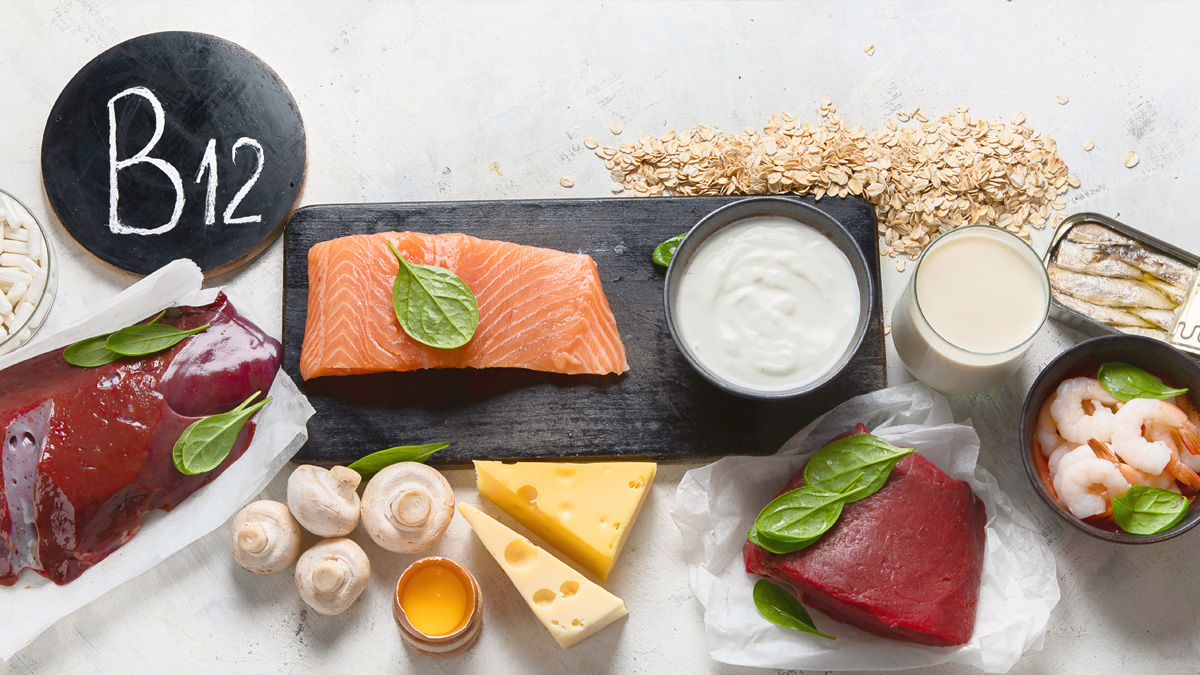
It is naturally found in meat and offal, fish, seafood, eggs and dairy products. Here are some foods that are particularly rich in vitamin B12.
| Food | Vitamin B12 content (µg/100 g) |
|---|---|
| Raw lamb’s liver | 95.8 |
| Braised lamb kidney | 78.9 |
| Cooked periwinkle | 60.7 |
| Cooked lamb’s liver | 60 |
| Cooked veal liver | 52.6 |
| Cooked clams | 39.5 |
| Cooked cockles | 38 |
| Cooked octopus | 36 |
| Raw oyster | 28.6 |
| Tinned sardines in olive oil, drained | 20 |
| Mussels, boiled in water | 17.6 |
| Grilled or pan-fried herring | 14.1 |
| Raw bluefin tuna | 9.43 |
| Raw wild salmon | 4.84 |
Source: ANSES, Nutritional Composition Table for Foods – Ciqual 2025 (20).
Supplementation: which form of vitamin B12 should you choose?
When dietary intake is insufficient or requirements are not met, vitamin B12 supplementation may be considered.
The choice of supplement then depends on the form of vitamin B12 (not all forms are equal) and on an appropriate dosage.
Methylcobalamin is a coenzyme form of vitamin B12, naturally present in the body. It is in this form that B12 performs some of its functions within cells (21).
It thus differs from cyanocobalamin, a synthetic form that must be converted by the body to produce the coenzyme forms of B12.
The dosage form is also important.
When vitamin B12 is swallowed, its absorption in the gut is limited: only part of the dose consumed enters the bloodstream.
The sublingual route brings vitamin B12 into contact with a highly vascularised mucous membrane.
This route of administration has been shown to be particularly effective at increasing blood levels of vitamin B12 (22).
Discover the Methylcobalamin dietary supplement, which provides 1 mg of vitamin B12 in the form of methylcobalamin per sublingual tablet.
It may also be beneficial to capitalise on the activity of all the B-complex vitamins, each of which has its own physiological benefits.
Discover the Coenzymated B Formula dietary supplement, which combines all 8 B vitamins in their coenzyme forms, including vitamin B12 in the form of methylcobalamin.
Vitamin B12 forms part of a broader nutritional balance.
Other compounds play a role in protecting cells, such as glutathione, an antioxidant naturally produced by the body that contributes to the cellular defence systems against oxidative stress.
Discover Daily 3®, a comprehensive multivitamin formula containing 49 ingredients, including vitamin B12 – this time in the form of cyanocobalamin – as well as glutathione.
Key points on cobalamin reference ranges
- A blood test for vitamin B12 is an initial indicator of cobalamin status. When the result falls within a borderline range, other markers such as holotranscobalamin or methylmalonic acid can be used to supplement the assessment.
- A level that is too low may be linked to insufficient intake or poor absorption in the digestive tract. Conversely, an abnormally high level, unless due to supplementation, requires medical advice.
- A diet providing sufficient vitamin B12 helps maintain adequate levels. Supplementation tailored to individual needs may be considered when dietary intake is insufficient or in certain high-risk situations.
If your result falls outside the laboratory’s reference range, seek advice from your doctor.
SUPERSMART ADVICE
References
- Kraselnik A, Hernández RM, Laviano J. Vitamin B12 in adults on vegetarian and vegan diets. Medicina (B Aires). 2026;86(3):733-741. PMID: 42330387. 🔗
- Langan RC, Goodbred AJ. Vitamin B12 Deficiency: Recognition and Management. Am Fam Physician. 2017 Sep 15;96(6):384-389. PMID: 28925645. 🔗
- Carence en vitamine B12 chez les personnes de plus de 16 ans : diagnostic et prise en charge. Recommandations du NICE (National Institute for Health and Care Excellence), 6 mars 2024. 🔗
- Harrington DJ, Stevenson E, Sobczyńska-Malefora A. The application and interpretation of laboratory biomarkers for the evaluation of vitamin B12 status. Ann Clin Biochem. 2025 Jan;62(1):22-33. doi: 10.1177/00045632241292432. Epub 2024 Oct 27. PMID: 39367523; PMCID: PMC11707970. 🔗
- Nexo E, Hoffmann-Lücke E. Holotranscobalamin, a marker of vitamin B-12 status: analytical aspects and clinical utility. Am J Clin Nutr. 2011 Jul;94(1):359S-365S. doi: 10.3945/ajcn.111.013458. Epub 2011 May 18. PMID: 21593496; PMCID: PMC3127504. 🔗
- Nexo E, Parkner T. Vitamin B12-Related Biomarkers. Food Nutr Bull. 2024 Jun;45(1_suppl):S28-S33. doi: 10.1177/03795721241227114. PMID: 38987873. 🔗
- Guéant JL, Guéant-Rodriguez RM, Alpers DH. Vitamin B12 absorption and malabsorption. Vitam Horm. 2022;119:241-274. doi: 10.1016/bs.vh.2022.01.016. Epub 2022 Mar 1. PMID: 35337622. 🔗
- Mumtaz H, Ghafoor B, Saghir H, Tariq M, Dahar K, Ali SH, Waheed ST, Syed AA. Association of Vitamin B12 deficiency with long-term PPIs use: A cohort study. Ann Med Surg (Lond). 2022 Sep 26;82:104762. doi: 10.1016/j.amsu.2022.104762. PMID: 36268318; PMCID: PMC9577826. 🔗
- Nunes R, Santos-Sousa H, Vieira S, Nogueiro J, Bouça-Machado R, Pereira A, Carneiro S, Costa-Pinho A, Lima-da-Costa E, Preto J, Group CRI. Vitamin B Complex Deficiency After Roux-en-Y Gastric Bypass and Sleeve Gastrectomy-a Systematic Review and Meta-Analysis. Obes Surg. 2022 Mar;32(3):873-891. doi: 10.1007/s11695-021-05783-2. Epub 2022 Jan 4. PMID: 34982396. 🔗
- Patel H, McGuirk R. Vitamin B12 Deficiency: Common Questions and Answers. Am Fam Physician. 2025 Sep;112(3):294-300. PMID: 40961307. 🔗
- Parakh N, Dewan P. Revisiting the hematological manifestations of vitamin B12 deficiency. Front Nutr. 2026 Aug 12;13:1898533. doi: 10.3389/fnut.2026.1898533. PMID: 42657046; PMCID: PMC13508813. 🔗
- Alvarez M, Poveda S, Cisneros A, Parra D, Luna M, Rincón O, Guzman I. B Vitamin Deficiencies and Associated Neuropathies. Curr Nutr Rep. 2026 Jan 29;15(1):8. doi: 10.1007/s13668-025-00723-3. PMID: 41609902; PMCID: PMC12855320. 🔗
- Sohouli MH, Almuqayyid F, Alfardous Alazm A, Ziamanesh F, Izze da Silva Magalhães E, Bagheri SE, Rodrigues de Oliveira B, Alfardous Alazm M, Adi AR, Alomar S, Abu-Zaid A. A comprehensive review and meta-regression analysis of randomized controlled trials examining the impact of vitamin B12 supplementation on homocysteine levels. Nutr Rev. 2024 May 10;82(6):726-737. doi: 10.1093/nutrit/nuad091. PMID: 37495210. 🔗
- Wu Y, Zhang L, Li S, Zhang D. Associations of dietary vitamin B1, vitamin B2, vitamin B6, and vitamin B12 with the risk of depression: a systematic review and meta-analysis. Nutr Rev. 2022 Feb 10;80(3):351-366. doi: 10.1093/nutrit/nuab014. PMID: 33912967. 🔗
- Wolffenbuttel BHR, Muller Kobold AC, Sobczyńska-Malefora A, Harrington DJ. Macro-B12 masking B12 deficiency. BMJ Case Rep. 2022 Jan 13;15(1):e247660. doi: 10.1136/bcr-2021-247660. PMID: 35027389; PMCID: PMC8762123. 🔗
- Jammal M, Deneuville T, Mario N, Tiev K, Tolédano C, Josselin-Mahr L, Pateron D, Guidet B, Retbi A, Taright N, Cabane J, Kettaneh A. Concentration plasmatique élevée de la vitamine B12 : un indicateur des maladies hépatiques ou tumorales. Rev Med Interne. 2013 Jun;34(6):337-341. doi: 10.1016/j.revmed.2012.10.006. 🔗
- Andrès E, Serraj K, Zhu J, Vermorken AJ. The pathophysiology of elevated vitamin B12 in clinical practice. QJM. 2013 Jun;106(6):505-515. doi: 10.1093/qjmed/hct051. Epub 2013 Feb 27. PMID: 23447660. 🔗
- Matthews DM, Beckett AG. Serum vitamin B12 in renal failure. J Clin Pathol. 1962 Sep;15(5):456-458. doi: 10.1136/jcp.15.5.456. PMID: 13933867; PMCID: PMC480434. 🔗
- Fernández-Téllez B, Franco-Rico JA, Valdez-Martínez E. Fisiopatología de la hipervitaminosis B12: del origen al acontecimiento clínico. Revisión de alcance [Pathophysiology of hypervitaminosis B12: from origin to clinical event. Scoping review]. Rev Med Inst Mex Seguro Soc. 2026 May 6;64(3):e6764. Spanish. doi: 10.5281/zenodo.18715386. PMID: 42095812; PMCID: PMC13186542. 🔗
- Table de composition nutritionnelle des aliments Ciqual 2025. 🔗
- Paul C, Brady DM. Comparative Bioavailability and Utilization of Particular Forms of B12 Supplements With Potential to Mitigate B12-related Genetic Polymorphisms. Integr Med (Encinitas). 2017 Feb;16(1):42-49. PMID: 28223907; PMCID: PMC5312744. 🔗
- Sharabi A, Cohen E, Sulkes J, Garty M. Replacement therapy for vitamin B12 deficiency: comparison between the sublingual and oral route. Br J Clin Pharmacol. 2003 Dec;56(6):635-638. doi: 10.1046/j.1365-2125.2003.01907.x. PMID: 14616423; PMCID: PMC1884303. 🔗



2 Days
sin problemas en la entrega
sin problemas en la entrega complementos punteros poniendo siempre el foco en la salud humana nos lo merecemos de pie a cabeza para una salud larga y duradera
sosa robaina
27 Days
Prodotti eccezionali
Prodotti eccezionali! Consegna rapida e precisa
paola
37 Days
Heldere info
Heldere info
HanS.
37 Days
Snelle levering
Snelle levering
harrie
43 Days
Adequate info en hoge kwaliteit
Adequate info en hoge kwaliteit
HanS.
52 Days
Supplementen zijn goed.
Supplementen zijn goed. Zachte prijzen. Website met problemen ( altijd ) niet goed voor nieuwe klanten.
Gino RJ
62 Days
Alles op tijd geleverd.
Alles op tijd geleverd. De producten worden alsmaar duurder, terwijl mijn pensioen niet meer stijgt. Vandaar kan ik alsmaar minder vaak bestellen.
Wouters
1132 Days
Great service
Great service
Ryszard
1145 Days
Profesjonalna obsługa
Bardzo dobre i rzeczowe opisy. Profesjonalna obsługa.
PIEKOSZEWSKI Chris
1813 Days
Wszystko OK!
Wszystko poszło jak powinno 🙂
SITKIEWICZ Pawel
2600 Days
Szybko sprawnie bez problemów
Szybko sprawnie bez problemów
Marek
of experience
your money back
##montant## purchase