
The 10 best aromatic plants and their benefits for health
As well as adding flavour to our cooking, certain aromatic plants have positive effects on our well-being. Discover these highly-fragrant and health-beneficial plants.

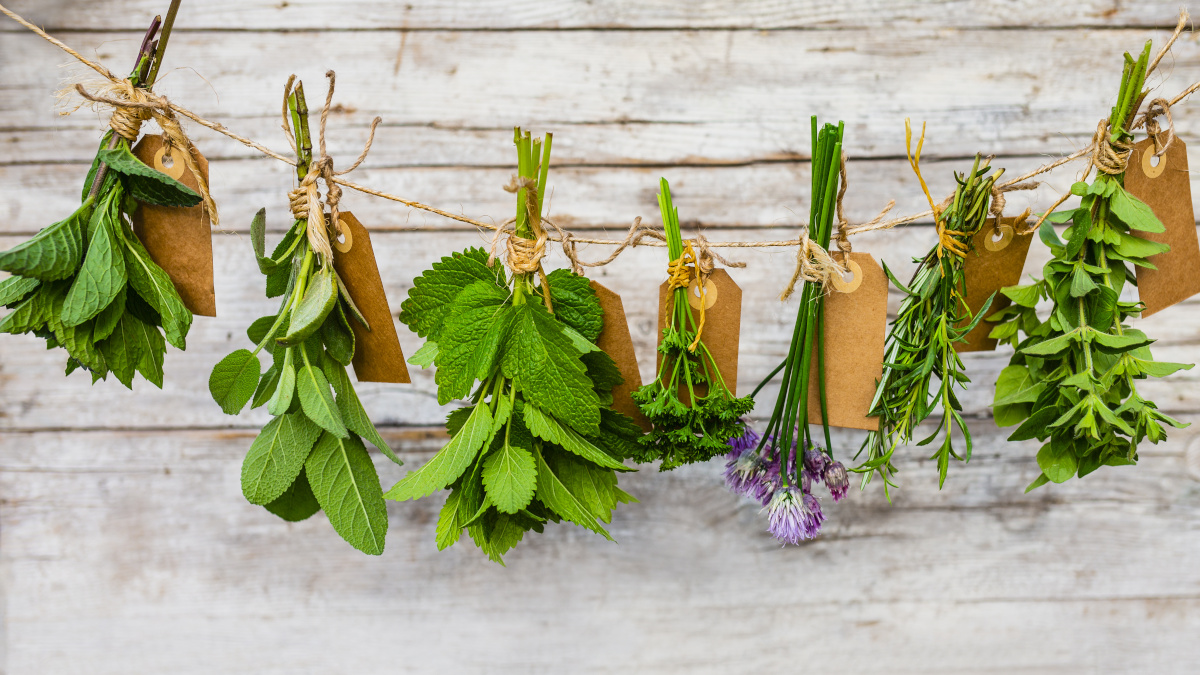
Coriander and digestion
Anaromatic herb with a strong, distinctive flavour, coriander is widely used in Asia, in India and the East.
A few, finely-chopped coriander leaves add an intense, exotic flavour, perfect for spicing up a tagine or a goat’s cheese-based dish!
In terms of composition, coriander contains a high concentration of vitamin K, and with its anti-spasmodic properties, supports a healthy digestive system (1).
The action of thyme
A symbol of Provence, like rosemary and lavender, thyme is a highly-fragrant and perennial dwarf shrub.
In ancient Egypt, it was used in religious rituals, while in Rome, thyme was predominantly recognised for its purifying and repellent action.
Nowadays, thyme is one of our most popular culinary herbs, especially for flavouring summer meat dishes and barbecued food. It is the leaves of the plant which are normally used and which can also be found in the form of an essential oil.
Instant relaxation with basil
Like thyme and oregano, basil (Ocimum basicilicum) is part of the Lamiaceae family.
In pesto, antipasti... basil brings an Italian or Mediterranean touch to all kinds of recipes. It also supports digestive health and promotes relaxation (2).
Its close relative holy basil (Ocimum tenuiflorum or Ocimum sanctum), also known as tulsi, supports respiratory health, immunity, vitality and physical and mental well-being. To benefit from its properties, choose a formulation such as Adrenal Support (with a high tulsi content) or Adaptogenic Potion (which also contains a number of other adaptogen plants).
Nutrient-rich chives
Originating from the East, specifically Siberia, chives are one of the easiest plants to grow and eat.
Part of the same family as garlic, they’re perfect for seasoning crudités, salads and sauces.
Low in calories, they contain vitamin C with antioxidant properties, and good levels of vitamin K, which supports healthy blood and bones.
Mint and respiratory health
A star of the herb world, perennially associated with summer, mint, like rosemary, comes in several varieties: spearmint, peppermint, Moroccan mint …
It was used in ancient Egypt and Greece for helping to soothe intestinal problems.
Peppermint is the variety used most widely in phytotherapy. A hybrid of spearmint and water mint, it is mainly known for its soothing effect on the mouth and throat, its benefits for respiratory health and its antispasmodic properties. You can find peppermint in certain synergistic formulations (such as Organic Defense Mix and Digestive Enzymes).
The powers of chervil
A plant native to southern Russia, we have the Romans to thank for bringing chervil to Northern Europe.
In the Middle Ages, chervil leaves were used for their appetite-stimulating and diuretic (urine-increasing) properties.
Composition-wise, chervil contains vitamin C, provitamin A and vitamin B9, as well as numerous minerals and trace-elements. It supports digestion by stimulating stomach and gut secretions. It is used raw in recipes as it loses its taste when cooked.
Parsley, a much-loved herb
First consumed more than 5000 years ago, parsley is undoubtedly one of the most widely-used aromatic herbs in the world.
Very easy to grow, parsley contains iron, vitamins C and K as well as potassium.
Considered sacred by the Greeks, it is widely used in cooking to flavour sauces, mayonnaise and stock. It can also be consumed as a dietary supplement alongside other active ingredients with similar properties (it features, for example, in Alkaline Formula, a supplement rich in alkaline compounds).
Dill, for digestion and sleep
Dill is an excellent herb for adding flavour to soft cheeses, sauces, as well as salmon, potatoes and crudités.
A source of antioxidants, it also contains potassium and vitamin C.
Used for centuries as a medicinal plant, dill was mainly consumed as an intestinal antiseptic decoction. Its benefits for digestion, as well as relaxation sleep, and lactation , are still recognised today ...
Oregano, a medicinal plant packed with benefits
An essential herb for flavouring pizzas, oregano is widely found in the Mediterranean region, as well as in Asia and North America.
In ancient Greece and Rome, it was often used as a perfume, and was thought to have a purifying and preserving effect. Oregano contains a number of aromatic molecules including terpenes (3). It supports mental performance and promotes good gastrointestinal, cardiovascular, liver and immune health.
To increase your intake, choose a dietary supplement (such as Oil of Oregano, a potent essential oil of oregano).
Improve your breathing with sage
A medicinal plant in common use in the Middle Ages as it is today, salvia officinalis or sage, is a popular cooking ingredient for flavouring meat, stock and marinades.
Whether in an infusion, decoction or ointment, sage offers many health benefits too, particularly antiseptic properties.
It also helps maintain good digestive and respiratory health, as well as general well-being during the menopause.
The secrets of rosemary
Another Mediterranean plant, rosemary comes in several varieties, all of which have their individual composition and properties.
It is the plant’s leaves and flowering tops which are predominantly used in cooking, aromatherapy and phytotherapy. Rosemary contains flavonoids, phenolic acid and multiple aromatic molecules such as camphor and cineole, depending on the variety (4).
It can be consumed as an infusion or as a dietary supplement (such as Ursolic Acid, an excellent extract of rosemary leaf).
Lavender, a heady, soothing plant
Like rosemary, mint and thyme, lavender also comes in several varieties.
The ultimate symbol of Provence, lavender was made popular by the town of Grasse and the rise of master-perfumiers in the 18th century.
Though it is primarily used for its sweet, floral perfume, lavender is also known for its medicinal properties. In infusions or as an ingredient in ointments and balms, it promotes relaxation and drowsiness(5).
Lemongrass and its alcohols
Used for its mosquito-repellent properties, lemongrass is also popular as an aromatic herb in cooking.
There’s nothing better for adding an exotic, citrussy and mild, spicy tang to Asian dishes!
Lemongrass exists in various forms depending on where it’s grown: Java, Sri Lanka or India. It contains a number of aromatic molecules, including monoterpene alcohols with antiseptic properties.
The virtues of aniseed
With its distinctive and somewhat polarising flavour, anise or aniseed (Pimpinella anisum) is thought to have been in use as far back as the 6th century BC, and was also popular in ancient Rome.
In cooking, aniseed adds a flavour similar to liquorice, fennel or star anise to biscuits, meat or fish.
Composition-wise, aniseed contains sesquiterpenes, phenolic acid and essential oil. It supports respiratory and digestive health.
References
- Medicinal benefits of coriander (Coriandrum Sativum L) - U. Rajeshwari, B. Andallu
Published 2011 BiologySpatula DD - Peer Reviewed Journal on Complementary Medicine and Drug Discovery - DOI:10.5455/SPATULA.20110106123153 Corpus ID: 86309875 - Vasorelaxant and anti-platelet aggregation effects of aqueous Ocimum basilicum extract - Journal of Ethnopharmacology - Volume 125, Issue 1, 17 August 2009, Pages 157-162
- Composition and Antimicrobial Activity of the Essential Oils of Two Origanum Species
Aligiannis, E. Kalpoutzakis, Sofia Mitaku, and Ioanna B. Chinou - Journal of Agricultural and Food Chemistry 2001 49 (9), 4168-4170 DOI: 10.1021/jf001494m - Effects of in vitro gastrointestinal digestion and colonic fermentation on a rosemary (Rosmarinus officinalis L) extract rich in rosmarinic acid - Food Chemistry
Volume 271, 15 January 2019, Pages 393-400 - Effects of Lavandula angustifolia Aroma on Electroencephalograms in Female Adults with Sleep Disorders - Journal of Life Science (생명과학회지) - Volume 22 Issue 2 / Pages.192-199 / 2012 / 1225-9918(pISSN) / 2287-3406(eISSN)





1 Days
I have been ordering supplements from…
I have been ordering supplements from SuperSmart for many years now. They are one, among the very few suppliers of Nutraceutical medicines, whom I trust implicitly. They produce supplements which align with the latest biochemical research in the field of natural medicines which is wonderful for a person like myself, since I loathe the drugs produced by big pharma. I shall continue to order from SuperSmart.
Wayne Chandler
8 Days
I’m really satisfied with SuperSmart
I’m really satisfied with SuperSmart. I’ve ordered from them many times, and the products are definitely worth every penny. Their customer service is excellent. They respond very quickly, are always professional. The only thing that could be improved is the order confirmation email, as it doesn’t always arrive in my inbox and I sometimes have to request it from customer support.
T Marina
14 Days
Always a winner
Always a winner Best of products. Delivers on time. What more do you want?
David Walsh
16 Days
Very fast delivery
The delivery was unexpectedly very fast and !
SADDEM Nadia
22 Days
tres efficace
tres efficace
KR
22 Days
Great to be able to buy a pure BHB…
Great to be able to buy a pure BHB powder at Supersmart. Thanks.
BusyBee
30 Days
There is one thing you need to be very…
There is one thing you need to be very aware of with Supersmart. The content described on the box - is based on a daily dosage - which means you have to look for how many tablets is described as a daily dosage. If is says 1000mg on the box - it might mean taht you have i.e. to take 3 tablets dayly to get your daily dosage. And 90 tablets equals i.e. 30 days.
Trusted
30 Days
Excellent performance
Excellent performance
David Walsh
43 Days
Fast delivery
Fast delivery, good products but relatively high prices
Ezio m Insinna
47 Days
My family and I have been using…
My family and I have been using SuperSmart supplements for a while now, and we’re genuinely impressed. The quality is consistently excellent, and we’ve noticed real benefits, both for everyday wellness support and during more challenging health issues (bc/artemisinin), where they’ve been a valuable part of our overall care and healing routine. Highly recommend for anyone looking for a trustworthy supplement brand to support their health.
VUKOTIC Sonja
47 Days
Good quality but way too expensive
Good quality, but way too expensive. 70 euros for a 2-week supply is excessive. If there'd be another supplier to sell these, I'd definitely switch because of costs.
Laura
48 Days
All good products and service
All good products and service
Trusted
59 Days
I believe in the quality of the products
I believe in the quality of the products
Lucia Keme
69 Days
Thank you guys ,Real and Great Products…
Thank you guys ,Real and Great Products ,fast/tide and clean shipping .I definitly trust you and go for a montly subscription !!!
Mr Mircea Blaj
71 Days
Fast delivery
Fast delivery, no hassle
Trusted
of experience
your money back
##montant## purchase