

Complete your selection





Do you suffer from bloating and other discomfort linked to gluten consumption?
These digestive problems can disrupt your day-to-day wellbeing and make it difficult to enjoy certain meals.
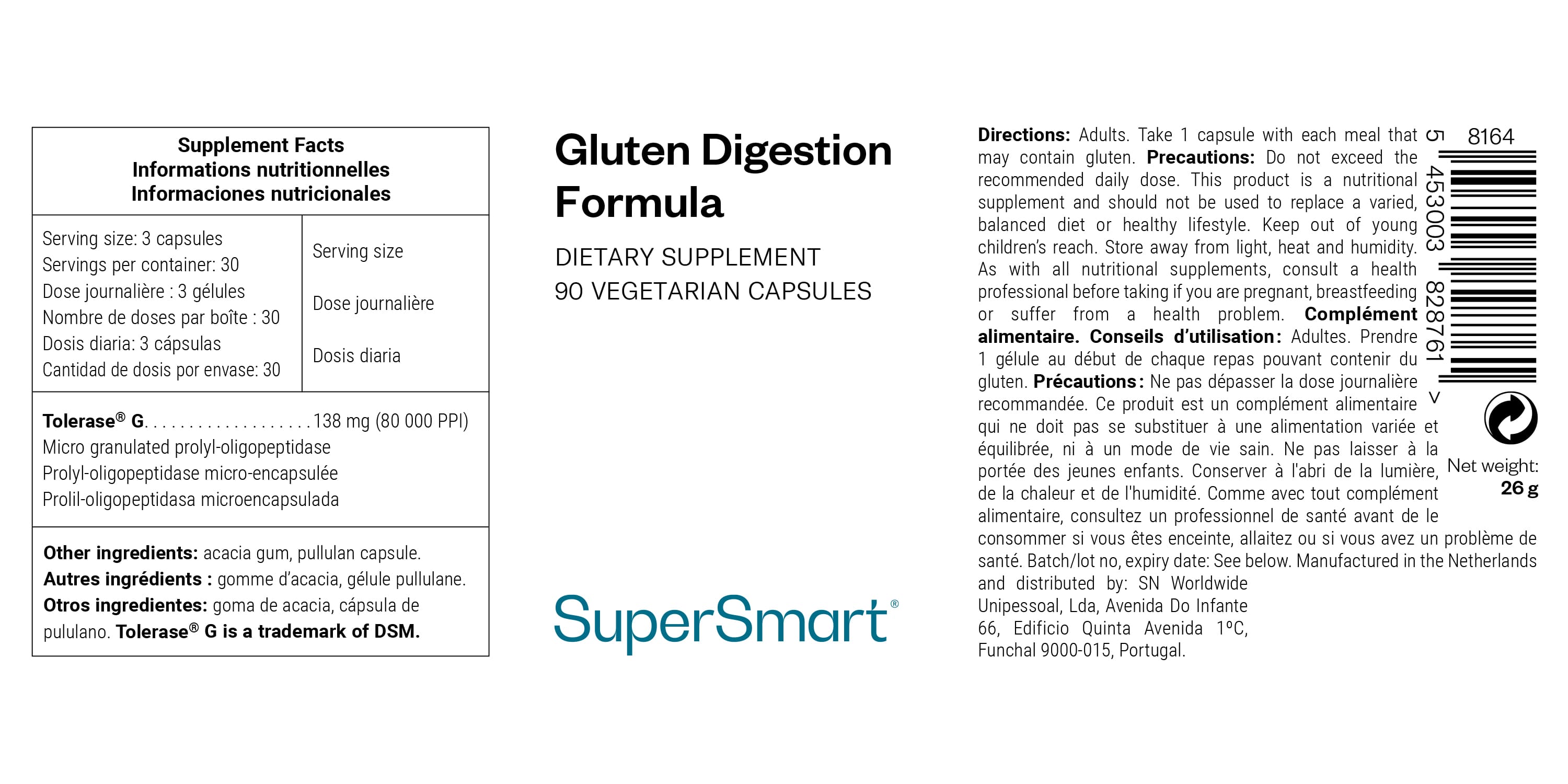
Gluten Digestion Formula is a dietary supplement enriched with Tolerase® G, a microencapsulated digestive enzyme that has been clinically studied for its role in the proper digestion of gluten (1).
The product is categorised under our range dedicated to gastrointestinal health.
Tolerase® G: a digestive enzyme designed to aid the digestion of gluten
How are proteins, and in particular gluten, digested?
Every day, our bodies naturally produce several digestive enzymes designed to break down the proteins, carbohydrates and fats found in food.
Together, they gradually break down long protein chains into peptides, and then into absorbable amino acids (2).
But gluten has a distinctive feature.
This group of proteins, naturally found in wheat, rye and barley, is particularly rich in proline.
Proline is an amino acid that makes certain peptide bonds more difficult for human digestive enzymes to hydrolyse.
Some of the fragments resulting from the digestion of gluten are therefore more resistant than those from many other dietary proteins (3).
This is precisely where Tolerase® G can help.
Tolerase® G: definition and benefits of this enzyme in breaking down gluten
A patented active ingredient, Tolerase® G is a prolyl endopeptidase (AN-PEP) derived from a filamentous fungus called Aspergillus niger.
Unlike conventional digestive proteases, this enzyme appears capable of cleaving bonds involving proline, an amino acid that is particularly abundant in gluten proteins.
It thus appears to complement the action of enzymes naturally present in the digestive system (4).
Another distinctive feature of Tolerase® G is that its activity appears to be optimised in the gastric environment, i.e. from the very early stages of protein digestion (5).
Its mechanism of action has been the subject of numerous scientific studies, including a randomised clinical trial which observed a significant reduction in the amount of α-gliadin—one of the main protein components of gluten—found in gastric contents compared with placebo following gluten ingestion (6).
6 key benefits and reasons to buy the Tolerase® G digestive enzyme for gluten
Our Gluten Digestion Formula supplement stands out for 6 key benefits:
- a patented and innovative active ingredient: developed by DSM-Firmenich, Tolerase® G is a recognised and patented active ingredient, not yet widely used in dietary supplements targeting gluten;
- an enzyme specifically designed for gluten: Tolerase® G preferentially targets the proline-rich sequences characteristic of gluten proteins (such as gliadins and glutenins), unlike conventional digestive proteases (enzymes that break down proteins);
- effectiveness supported by a clinical study: a randomised clinical trial demonstrated a significant reduction in gluten residues in the stomach after taking Tolerase® G with a meal containing gluten, compared with a placebo;
- an enzyme produced by controlled fermentation and microencapsulated: the enzyme is produced using a specific controlled fermentation process, ensuring high quality, and is then protected by microencapsulation technology designed to preserve its properties until it is utilised by the body;
- activity in the gastric environment: Tolerase® G is active from the very start of protein digestion in the stomach;
- a simple, refined formula: the product contains a single active ingredient, encapsulated in pullulan-based vegetable capsules, with acacia gum as the sole excipient.
Gluten: coeliac disease and gluten sensitivity (‘intolerance’) – what are the differences?
Gluten: a protein widely used in food… but not always easily digested
Gluten, as we have seen, is a group of proteins naturally present in wheat, rye and barley.
The high proline content of these proteins gives them desirable technological properties in baking and the food industry, for making bread, pasta, pastries, etc.
But it also explains why certain fragments are more difficult for human digestive enzymes to break down.
Gluten sensitivity: what are we talking about?
Some people report digestive discomfort (bloating, abdominal discomfort, wind, digestive problems, etc.) after eating foods containing gluten, without having a wheat allergy or coeliac disease.
This condition is generally referred to as gluten sensitivity.
In everyday language, the term ‘gluten intolerance’ is also frequently used.
This has led researchers to investigate the mechanisms involved in gluten digestion and to develop enzymes capable of supporting natural digestive processes.
Prolyl endopeptidases, such as Tolerase® G, form part of this approach by complementing the physiological mechanisms involved in the digestion of proline-rich proteins, such as those found in gluten (7–8).
Coeliac disease: a unique condition requiring strict avoidance of gluten
For patients with coeliac disease, an autoimmune condition triggered by the ingestion of gluten, a gluten-free diet remains essential (9–10).
In this context, taking a supplement designed to aid the digestion of gluten is not appropriate, as this protein must be completely eliminated from the diet and not merely broken down more effectively.
Who is it for?
Our Gluten Digestion Formula dietary supplement is particularly suitable for:
- people who wish to eat foods containing gluten (bread, pasta, pizzas, pastries, cakes, etc.) with greater digestive comfort;
- people who wish to supplement their intake of digestive enzymes as part of their nutritional routine;
- people who frequently eat out without being able to control what is in their meals (restaurants, business meals, dinner parties, etc.);
- people who travel regularly and wish to have a supplement specifically designed to aid gluten digestion that is easy to carry with them when needed.
Which synergistic dietary supplements should be taken alongside our Gluten Digestion Formula capsules?
A complex of digestive enzymes: proteases, amylases, etc.
Digestive enzymes help break down the main macronutrients provided by food.
These include, in particular, proteases, which are involved in the digestion of proteins; amylases, which break down carbohydrates; and lipases, which specialise in fats (11).
In addition to Tolerase® G, a digestive enzyme complex can support the digestion of dietary proteins as a whole, beyond just gluten proteins (for example, you could take Digestive Enzymes, a complex of various digestive enzymes, or Pancreatin, a formula providing pancreatic enzymes).
Probiotics for a balanced gut microbiota
The gut microbiota plays a vital role in maintaining the balance of the digestive ecosystem.
Probiotics, these beneficial microorganisms, help to maintain this balance and thus complement a holistic approach to digestive health (12).
They can therefore be a useful supplement to Gluten Digestion Formula (you might, for example, opt for Probio Forte or Full Spectrum Probiotic).
Zinc L-carnosine for the digestive mucosa
Zinc L-carnosine combines the trace element zinc with L-carnosine, a dipeptide naturally present in the body.
It is being studied for its interactions with the gastric and intestinal mucosa.
It is therefore frequently found in dietary supplements designed to support the digestive system (13).
You can purchase and take it alongside your Tolerase® G enzyme supplement (see Zinc L-Carnosine).
Quality, purity and traceability
Our Gluten Digestion Formula dietary supplement uses exclusively the patented active ingredient Tolerase® G, a prolyl endopeptidase obtained through controlled fermentation of Aspergillus niger.
This active ingredient is developed by DSM-Firmenich, a leading player in the field of ingredients for nutrition and health.
Each batch undergoes rigorous quality controls to ensure it complies with the relevant specifications.
Certificates of Analysis (COAs) are freely available on this product page.
These requirements regarding raw material selection, traceability and quality control are fully in line with SuperSmart’s commitment to quality.
What is in Gluten Digestion Formula
Any questions?
Our team of nutrition experts and scientists has the answers.
Tolerase® G (AN-PEP) is a prolyl endopeptidase (PEP) produced by controlled fermentation using Aspergillus niger (AN).
This digestive enzyme has been specifically developed to complement the body’s natural mechanisms for digesting gluten proteins, thanks to its targeted action on proline-rich sequences.
Digestive enzymes naturally produced by the body break down the majority of dietary proteins without any particular difficulty.
However, they struggle to break down those containing proline, an amino acid that is particularly abundant in gluten proteins.
Tolerase® G differs from conventional digestive enzymes in its ability to target peptide bonds involving proline, thereby complementing the action of conventional digestive enzymes.
The capsules in this product are made from pullulan, a natural polysaccharide derived from the fermentation of tapioca or maize.
Pullulan contains no ingredients of animal origin and provides an excellent barrier against oxygen, which helps to preserve the integrity of the ingredients contained in the capsule.
It also offers an excellent eco-friendly alternative to synthetic materials.
It is recommended to take Gluten Digestion Formula at the start of every meal containing gluten.
Active in the stomach, where the digestion of dietary proteins naturally begins, the enzyme can thus act directly on the food consumed.
No.
Tolerase® G is a dietary supplement which cannot under any circumstances replace a gluten-free diet when medically indicated.
If you have coeliac disease or a wheat allergy, it is essential to follow the advice of the healthcare professional treating you.
Need help?
of experience
your money back
##montant## purchase