

In stock
Vitamin D3 5000 IU
Vitamin D3 5000 IU (cholecalciferol) – bioavailable for immunity and bone health


Complete your selection
What are the benefits of vitamin D3?
Compensating for an insufficient intake of vitamin D
When there is less sunlight, particularly in winter, it becomes more difficult to maintain sufficient vitamin D intake.
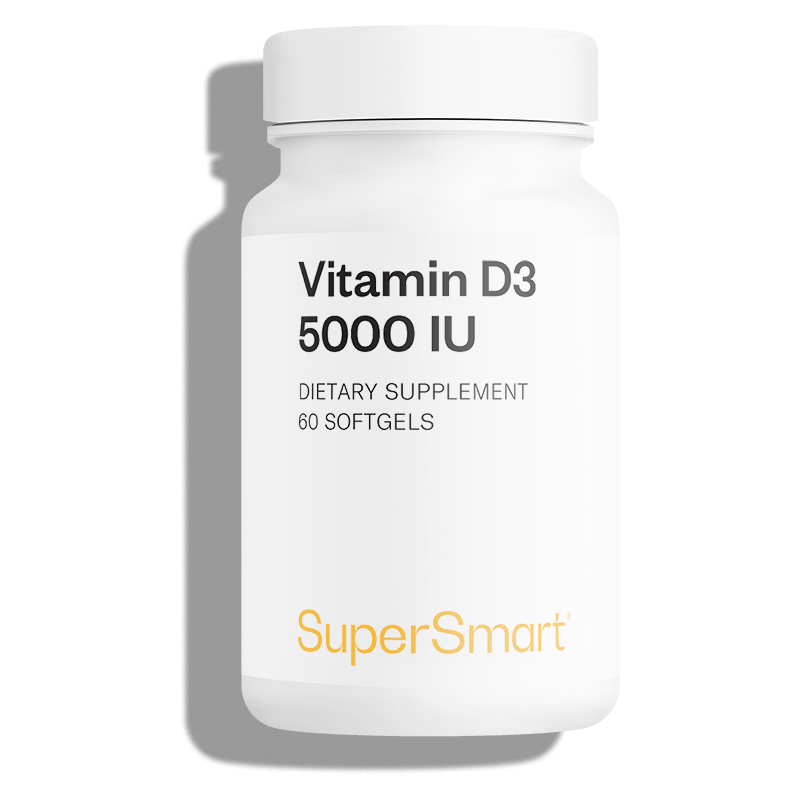
Vitamin D3 5000 IU is a high-potency vitamin D3 food supplement, providing 5000 IU, or 125 µg, of cholecalciferol per softgel.
Formulated from lanolin and combined with sunflower oil, it combines an effective form of the vitamin with an oily matrix perfectly suited to the fat-soluble nature of vitamin D.
This supplement is part of our Fatigue range.
A recognised role in immunity
Vitamin D contributes to the normal functioning of the immune system.
The vitamin D receptor is expressed by several immune cells, notably monocytes, macrophages and lymphocytes.
Some of these cells also possess the enzymes required for the local activation of vitamin D.
Calcitriol may therefore influence the mechanisms of innate immunity – the body’s first line of defence – and help regulate adaptive immunity (3).
Calcium absorption, bones and teeth
In the intestine, calcitriol activates the expression of proteins involved in the transport of calcium across the intestinal epithelium.
Vitamin D thus contributes to the normal absorption and utilisation of calcium and phosphorus (4).
It also helps maintain normal blood calcium levels, which are essential for many physiological processes.
By maintaining this calcium-phosphorus balance, it promotes the mineralisation and maintenance of normal teeth and bones (5).
Muscle function and benefits for athletes
Vitamin D contributes to the maintenance of normal muscle function.
Its receptors are located within muscle tissue, where it is thought to modulate various pathways involved in muscle contraction and protein turnover.
This aspect is naturally of interest to athletes, but also to older people affected by muscle wasting, which itself can lead to postural instability.
Some research also examines its effects on performance, muscle damage and recovery after exercise (6).
Cell division
Vitamin D plays a role in the process of cell division.
Once bound to its receptor, calcitriol forms a complex capable of interacting with DNA and modulating the expression of certain genes associated with cell differentiation and the cell cycle.
5 key benefits and reasons to choose our Vitamin D3 5000 IU
- Vitamin D3 5000 IU stands out for 5 key benefits:
- a high and concentrated dosage: each softgel provides 5,000 IU, or 125 µg of vitamin D3. Each capsule offers a high intake, whilst allowing the frequency of intake to be easily adapted to individual needs;
- the choice of cholecalciferol: Vitamin D3 5000 IU uses vitamin D3, in the same form as that synthesised by the skin. Comparative studies show that D3 generally raises 25(OH)D levels more than vitamin D2 (7);
- a suitable oil-based matrix: as vitamin D3 is fat-soluble, it is combined with sunflower oil, which acts as a lipid carrier directly within the capsule. The presence of fat at the time of taking the supplement thus optimises its absorption (8);
- an easy-to-swallow softgel: the softgel makes it easy to take whilst combining vitamin D3 and its oil-based matrix into a ready-to-use unit;
a simple, refined composition: our formula is certified gluten-free, lactose-free and free from added sugars, sweeteners, nanoparticles and controversial excipients.
What is the composition of Vitamin D3 5000 IU?
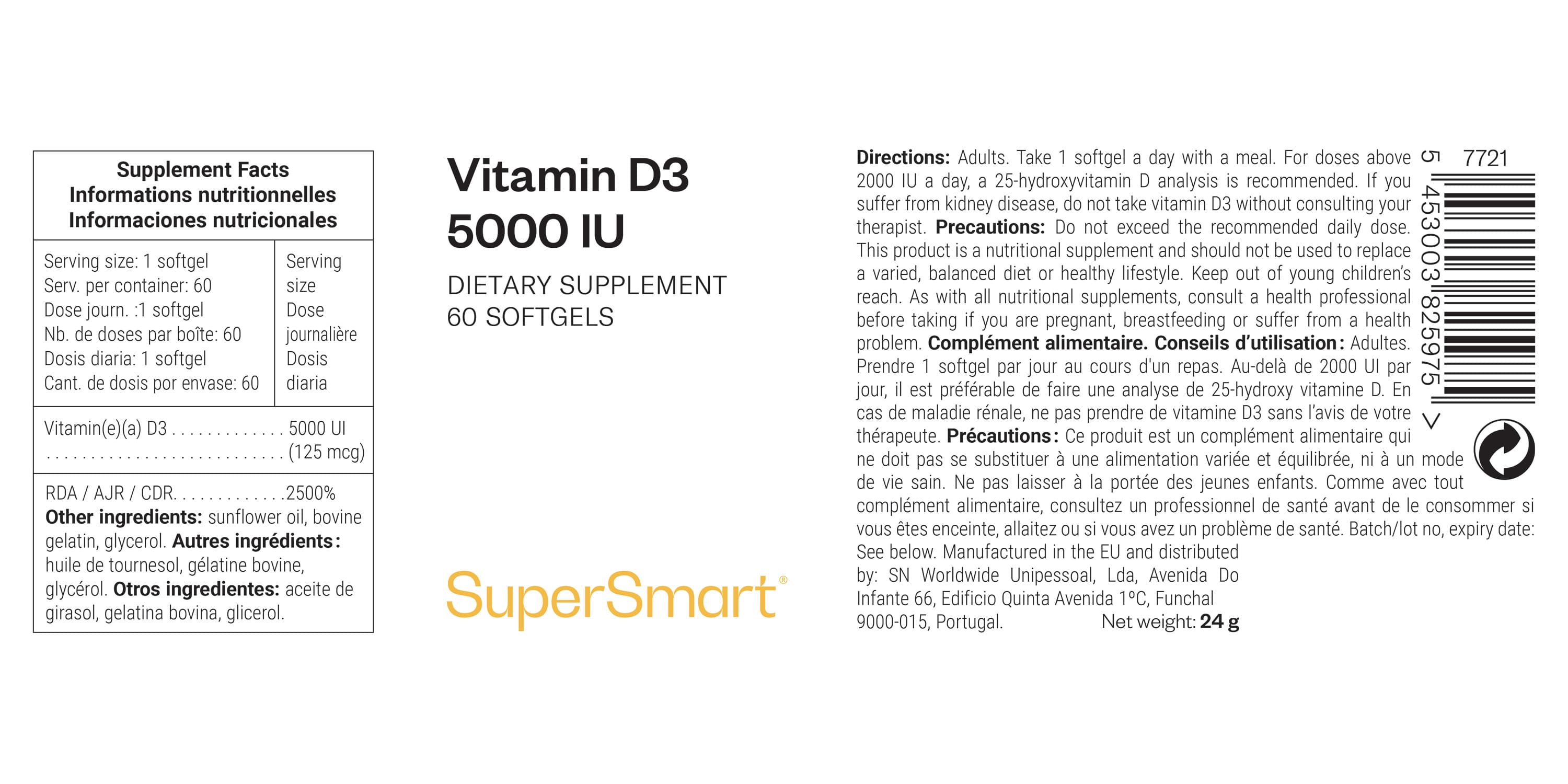
| Daily dose: 1 softgel Number of doses per box: 60 | Amount per dose |
| Vitamin D3 | 5000 IU |
| Other ingredients: sunflower oil | |
What is vitamin D3 (cholecalciferol) and how is it metabolised?
Vitamin D: definition and sources
Vitamin D is a fat-soluble vitamin that acts as a hormonal precursor.
Its active form, calcitriol, exerts a hormonal effect in the body.
The body produces it mainly in the skin, under the influence of the sun’s UV-B rays.
However, this endogenous synthesis in the skin varies greatly depending on the season, latitude, time of day, age, skin pigmentation, the area of skin exposed and lifestyle.
Few foods naturally provide significant amounts of vitamin D: the main sources are limited to oily fish, cod liver oil, offal, egg yolks and certain fortified dairy products.
What are the differences between vitamins D2 and D3?
Vitamin D comes in two main nutritional forms: vitamin D2 (or ergocalciferol), which is derived mainly from certain fungal sources, notably mushrooms and yeasts, and vitamin D3 (or cholecalciferol), which is found primarily in animal sources and is synthesised by the skin when exposed to UV-B radiation.
Whilst both can theoretically be utilised by the body, several trials and meta-analyses have shown that vitamin D3 raises blood levels of 25(OH)D more significantly than vitamin D2 (1).
This is why Vitamin D3 5000 IU has chosen to use cholecalciferol derived from lanolin, a fatty substance extracted from sheep’s wool, in its formulation.
To find out more, read our article which explains in greater detail why to choose cholecalciferol over ergocalciferol.
To find out about the different formats and dosages available, explore our full range of vitamin D products.
From cholecalciferol to calcitriol: the role of the liver and kidneys
Once absorbed in the small intestine, vitamin D3 enters the bloodstream along with dietary fats.
It is then transported to the liver, where an enzyme hydroxylates it to form 25-hydroxyvitamin D, or 25(OH)D, also known as calcidiol.
25(OH)D is both the main circulating form of vitamin D and the reference marker measured in a blood test to assess vitamin D status.
A second hydroxylation, which takes place mainly in the kidneys, then converts 25(OH)D into 1,25-dihydroxyvitamin D, or calcitriol.
This biologically active form binds to vitamin D receptors found in many tissues and regulates the expression of genes involved in several physiological functions (2).
The production of calcitriol is finely regulated by concentrations of calcium and phosphorus, parathyroid hormone and other hormonal messengers.
This liver-kidney cascade enables the body to adjust vitamin D activity to the needs of calcium and phosphorus metabolism.
Who is our vitamin D supplement intended for?
Some people have a greater number of factors that may lower their blood levels of vitamin D (9–10):
- people with limited sun exposure, reduced mobility or who spend most of their time indoors;
- people with dark skin living at mid or high latitudes, as melanin reduces skin synthesis even with the same level of exposure;
- older people, in whom the skin’s production of vitamin D decreases with age;
- people who are overweight or obese, in whom circulating vitamin D levels are often lower;
- people with fat malabsorption, for example those with coeliac disease, Crohn’s disease or who have undergone gastrointestinal surgery;
- people whose diet provides little vitamin D, for example when it excludes oily fish, eggs and fortified foods;
- people who use strict sun protection or who constantly cover most of their skin;
- athletes who train mainly indoors.
If your vitamin D status requires a lower-strength supplement, opt for a lower-dose form such as Vitamin D3 1000 IU.
If you’re looking for a more portable and convenient format, opt for Vitamin D3 Spray 2000 IU.
Vitamin D deficiency: what are the causes and symptoms?
Why does the risk of deficiency increase in winter?
In mid- and high-latitude regions, the skin’s synthesis of vitamin D drops during autumn and winter due to a combination of factors, including reduced exposure to UV-B rays, shorter days and the wearing of more covering clothing.
A harmonised analysis of 55,844 Europeans estimated that 40.4% of them had a 25(OH)D concentration below 50 nmol/L.
More severe deficiency, defined as a level below 30 nmol/L, affected 13% of participants throughout the year and 17.7% during the period from October to March, compared with 8.3% from April to November (14).
In France, the national Esteban study indicated that only 1 in 4 adults reached the threshold considered adequate (15).
A sedentary lifestyle, infrequent outdoor activities or very strict sun protection can further reduce this endogenous production.
However, excessive sun exposure is not advisable (particularly where there is an identified risk of malignant skin conditions).
In this respect, appropriate supplementation may appear to be a more controllable and safer strategy.
Non-specific symptoms
A moderate vitamin D deficiency may remain asymptomatic for a long time.
As the deficiency worsens, fatigue, muscle weakness or bone discomfort may occur, but these symptoms remain non-specific.
In its nutritional guidelines, ANSES points out that bone mineralisation disorders (historically, rickets in children and osteomalacia in adults) are the characteristic clinical manifestations of severe and prolonged deficiency (16).
A blood test for 25(OH)D, interpreted by a healthcare professional, allows for an objective assessment of vitamin D status.
What is the recommended dose for this vitamin D supplement?
Each softgel provides 5,000 IU – equivalent to 125 µg of vitamin D3 – and more than meets the nutritional reference value of 15 µg per day recommended by ANSES for adults (17).
Following your healthcare professional’s advice, take 1 softgel a day with a meal containing a source of fat (such as olive oil, avocado, eggs, nuts or oily fish), as fats aid the absorption of vitamin D3 (18).
Do not exceed the recommended daily intake and keep the product out of the reach of young children.
Seek advice from a healthcare professional if you are pregnant or breastfeeding, if you are taking any medication, or if you have kidney disease or any other health condition.
Which supplements should vitamin D3 be taken with?
Synergistic combinations depend on your initial biological vitamin D status, as well as your specific goals.
Vitamin D3 and vitamin K2 MK-7: two complementary roles
Vitamin D and vitamin K both help maintain normal bones, but through complementary mechanisms.
Vitamin K is involved in the carboxylation of certain proteins, including osteocalcin and Matrix Gla Protein (MGP).
Produced by osteoblasts (the cells that build bone), osteocalcin helps bind calcium within the bone matrix; MGP, meanwhile, plays a role in regulating calcium deposits in soft tissues, particularly in blood vessel walls (11–12).
This latter mechanism explains why vitamin K2 is attracting growing interest in research into arterial calcification and, more broadly, cardiovascular health.
Of all the forms of vitamin K2, MK-7 is distinguished by its long half-life: it therefore remains available in the body for a longer period (13).
 Complete K combines vitamin K1, vitamin K2 MK-4 and vitamin K2 MK-7 (MenaQ7®).
Vitamin K2 MK-7 + Vitamin D3 combines both vitamins in an all-in-one formula.
Note: people taking anticoagulants (vitamin K antagonists) should not take vitamin K supplements without medical advice.
Which supplements support immunity?
Vitamin C and zinc contribute to the proper functioning of the immune system and help protect cells against oxidative stress. Both are therefore useful additions to an approach focused on the body’s natural defences.
Triple C combines three forms of vitamin C renowned for their high bioavailability.
Zinc Orotate utilises zinc orotate, a form that is directly absorbed by the body.
Which supplements are best for muscles and athletes?
Magnesium, an essential mineral, contributes to normal muscle function and energy metabolism.
Creatine, meanwhile, enhances physical performance during short, intense and repeated exercises by accelerating the regeneration of ATP (the muscles’ main source of immediate energy).
Magnesium Bisglycinate complements muscle and bone health by providing magnesium bisglycinate, a form that is highly bioavailable and very well tolerated by the digestive system.
Creatine Monohydrate provides creatine in monohydrate form, as a powder.
Quality, purity and traceability
Vitamin D3 5000 IU provides vitamin D3 in the form of cholecalciferol derived from lanolin, which is well documented in the scientific literature.
Each softgel delivers a precisely measured dose of 5,000 IU, equivalent to 125 µg of vitamin D3.
Cholecalciferol is incorporated into a lipid matrix based on sunflower oil, then encapsulated in a softgel made from bovine gelatine — a formulation particularly suited to the fat-soluble nature of vitamin D3.
The formula has been deliberately kept to the essentials, containing only the ingredients necessary for the delivery and preservation of the product.
Like all SuperSmart supplements, Vitamin D3 5000 IU undergoes rigorous quality controls at various stages of its manufacture: the certificates of analysis (COA) for the batches released for sale can be viewed directly on this page, ensuring maximum transparency regarding the product’s quality and traceability.
This vitamin D supplement is also free from gluten, lactose, added sugars, sweeteners, nanoparticles and controversial excipients.
Note: as this formulation contains sheep-derived cholecalciferol and bovine gelatine, it is not suitable for vegetarians or vegans.
What is in Vitamin D3 5000 IU
Any questions?
Our team of nutrition experts and scientists has the answers.
A mild to moderate vitamin D deficiency often goes unnoticed.
Fatigue, muscle weakness or bone problems may develop if the deficiency worsens.
To find out more, read our article which outlines the main symptoms suggestive of a deficiency.
The cholecalciferol in Vitamin D3 5,000 IU is derived from lanolin, a substance of sheep origin.
This source provides vitamin D3 in the same form as that synthesised by the skin, which is well documented to effectively increase blood levels of 25(OH)D.
If you are vegetarian or vegan, we invite you to discover its plant-based counterpart, Vegan D3 5000 IU, formulated from non-GMO, pesticide-free seaweed.
As vitamin D is fat-soluble, the body can build up reserves, particularly in fatty tissue, when intake exceeds its immediate needs.
However, it appears that regular doses of vitamin D are more in line with our natural biological rhythms than mega-doses (100,000 to 500,000 IU) taken monthly or annually.
The intermediate dose of Vitamin D3 5,000 IU offers great flexibility in this regard.
It can be taken daily (one capsule a day) or at longer intervals: every other day for an average of 2,500 IU per day, twice a week for around 1,400 IU per day, or once a week for around 700 IU per day.
For prolonged daily use, it is recommended that you take into account your 25(OH)D levels, other sources of vitamin D and the advice of a healthcare professional.
People over the age of 50 are still able to synthesise vitamin D from sunlight.
However, this production becomes less efficient with age and is often combined with reduced sun exposure, which leads to lower circulating levels.
may 19 2026
Excellent products I have been taking the vitamin for over 10 years very effective
 Translated by SuperSmart
may 13 2026
For me, this vitamin D has become essential.
Translated by SuperSmart
may 5 2026
Very good product
Translated by SuperSmart
may 2 2026
very good product, but you have to monitor its level from time to time
Translated by SuperSmart
may 2 2026
Very easy to swallow.
Translated by SuperSmart
Need help?
You may also like
of experience
your money back
##montant## purchase






Hello,
Thank you very much for your feedback on our Vitamin D3 5000 IU. The exact composition of our products, including the excipients, is available on our website under the "Nutritional Information" section for each product. You can also find this information on the labels of the products themselves.
If you have any further questions, please do not hesitate to contact us. We are happy to assist you.
Kind regards,
Gaëlle
Customer Service Supersmart